Sony unveils 3D and color e-paper displays at this week's SID 2011

May 20, 2011 by John Messina
At the 49th SID International Symposium, Seminar & Exhibition Sony unveiled their new 3D glasses free display and flexible color e-paper.
(PhysOrg.com) -- Sony unveiled a 13.3 inch flexible color e-paper device and two glass free 3D displays. The announcement was made at the 49th SID International Symposium, Seminar & Exhibition which is the world's largest academic conference on display technologies. The conference is being held this week in Los Angeles, CA (USA).
Sonys 13.3 inch flexible color e-paper has a thickness of 150 microns and weighs 20g and uses a plastic substrate. The e-paper display has a 13% color gamut (NTSC), a reflectance of 10% and a 100,000:1 contrast ratio.
The displays 800 x 1200 pixel array consists of red, green, blue, and white sub-pixels. The sub-pixel measures 169 microns x 169 microns and the resolution and gradation of the screen are 75ppi and 16, respectively.
The e-paper display is manufactured by applying adhesive to the glass substrate and attaching a plastic substrate. Amorphous TFTs are then formed on it with a180°C or lower temperature process. The plastic substrate is then finally removed from the glass substrate.
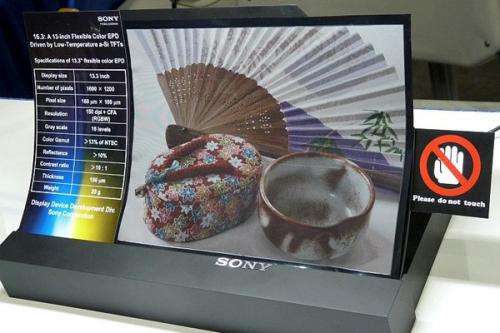
Sony's 13.3 inch flexible color e-paper.
Sonys 3D displays come in a 10 inch and 23 inch size and can deliver a 3D image without the use of any special glasses. The method uses a backlight for 3D images positioned between an LCD panel and a backlight for normal 2D images. Switching between 2D and 3D is accomplished by lighting one of the two backlights.The backlight for the 3D images are LEDs placed on the light guide plate and its edges. On the light guide plate scatter patterns are produced at even intervals in the horizontal direction to direct light to the outside.
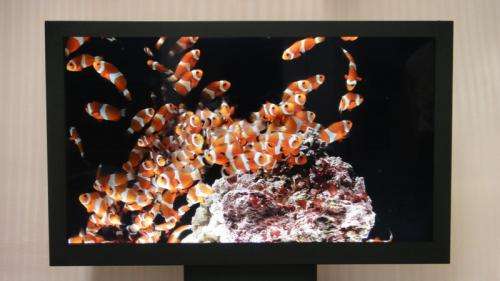
Sony’s 3D 10 inch and 23 inch displays deliver 3D images without the use of any special glasses.
The 3D effect is produced by the LED light sources being reflected on the scatter patterns to go to the back side of the panel as if lights are partially controlled by using "parallax barriers." The result shows different images to the right and left eye.Sonys 24-inch 3D LCD display has six viewpoints, and its pixel count is 960 x 360, and its brightness is 86.1cd/m2. 3D images are best viewed between distances of 80 to 160cm. The 2D mode, the pixel count of the display becomes 1,920 x 1,080 and has a brightness of 192cd/m2.
Sony states that the new method can be applied to displays between 4 to 30 inches and hopes to commercialize it within a few years.
More information:
via Tech-On e-paper, Tech-On 3D display
© 2010 PhysOrg.com
-
From lemons to lemonade: Reaction uses carbon dioxide to make carbon-based semiconductor,
32 comments
-
Thioridazine kills cancer stem cells in human while avoiding toxic side-effects of conventional cancer treatments,
3 comments
-
SpaceX private rocket blasts off for space station (Update),
42 comments
-
Climate scientists say they have solved riddle of rising sea,
31 comments
-
Research team claims to have found evidence Lake Cheko is impact crater for Tunguska Event,
18 comments
-
Need a rigid insulation material???
8 hours ago
-
magnets or EMF in car bumpers to protect from fender bender
May 26, 2012
-
length of wire in a coil of known dimensions?
May 25, 2012
-
India Engineering Powerhouse
May 25, 2012
-
electromagnet core dereference between hard and soft iron
May 25, 2012
-
Measuring water pressure in an open tank
May 24, 2012
- More from Physics Forums - General Engineering
More news stories
Nvidia trumpets Tegra 3 phone design wins for 2012
(Phys.org) -- Nvidias competitive war paint has a name, Tegra 3. On the heels of Nvidia announcements about lowering costs of its Tegra 3 processors and Nvidia-enabled tablets running Android Ice Cream ...
Dell tablet leak: 10.1-inch display, two-battery choice
(Phys.org) -- Headline after headline talks about vendors tablets in the wings as likely number-one contenders for the iPad. Such claims have justifiably been taken with a grain of salt, considering ...
MIT researchers devise new means to synchronize a group of robots (w/ Video)
(Phys.org) -- For several years, roboticists have been working out ways to get a group of robots to perform synchronized activities as demonstrated most often in dance routines. Its not just about trying ...
Nvidia says Kai platform will turn price tide for tablets
(Phys.org) -- In March, Nvidia gave some signs that they were working to lower the cost of their Tegra 3 processors and they suggested consumers might see prices for Android tablets as low as $199. Connect ...
OmniVision tops up sensors for cameras, phones
(Phys.org) -- OmniVision has announced two high-resolution image sensors for the digital still and digital video camera market (DS/DVC) and higher end smartphones. In end-user language, it is a claim for superior ...
Browser wars flare in mobile space
The browser wars are heating up again, but this time the fight is for dominance of the mobile Internet.
Scientist: Evolution debate will soon be history
(AP) -- Richard Leakey predicts skepticism over evolution will soon be history. Not that the avowed atheist has any doubts himself.
SpaceX capsule has 'new car' smell, astronauts say (Update)
SpaceX's Dragon cargo vessel smells like a new car, said astronauts at the International Space Station after opening the hatches Saturday following the spacecraft's landmark mission to the orbiting lab.
Of mice and mental models: Neuroscientific implications of risk-optimized behavior in the mouse
(Medical Xpress) -- Regardless of an organism’s biological complexity, every encephalized animal continuously makes under-informed behavioral choices that can have serious consequences. Despite its ubiquity, ...
SpotterRF debuts Radar Backpack Kit (w/ Video)
(Phys.org) -- SpotterRF has announced a special radar backpack kit designed to enhance situational awareness for soldiers on the ground. The company says its special radar is designed for warfighters as part ...
Is a classical electrodynamics law incompatible with special relativity?
(Phys.org) -- The laws of classical electromagnetism that were developed in the 19th century are the same laws that scientists use today. They include Maxwell’s four equations along with the Lorentz la ...


May 20, 2011
Rank: not rated yet
May 20, 2011
Rank: not rated yet
Soon. I'm still waiting for all those pop-up books to come to kindle, in 3d popup.