Similarities cause protein misfolding
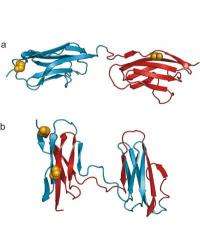
This is an illustration of the correctly folded (a) and the misfolded (b) structures for a multidomain protein studied using single-molecule spectroscopy. The positions in the protein labeled with dye probes are shown as orange balls. The structure in (b) arises from the combination of spectroscopic distance measurements in the molecule and simulations. Credit: UZH
A large number of illnesses stem from misfolded proteins, molecules composed of amino acids. Researchers at the University of Zurich have now studied protein misfolding using a special spectroscopic technique. Misfolding, as they report in Nature, is more frequent if the sequence of the amino acids in the neighboring protein domains is very similar.
Proteins are the main molecular machines in our bodies. They perform a wide range of functions, from digesting and processing nutrients, converting energy and aiding cell structure to transmitting signals in cells and the whole body. In order to perform these highly specific functions, proteins have to adopt a well-defined, three-dimensional structure. Remarkably, in most cases they find this structure unaided once they have been formed out of their individual building blocks, amino acids, as a long chain molecule in the cell.
However, the process of protein folding can also go wrong, which means the proteins affected are no longer able to perform their function. In some cases, this can even have much more serious consequences if these misfolded proteins clump and trigger neurodegenerative diseases such as Alzheimer's or Parkinson's disease.
In the course of evolution, a crucial factor in the development of proteins has thus been to avoid such "misfolding processes". However, this is no easy task since the same molecular interactions that stabilize the correct structure of the individual proteins can also bring about interactions between protein molecules, causing them to misfold.
Using a special spectroscopic method called single-molecule fluorescence, researchers from the Universities of Zurich and Cambridge have now studied the circumstances under which misfolding occurs. The team headed by Prof. Benjamin Schuler from the University of Zurich studied sections, or "domains", of the largest protein in our bodies, titin, which helps the stability and elasticity of the muscle fibers. It is assumed that individual titin domains can unfold while the muscle is heavily exerted to avoid damaging the muscle tissue. When the muscle relaxes again, however, there is a danger that these unfolded domains might fold incorrectly. There is also a similar risk for other multidomain proteins.
For their study, the researchers attached small dye molecules as probes in the protein. "Using our laser-spectroscopic method we were able to determine distances on a molecular scale, i.e. down to a few millionths of a millimeter, through the energy transfer between the probes," explains Prof. Schuler. This enabled the structures of correctly and misfolded proteins to be distinguished and thus the proportion of misfolding determined.
"The study of different titin domains in our experiments revealed that the probability of misfolding increases if neighboring domains are very similar in the sequence of their amino acids," says Prof. Schuler. This is apparently the reason why neighboring domains in proteins have a limited degree of similarity. "This seems to be a key evolutionary strategy to avoid protein misfolding and thus guarantee their maximum functionality," says Schuler.
Provided by University of Zurich
-
From lemons to lemonade: Reaction uses carbon dioxide to make carbon-based semiconductor,
32 comments
-
Thioridazine kills cancer stem cells in human while avoiding toxic side-effects of conventional cancer treatments,
3 comments
-
SpaceX private rocket blasts off for space station (Update),
42 comments
-
Climate scientists say they have solved riddle of rising sea,
31 comments
-
Research team claims to have found evidence Lake Cheko is impact crater for Tunguska Event,
18 comments
-
What would stain as translucent on light-coloured fabric?
12 hours ago
-
How do I identify different bacteria on culture plates?
22 hours ago
-
Why Do Dogs do Strange things...
May 25, 2012
-
What does exophillic and endophillic mean in terms of mosquito and their control?
May 24, 2012
-
Semen stains glows under black lights (uv light)?
May 23, 2012
-
Question on Human Chromosome 2
May 23, 2012
- More from Physics Forums - Biology
More news stories
Scientist: Evolution debate will soon be history
(AP) -- Richard Leakey predicts skepticism over evolution will soon be history. Not that the avowed atheist has any doubts himself.
11 hours ago |
3.5 / 5 (11) |
29
It's in the genes: Research pinpoints how plants know when to flower
Scientists believe they've pinpointed the last crucial piece of the 80-year-old puzzle of how plants "know" when to flower.
May 25, 2012 |
3.9 / 5 (9) |
1
|
Researchers solve structure of human protein critical for silencing genes
In a study published in the journal Cell on May 24, Cold Spring Harbor Laboratory (CSHL) scientists describe the three-dimensional atomic structure of a human protein bound to a piece of RNA that "guides" the pr ...
May 25, 2012 |
4.7 / 5 (7) |
0
|
Thousands of shellfish found dead in Peru
Thousands of crustaceans were found dead off the coast of Lima following the mystery mass death of dolphins and pelicans, the Peruvian Navy said Friday.
21 hours ago |
4.8 / 5 (4) |
6
Copy of the genetic makeup travels in a protein suitcase
Scientists from the Institute for Physical and Theoretical Chemistry at the University of Bonn have succeeded for the first time in the real time filming of the transport of an important information carrier in biological ...
May 25, 2012 |
not rated yet |
0
|
Nvidia trumpets Tegra 3 phone design wins for 2012
(Phys.org) -- Nvidias competitive war paint has a name, Tegra 3. On the heels of Nvidia announcements about lowering costs of its Tegra 3 processors and Nvidia-enabled tablets running Android Ice Cream ...
Browser wars flare in mobile space
The browser wars are heating up again, but this time the fight is for dominance of the mobile Internet.
Dell tablet leak: 10.1-inch display, two-battery choice
(Phys.org) -- Headline after headline talks about vendors tablets in the wings as likely number-one contenders for the iPad. Such claims have justifiably been taken with a grain of salt, considering ...
SpaceX capsule has 'new car' smell, astronauts say (Update)
SpaceX's Dragon cargo vessel smells like a new car, said astronauts at the International Space Station after opening the hatches Saturday following the spacecraft's landmark mission to the orbiting lab.
Of mice and mental models: Neuroscientific implications of risk-optimized behavior in the mouse
(Medical Xpress) -- Regardless of an organism’s biological complexity, every encephalized animal continuously makes under-informed behavioral choices that can have serious consequences. Despite its ubiquity, ...
SpotterRF debuts Radar Backpack Kit (w/ Video)
(Phys.org) -- SpotterRF has announced a special radar backpack kit designed to enhance situational awareness for soldiers on the ground. The company says its special radar is designed for warfighters as part ...
May 31, 2011
Rank: not rated yet
May 31, 2011
Rank: not rated yet
This is a common phrasing both inside and outside of the science community, even though technically incorrect. It is anthropomorphizing -- using the perspective of genetic material in the 1st person. High rates of improper folds have proven deleterious, thus proteins with similar domains are selected against. The genetic material can be said to have employed this specific strategy (ex post facto, of course).