Shuttle brings big-bucks magnet to space station
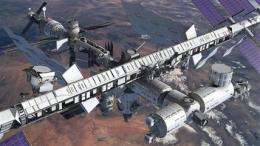
(AP) -- A mammoth cosmic ray detector arrived at the International Space Station on Wednesday, a $2 billion experiment that will search the invisible universe and help explain how everything came to be.
It's the most expensive cargo ever carried by a space shuttle and almost didn't make it to orbit before the fleet retires this summer. It was launched this week aboard Endeavour on the second-to-last flight.
Two astronaut teams were assigned to attach the Alpha Magnetic Spectrometer to the outside of the space station on Thursday, using a pair of robot arms, where it will stay for the life of the outpost.
The scientists on Endeavour's crew said it will justify the scientific purpose of space station.
"It's in the same scale of importance as Hubble (Space Telescope)," astronaut Gregory Chamitoff said before the flight. "And it is going to be by far the biggest, most expensive and perhaps the most fundamentally valuable science apparatus we have on the space station."
Physicist Phil Schewe said the experiment is part of a centuries-long tradition of scientists exploring the building blocks of matter, from elements to atoms to subatomic particles.
"This is just a grand extension of trying to answer the question, why we have matter and what it is," said Schewe, a spokesman for the American Institute of Physics.
"Is this a big deal? Especially if they find something, yes it is."
The 7-ton instrument, known by its acronym AMS, has been 17 years in the making, and involves 600 scientists from 16 countries. The heart of the experiment is a magnet ring 3 feet across.
The made-in-China magnet will bend the path of charged cosmic particles as they pass through eight detectors, enabling scientists to identify their properties.
Nobel Laureate Samuel Ting, the team leader, said the greatest discovery may well be what he and others aren't anticipating. On Wednesday, he said he was excited but not nervous.
"It's a bit too late to think about that now," Ting said from NASA's Johnson Space Center in Houston.
The experiment is "going to look at some fundamental questions ... that would be important in our overall understanding of the makeup of the universe and some of its basic characteristics," said Hooman Davoudiasl, a physicist at Brookhaven National Laboratory in Upton, N.Y.
One question is why the universe is dominated by matter rather than sharing the stage with so-called "antimatter." While matter is made up of familiar particles like protons and electrons, antimatter is a collection of particles that are identical except for carrying the opposite charge. Standard theories have trouble explaining why matter is so dominant, Davoudiasl said. By studying cosmic rays, the spectrometer can help determine whether the universe actually has significant sources of antimatter. he said.
Another key question is how to explain so-called "dark matter," which is more common in the universe than the ordinary matter we're familiar with, he said. The experiment may shed some light on what this mysterious stuff is and how it behaves, he said.
The spectrometer almost didn't get into space. Ting and his team won approval to put it on the space station and it was assembled at the European Organization for Nuclear Research lab near Geneva.
But in the wake of the 2003 Columbia tragedy and the 2004 announcement of the shuttles' retirement, some flights were canceled and cargo space on the remaining missions filled up quickly. NASA was uncertain there would be room for the large detector.
Ting never gave up. Now 75, he was born in Michigan but raised in China, and returned to the United States to earn all his degrees. He was a co-winner of the Nobel Prize in physics in 1976 at age 40.
Launching the spectrometer on an unmanned rocket wasn't an option, Ting said, because of the enormous cost of the rocket and providing solar power to what would be a free-flying satellite.
A shuttle flight finally was added for the spectrometer. But when the lifetime of the space station was extended last year to at least 2020, the team swapped out a three-year magnet for one that could operate forever. The switch delayed the shuttle mission by months.
Endeavour - making its final journey and the next-to-last flight of NASA's shuttle era - arrived at the space station Wednesday. Commander Mark Kelly, the husband of wounded Rep. Gabrielle Giffords, expertly steered the shuttle in for the 220-mile-high linkup.
The docking, though, was overshadowed by the continuing Kelly-Giffords saga, with the daily flight director's news conference dominated by questions about the Arizona congresswoman. Giffords was set to receive a plastic skull implant during surgery in Houston on Wednesday, two days after witnessing her husband's launch. She was shot in the head on Jan. 8 at a political event in Tucson, Ariz., her hometown.
Lead flight director Gary Horlacher said Kelly performed "unbelievably" well during the linkup and noted that no one would know all he's been through in recent months.
"I know folks are kind of focused on Mark and his situation," he told reporters. "But AMS is going to be around talking to us for a long, long time. So I'm very much looking forward to the results over the years."
Ting, a deliberate, soft-spoken physicist at the Massachusetts Institute of Technology, said recently that he wasn't concerned that the attention was on Kelly and Giffords, rather than the spectrometer.
"All success or failure depends on what physics we find. That's the only thing that's important," he said.
More information:
NASA: http://www.nasa.gov/shuttle
Alpha Magnetic Spectrometer: http://www.ams02.org/
©2011 The Associated Press. All rights reserved. This material may not be published, broadcast, rewritten or redistributed.


