Scientists achieve high temperature milestone in silicon spintronics
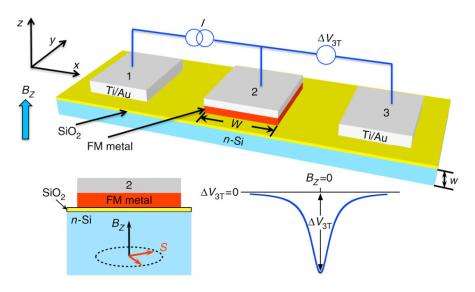
(PhysOrg.com) -- Researchers in the Materials Science and Technology division of the Naval Research Laboratory have recently demonstrated electrical injection, detection and precession of spin accumulation in silicon, the cornerstone material of modern device technology, at temperatures up to 225 degrees Celsius.
These results provide the first demonstration that spin accumulation in Si is viable as a basis for practical devices which meet the operating temperatures specified for commercial (85°C), industrial (100°C) and military (125°C) applications. This is a key enabling step for developng devices which rely on electron spin rather than electron charge, an approach known as semiconductor spintronics that is expected to provide devices with higher performance, lower power consumption and less heat dissipation.
The complete findings of this study titled, "Electrical injection and detection of spin accumulation in silicon at 500K with magnetic metal / silicon dioxide contacts" are published in the 22 March 2011 issue of Nature Communications 2:245 (2011).
The electron possesses an internal angular momentum called the spin. The International Technology Roadmap for Semiconductors has identified the electron's spin as a new state variable that should be explored as an alternative to the electron's charge for use beyond Moore's Law, a projection named after Intel co-founder Gordon E. Moore. Moore predicted in 1965 that the number of transistors per unit area in an integrated circuit would double approximately every two years as advances in fabrication technology enabled the devices to be made smaller. Although this approach has been remarkably successful, critical device dimensions now approach atomic length scales, so that further size scaling becomes untenable. "Researchers have been forced to look beyond the simple reduction of size to develop future generations of electronic devices," states NRL senior scientist Dr. Berry Jonker. "Electrical generation, manipulation and detection of significant spin polarization in silicon at temperatures that meet commercial and military requirements are essential to validate spin as an alternative to charge for a device technology beyond Moore's Law."
Using ferromagnetic metal / silicon dioxide contacts on silicon, NRL scientists Connie Li, Olaf van 't Erve and Jonker electrically generate and detect spin accumulation and precession in the silicon transport channel at temperatures up to 225°C, and conclude that the spin information can be transported in the silicon over distances readily compatible with existing fabrication technology. They thus overcome a major obstacle in achieving control of the spin variable at temperatures required for practical applications in the most widely utilized semiconductor.
To make a semiconductor spintronic device, one needs contacts that can both generate a current of spin-polarized electrons (called a spin injector), and detect the spin polarization of the electrons (spin detector) in the semiconductor. Because the magnetic contact interface is likely to introduce additional scattering and spin relaxation mechanisms not present in the silicon bulk, the region of the semiconductor directly beneath the contact is expected to be a critical factor in the development of any future spin technology. The NRL scientists probe the spin environment directly under the magnetic metal / silicon dioxide contact using the three terminal geometry illustrated in the accompanying figure. Demonstration of spin precession and dephasing in a magnetic field transverse to the injected spin orientation, known as the Hanle effect, is conclusive evidence of spin accumulation, and enables a direct measure of the spin lifetime, a critical parameter for device operation. The NRL researchers observed Hanle precession of the electron spin accumulation in the silicon channel under the contact for biases corresponding to both spin injection and extraction, and determine the corresponding spin lifetimes.
Electronic states can form at the contact interface and introduce deleterious effects for both charge and spin transport. These undesirable states can serve as traps which prevent propagation of either charge or spin in the silicon channel. In bulk silicon, the spin lifetime is known to depend upon the carrier density, and generally decreases as the electron density increases.. "In this study we show that the spin lifetime determined from our measurements changes systematically as one changes carrier concentration of the particular silicon sample used," adds Jonker. "Our results were obtained for a number of different carrier densities and show this trend, thus making it very clear that we obtain spin injection and accumulation in the silicon itself rather than in interface defect states." The result of this research rules out spin accumulation in interface states and demonstrates spin injection, accumulation and precession in the silicon channel.
More information: DOI: 10.1038/ncomms1256
Provided by Naval Research Laboratory


