Battle scars found on an ancient sea monster
May 4, 2011

Battle scars found on an ancient sea monster

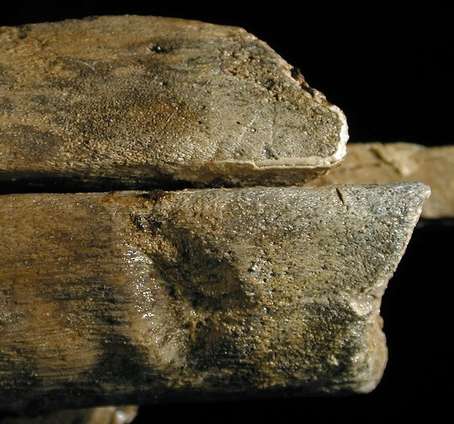
Ichthyosaur bite marks. A close-up of the ichthyosaur snout showing the healed wounds. Photo courtesy Jo Bain, South Australian Museum

(PhysOrg.com) -- Scars on the jaw of a 120 million year old marine reptile suggest that life might not have been easy in the ancient polar oceans. The healed bite wounds were probably made by a member of the same species. Such injuries give important clues about the social behaviour of extinct sea creatures from the time of dinosaurs. The find is described in a forthcoming issue of Acta Palaeontologica Polonica.

Found in the remote desert near the town of Marree in northern South Australia, the fossilised skeleton belonged to an ichthyosaur, a dolphin-like marine reptile that lived during the 'Age of Dinosaurs'. Ichthyosaurs were fast swimming predators that fed on fish and squid-like animals. Adults would have been around six metres in length and had long-snouted heads with over 100 pointed, crocodile-like teeth.

When the ichthyosaur was alive, the Australian continent was still joined to Antarctica and would have been much further south than it is today close to the southern polar circle. What is now arid grassland was then the bottom of a vast inland sea that experienced freezing water temperatures and even seasonal icebergs.
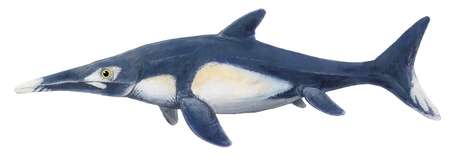
ichthyosaur

Reconstruction of a an ichthyosaur. Image: Josh Lee (Adelaide) "Dinosaurs in Australia" by BP Kear and RJ Hamilton-Bruce (CSIRO Publishing).

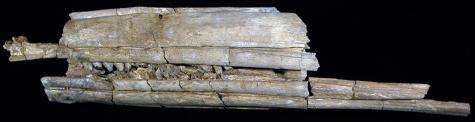
The surprising discovery of well preserved bite marks on the bones of the ichthyosaur's lower jaw were made during painstaking cleaning and reassembly of its skeleton in the laboratory. Evidence of advanced healing indicates that the animal survived the attack and lived on for some time afterwards.

“Pathological traces on ancient fossilised bones and teeth give unique insights into the lives and social behaviours of extinct animals” says Benjamin Kear, one of the authors of the study and an Assistant Professor with the Palaeobiology Programme at Uppsala University. “Such finds have also rarely been reported in ichthyosaurs before”.
Battle scars found on an ancient sea monster
Enlarge

Bitten ichthyosaur snout. The incomplete snout of the bitten ichthyosaur as reassembled. Photo courtesy Jo Bain, South Australian Museum

The size and spacing of the tooth marks do match any potential predators or prey. Rather, they are most consistent with another adult ichthyosaur, suggesting that the wounds were inflicted during combat over food, mates or territory. Facial biting is a common social interaction observed in animals today and is often directed towards restraining the opponents jaws.

More information: Zammit, M. and Kear, B.P. 201X. Healed bite marks on a Cretaceous ichthyosaur. Acta Palaeontologica Polonica 5X (X): xxx-xxx. doi:10.4202/app.2010.0117

Provided by Uppsala University search and more info website

4.5 /5 (4 votes)  

Filter


Move the slider to adjust rank threshold, so that you can hide some of the comments.


Display comments: newest first

jmcanoy1860
May 04, 2011

Rank: not rated yet
First thing- Is everyone marking the above crap as abuse or just me.

As for this finding (not that it hasn't been seen previously), so much for all the dinosaurs being hippie vegetarians.
macsglen
May 04, 2011

Rank: not rated yet
Should this be a surprise to anyone?

Animals eat one another. Sometimes predators get eaten, too.
Rank 4.5 /5 (4 votes)
Relevant PhysicsForums posts

More news stories

Math predicts size of clot-forming cells

UC Davis mathematicians have helped biologists figure out why platelets, the cells that form blood clots, are the size and shape that they are. Because platelets are important both for healing wounds and in strokes and other ...

Other Sciences / Mathematics

created May 25, 2012 | popularity not rated yet | comments 0 | with audio podcast

Dinosaur with tiny arms unearthed in Argentina

Argentine experts have discovered the near-complete remains of a new species of Jurassic-era dinosaur that stood on its rear legs and had tiny arms, according to a leading paleontologist.

Other Sciences / Archaeology & Fossils

created May 25, 2012 | popularity 5 / 5 (2) | comments 0

Relatively speaking: Researchers identify principles that shape kinship categories across languages

Different languages refer to family relationships in different ways. For example, English speakers use two terms — grandmother and grandfather — to refer to grandparents, while Mandarin Chinese uses four terms. ...

Other Sciences / Social Sciences

created May 24, 2012 | popularity 4 / 5 (5) | comments 0 | with audio podcast

Oldest Jewish archaeological evidence on the Iberian Peninsula

German archaeologists of the Friedrich Schiller University Jena found one of the oldest archaeological evidence so far of Jewish Culture on the Iberian Peninsula at an excavation site in the south of Portugal, ...

Other Sciences / Archaeology & Fossils

created May 25, 2012 | popularity 4.3 / 5 (4) | comments 12

Earliest musical instruments in Europe 40,000 years ago

The first modern humans in Europe were playing musical instruments and showing artistic creativity as early as 40,000 years ago, according to new research from Oxford and Tübingen universities.

Other Sciences / Archaeology & Fossils

created May 25, 2012 | popularity 5 / 5 (3) | comments 1


Nvidia trumpets Tegra 3 phone design wins for 2012

(Phys.org) -- Nvidia’s competitive war paint has a name, Tegra 3. On the heels of Nvidia announcements about lowering costs of its Tegra 3 processors and Nvidia-enabled tablets running Android Ice Cream ...

Browser wars flare in mobile space

The browser wars are heating up again, but this time the fight is for dominance of the mobile Internet.

Dell tablet leak: 10.1-inch display, two-battery choice

(Phys.org) -- Headline after headline talks about vendors’ tablets in the wings as likely number-one contenders for the iPad. Such claims have justifiably been taken with a grain of salt, considering ...

Scientist: Evolution debate will soon be history

(AP) -- Richard Leakey predicts skepticism over evolution will soon be history. Not that the avowed atheist has any doubts himself.

SpaceX capsule has 'new car' smell, astronauts say (Update)

SpaceX's Dragon cargo vessel smells like a new car, said astronauts at the International Space Station after opening the hatches Saturday following the spacecraft's landmark mission to the orbiting lab.

Of mice and mental models: Neuroscientific implications of risk-optimized behavior in the mouse

(Medical Xpress) -- Regardless of an organism’s biological complexity, every encephalized animal continuously makes under-informed behavioral choices that can have serious consequences. Despite its ubiquity, ...