Why Russians think Americans don't own their homes
May 19, 2011 By Jeff Harrison
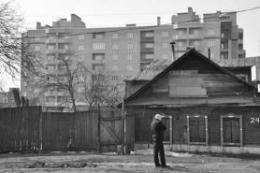
A Soviet-era apartment complex looms behind a house that probably predates the 1917 Russian Revolution. Credit: Jane Zavisca
University of Arizona sociologist Jane Zavisca says the two countries are polar opposites when it comes to mortgage financing.
When the Soviet Union disintegrated in 1991, one of the structural problems the new government and free-market economy had to deal with was housing. Most Russians lived in government-owned apartments that had been built beginning in the late 1950s. The question then became, who owned all of that Soviet-era housing?
In her new book, "Housing the New Russia," due to be published by Cornell University Press, Jane Zavisca said the new Russian government dealt with it by announcing that this huge stock of apartments was, as of 1992, privately owned.
"Wherever you were, that's what you got," said Zavisca, an assistant professor of sociology at the University of Arizona.
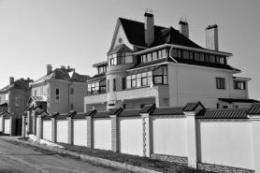
An example of housing built after the 1991 collapse of the Soviet Union. Since mortgages are anathema to many Russians, new housing in Russia is generally built for the well-to-do who have cash to pay up front for construction.
It was a hugely popular move because it instantly created wealth. But it also created problems, she said. If you shared an apartment with six other people, you owned one-seventh of it. And if you wanted a nicer place with more room, a better view, or to be closer to work and shopping, unless you had ready cash, you would need a mortgage.The new government tried to create a housing market by replicating the American housing system, essentially using the Federal National Mortgage Association, or Fannie Mae, as a template to encourage Russians to take out mortgage loans.
"This was all designed by USAID, one of their biggest foreign aid programs ever," Zavisca said. "It was an American model of what a housing market is: home ownership and securitized mortgages."
Supposedly all of that privatized housing and wealth would spur the natural development of a housing market. Those who felt they had more housing than they needed would look to trade down and use the leftover money for other things. The private sector would emerge to produce housing for those who had been left out.
"That didn't really happen," Zavisca said.
Housing construction declined by 70 percent from 1992 to 2002, the first decade after the Soviet era. The construction industry in Russia has evolved to cater to wealthy and well-to-do middle class clients who could pay with cash, but there is a lack of trust by both contractors and consumers. No one wants to pay up front and wait, or deal with credit.
Unlike Americans who for decades have willingly taken on 30-year mortgages to buy housing, Russians have largely balked at the notion. Even when young families were offered a $10,000 credit, roughly a year's wages and the equivalent of $60,000 in the U.S., toward the down payment for a house, Zavisca said there was little interest.
"Few Russians are willing to take out mortgages because the risk of foreclosure is unacceptable, and because they view interest payments which they call overpayments as unfair. As one Russian put it: To enter into a mortgage is to become a slave for 30 years, with the bank as your master.'"
That hasn't stopped Russians from going into debt, though. They may be averse to mortgages but they love credit cards, small consumer loans and point-of-purchase store credit.
"In my interviews, people there often compared credit card debt favorably to mortgages, the inverse of here in the U.S., where mortgages are viewed as virtuous and responsible.
"Russia is completely the opposite. It may be a legacy of Soviet entitlement to housing, where housing is viewed as a right to them. Even thought the Soviet government owned the housing, people thought of it as their own and had the right to pass it down to their children, or swap with someone who wanted to trade with you.
"It was a kind of quasi-marketplace. It just wasn't financialized."
She said Russians find it odd that Americans call themselves "homeowners" from the day they close on a mortgage loan. For Russians, ownership only begins after all debts are paid off.
Zavisca said she is planning a follow-up study on mortgages in the U.S. to learn how Americans equate owing with owning, and how "home ownership" has become Americans' metaphor for a mortgage.
Provided by
University of Arizona
-
From lemons to lemonade: Reaction uses carbon dioxide to make carbon-based semiconductor,
32 comments
-
Thioridazine kills cancer stem cells in human while avoiding toxic side-effects of conventional cancer treatments,
3 comments
-
SpaceX private rocket blasts off for space station (Update),
42 comments
-
Climate scientists say they have solved riddle of rising sea,
31 comments
-
Research team claims to have found evidence Lake Cheko is impact crater for Tunguska Event,
18 comments
-
Consumption rivalry
May 25, 2012
-
Bilateral trade between all countries
May 24, 2012
-
Is the economic foundation of social media in jeopardy?
May 20, 2012
-
Psychology: Rosenthal and Hawthorne Effect
May 15, 2012
-
Is GDP and National Income the Same Thing?
May 13, 2012
-
Difference between hourly wage and real GDP per hour worked?
May 12, 2012
- More from Physics Forums - Social Sciences
More news stories
Math predicts size of clot-forming cells
UC Davis mathematicians have helped biologists figure out why platelets, the cells that form blood clots, are the size and shape that they are. Because platelets are important both for healing wounds and in strokes and other ...
May 25, 2012 |
not rated yet |
0
|
Dinosaur with tiny arms unearthed in Argentina
Argentine experts have discovered the near-complete remains of a new species of Jurassic-era dinosaur that stood on its rear legs and had tiny arms, according to a leading paleontologist.
Other Sciences / Archaeology & Fossils
May 25, 2012 |
5 / 5 (2) |
0
Relatively speaking: Researchers identify principles that shape kinship categories across languages
Different languages refer to family relationships in different ways. For example, English speakers use two terms grandmother and grandfather to refer to grandparents, while Mandarin Chinese uses four terms. ...
Other Sciences / Social Sciences
May 24, 2012 |
4 / 5 (5) |
0
|
Oldest Jewish archaeological evidence on the Iberian Peninsula
German archaeologists of the Friedrich Schiller University Jena found one of the oldest archaeological evidence so far of Jewish Culture on the Iberian Peninsula at an excavation site in the south of Portugal, ...
Other Sciences / Archaeology & Fossils
May 25, 2012 |
4.3 / 5 (4) |
12
Earliest musical instruments in Europe 40,000 years ago
The first modern humans in Europe were playing musical instruments and showing artistic creativity as early as 40,000 years ago, according to new research from Oxford and Tübingen universities.
Other Sciences / Archaeology & Fossils
May 25, 2012 |
5 / 5 (3) |
1
Nvidia trumpets Tegra 3 phone design wins for 2012
(Phys.org) -- Nvidias competitive war paint has a name, Tegra 3. On the heels of Nvidia announcements about lowering costs of its Tegra 3 processors and Nvidia-enabled tablets running Android Ice Cream ...
Browser wars flare in mobile space
The browser wars are heating up again, but this time the fight is for dominance of the mobile Internet.
Dell tablet leak: 10.1-inch display, two-battery choice
(Phys.org) -- Headline after headline talks about vendors tablets in the wings as likely number-one contenders for the iPad. Such claims have justifiably been taken with a grain of salt, considering ...
Scientist: Evolution debate will soon be history
(AP) -- Richard Leakey predicts skepticism over evolution will soon be history. Not that the avowed atheist has any doubts himself.
SpaceX capsule has 'new car' smell, astronauts say (Update)
SpaceX's Dragon cargo vessel smells like a new car, said astronauts at the International Space Station after opening the hatches Saturday following the spacecraft's landmark mission to the orbiting lab.
Of mice and mental models: Neuroscientific implications of risk-optimized behavior in the mouse
(Medical Xpress) -- Regardless of an organism’s biological complexity, every encephalized animal continuously makes under-informed behavioral choices that can have serious consequences. Despite its ubiquity, ...

May 19, 2011
Rank: 4 / 5 (16)
And he's exactly right.
During the colonial period in the U.S. and during the land rush periods in the central plains, people got land for free, and built homes from the timber on the site. Housing in the U.S. in those times was "communized" because people helped one another build their homes for free on free land, and often from available free materials. About the only thing that cost anything were tools and food. Land ownership and home ownership was a basic right for anyone who wanted to stake a claim.
Allegedly, our country's founding documents says all people have a right to life, LIBERTY, and pursuit of happiness. However, in today's capitalistic market, "Liberty" actually is not possible for 70% to 80% of people, because "ownership" of real assets is a "priviledge" reserved mostly for the upper middle class and the filthy rich.
May 19, 2011
Rank: 3.5 / 5 (13)
Capitalism is, at it's very foundation, based on abuse of this principle to enslave normal people to the wealthy.
May 19, 2011
Rank: 3.8 / 5 (5)
I always say this: "if you don't have the money to buy it then don't".
May 19, 2011
Rank: 2.8 / 5 (12)
Our homes are also much nicer than average russian homes. But this does expose a flaw in our culture that helped cause the mortgage mess. We consider possession to be ownership, rather than the fact that we won't own it for 30 years.
Without capitalism, we would still have feudalism, communism, socialism, etc. capitalism really is the basis of our economy and way of life - but like any good thing, there can be too much, and it comes full circle. We just need to have a reasonablism.
May 19, 2011
Rank: 2.9 / 5 (8)
I guess we can all agree that it's better for people to actually own their homes without a mortgage or be in "public" housing. At least with a mortgage there's a possibility of paying it off and a path to actual ownership...
May 19, 2011
Rank: 4.1 / 5 (8)
Or you can choose to not own a home.
Whats the big deal?
May 19, 2011
Rank: 3.1 / 5 (8)
There are pre-made houses available and they are pretty cheap.
And if you still can not afford that, what is the big deal of living in a cheap apartment while you spend all your time earning the money to buy your dream house?
Or live with relatives temporarily?
Getting a loan/mortage for your house... paying your house 3 times over.. really? Why not just spent that time temporarily somewhere and save your money.
I dont understand why so many must have a big house in first place, its just a place to sleep...
May 19, 2011
Rank: 3.3 / 5 (12)
Which is what socialism should be.
I rather trust a government owned organization to "hold" my house until i payed it off than a bank who's first motive is to maximize profit.
May 19, 2011
Rank: 4.3 / 5 (6)
May 19, 2011
Rank: 4.7 / 5 (6)
Those who didn't want to buy simply rented. There was no stigma to this.
The problems have come about in the way home ownership has been sold to the US citizen. Instead of a being sold a home to live in, Americans began to be sold a home as an investment... a way to make money. And, of course, as soon as that became the accepted view of homes, the housing market became just another tool of the financial manipulators who can and do produce booms and busts in other fields of investment such as stocks, bonds and commodities.
And that is the final failure of the capitalist system. Unmitigated greed by those in power.
There is more to this story, but this bit suffices for this thread.
May 19, 2011
Rank: 1 / 5 (3)
Russians is Smart.
Americans is SmarDt.
May 19, 2011
Rank: 4 / 5 (1)
May 20, 2011
Rank: 4.5 / 5 (4)
May 20, 2011
Rank: not rated yet
May 20, 2011
Rank: 5 / 5 (1)
May 20, 2011
Rank: 3 / 5 (2)
For nomads like me (2/4/15/40 continents, countries, towns, villages, "permanent" residences) this disadvantage is inacceptable.
May 20, 2011
Rank: not rated yet
May 20, 2011
Rank: 4.7 / 5 (3)
You don't OWN anything until the last payment is made.
As far as the other issues commentors bring up:
If we didn't have the FED devaluaing the dollar every generation, families could build wealth, pass it on and offspring could inherit and build. Instead we are taxed to death and after, the dollar devalued, and the ranks of the poor ever increasing. There was a reason you had to be a property owner to VOTE, you had a stake in the outcome. instead we have voters voting for redistribution, until there is no more wealth. while the FED redistributes the last of the US equity to foreign central banks doing the same thing to their countries. The solution is simple, end the fed and confiscate its assets, impart a gold standard, end income taxes and replace with SALES tax, require citizenship and a stake in the country to VOTE.
May 20, 2011
Rank: not rated yet
It's not like it takes a small amount of time to save enough money to live in a house. You're talking about living in a cheap apartment or with relative for probably 15-20 years of your adult life to save enough to buy a house. People can get a mortgage and live in their dream home now so they do.
Also, if you're saving what your mortgage payment would be every month for the house you want to buy and you're paying rent at the same time... well that's pretty expensive and you'd still be doing it for 10-15 years. Most people just opt to pay the mortgage.
Of course, if your house becomes worthless, you still need to pay the mortgage so there's obviously risk there, but most people take the risk anyways. Worst case you'll end up living in the conditions you're suggesting anyways (relatives/cheap apt).
May 22, 2011
Rank: 5 / 5 (1)
Imagine that, those folks thinking that they have a right to housing! So I guess in the US our legacy is the right to homelessness?
May 22, 2011
Rank: not rated yet
May 22, 2011
Rank: 1 / 5 (4)
There were many "experiments" in the US in the 60's and 70's that wanted to show that socialistic ideals worked; they all failed. The only ones who liked it, were those in power. When the population reached ~2,000 the system fell apart.
What does socialism sell? "the government will provide"
What did the American founders sell? "the individual must provide for themselves"
I choose freedom, responsibility... a chance at a new life is hella better than no chance.
May 22, 2011
Rank: 5 / 5 (1)
The only one who like it now are the wealthy, who own their own homes, well mansions really, free and clear. They are the same people who own the finance companies an banks that have the majority of US homeowners enslaved via mortgage.
May 22, 2011
Rank: not rated yet
They steal from you in the form of property taxes which, when not paid, causes a sheriff to forcefully evict you from "your property" and sell it to the highest bidder.
That is not ownership no matter how one may want to use mind games to believe it is.
Pay rent, at least you then have a contract that if the other party breaks it you have some recourse.
May 22, 2011
Rank: not rated yet
When I finish paying off the mortgage, my taxes/insurance will be about $300/mo, so by the time I retire my bills will be reduced.
If I want to move I can rent out my home to pay the mortgage. I don't really see a downside unless you overestimate the real value of the house and pay too much.
May 23, 2011
Rank: not rated yet
Yes, this is true. And now may be a good time to do this (I hope so!). The problem many have is that they got caught up the a feeding frenzy of housing and now are stuck. We need to prevent housing from becoming another 'stock market' or 'commodities market'.
People need to realize that gambling is best done with extra cash.. and done in casinos.
May 23, 2011
Rank: not rated yet
May 23, 2011
Rank: 1 / 5 (2)
Socalistic ideas have and will always fail. If America chooses Obama again, the country will fall into a socalistic pool... and the "American Experiment" will cease. Some time after, the world economy will crumble.
May 23, 2011
Rank: not rated yet
In any case this article seemed to be more about a cutural difference. Russians are talking about a "family" house. One that get passed down to children. Now that may actualy happen in America today, but as far as I can tell American houses are bought and sold like a commoditie. How many people would actualy rent till their parents died so they could get the family house? It's an American cutural view of grow up, get a job and move out.
May 24, 2011
Rank: not rated yet
Jun 02, 2011
Rank: not rated yet
"I rather trust a government owned organization to "hold" my house until i payed it off than a bank who's first motive is to maximize profit."
I found this comment of interest because I learned something about myself while reading it. I tend to be comfortable with private corporations for the exact same reason that some others are skeptical. Private motives are clear. Ka-Ching! When in doubt, follow the money. Dealing with private corporations, you know exactly where their interests lie. All deer must trek to water and all bankers must go home with a check. Although this exclusive group may not have my best interest
Jun 02, 2011
Rank: not rated yet