Razing Seattle's viaduct doesn't guarantee nightmare commutes, model says
May 10, 2011

Razing Seattle's viaduct doesn’t guarantee nightmare commutes, model says

Enlarge

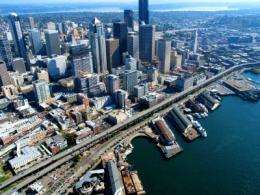
The Alaskan Way Viaduct is slated for demolition for seismic reasons. Credit: Washington State Department of Transportation

Debate about how to replace Seattle's deteriorating waterfront highway has centered on uncertainties in the project's price tag. Drilling a deep-bore tunnel and building an underground highway is estimated to cost around $4 billion, but some worry the final price could be higher, as it was for Boston's infamous Big Dig.

University of Washington have, for the first time, explored a different subject of uncertainty, namely surrounding how much commuters might benefit from the project. They found that relying on surface streets would likely have less impact on travel times than previously reported, and that different options' effects on commute times are not well known.

The research, conducted in 2009, was originally intended as an academic exercise looking at how to assess uncertainties in travel-time projections from urban transportation and land-use models. But the paper is being published amid renewed debate about the future of Seattle's waterfront thoroughfare.

"In early 2009 it was decided there would be a tunnel, and we said, 'Well, the issue is settled but it's still of academic interest,'" said co-author Adrian Raftery, a UW statistics professor. "Now it has all bubbled up again."

The study was cited last month in a report by the Seattle Department of Transportation reviewing the tunnel's impact. It is now available online, and will be published in an upcoming issue of the journal : Part A.

Razing Seattle's viaduct doesn’t guarantee nightmare commutes, model says
Enlarge

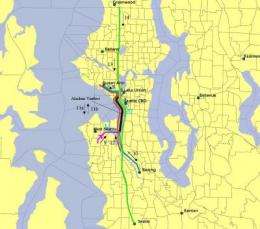
Researchers looked at eight routes that currently include the Alaskan Way Viaduct. Credit: University of Washington

The UW authors considered 22 commuter routes, eight of which currently include the viaduct. They compared a business-as-usual scenario, where a new elevated highway or a tunnel carries all existing traffic, against a in which the viaduct is removed and no measures are taken to increase public transportation or otherwise mitigate the effects.

The study found that simply erasing the structure in 2010 would increase travel times a decade later for the eight routes that currently include the viaduct by 1.5 minutes to 9.2 minutes, with an average increase of 6 minutes. The uncertainty was fairly large, with zero change within the 95 percent confidence range for all the viaduct routes, and more than 20 minutes increase as a reasonable projection in a few cases. In the short term some routes along Interstate 5 were slightly slower, but by 2020 the travel times returned to today's levels.

"This indicates that over time removing the structure would increase commute times for people who use the viaduct by about six minutes, although there's quite a bit of uncertainty about exactly how much," Raftery said. "In the rest of the region, on I-5, there's no indication that it would increase commute times at all."
Razing Seattle's viaduct doesn’t guarantee nightmare commutes, model says
Enlarge

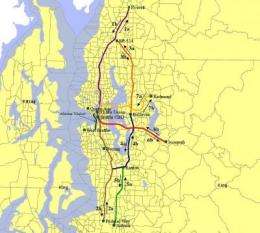
The study also considered the effects on 14 routes, shown here, that do not include the viaduct. Credit: University of Washington

The Washington State Department of Transportation had used a computer model in 2008 to explore travel times under various project scenarios. It found that the peak morning commute across downtown would be 10 minutes longer if the state relied on surface transportation. Shortly thereafter state and city leaders decided to build a tunnel.

The UW team in late 2009 ran the same travel model but added an urban land-use component that allows people and businesses to adapt over time – for instance by moving, switching jobs or relocating businesses. It also included a statistical method that puts error bars around the travel-time projections.

"There is a big interest among transportation planners in putting an uncertainty range around modeling results," said co-author Hana Sevcikova, a UW research scientist who ran the model.

"Often in policy discussions there's interest in either one end or the other of an interval: How bad could things be if we don't make an investment, or if we do make an investment, are we sure that it's necessary?" Raftery said. "The ends of the interval can give you a sense of that."

The UW study used a method called Bayesian statistics to combine computer models with actual data. Researchers used 2000 and 2005 land-use data and 2005 commute travel times to fine-tune the model. Bayesian statistics improves the model's accuracy and provides an uncertainty range around the model's projections.

The study used UrbanSim, an urban simulation model developed by co-author and former UW faculty member Paul Waddell, now a professor at the University of California, Berkeley. The model starts running in the year 2000, the viaduct is taken down in 2010 and the study focuses on peak morning commutes in the year 2020.

Despite renewed discussion, the authors are not taking a position on the debate.

"This is a scientific assessment. People could well say that six minutes is a lot, and it's worth whatever it takes [to avoid it]," Raftery said. "To some extent it comes down to a value judgment, factoring in the economic and environmental impacts."

Provided by University of Washington search and more info website

Filter


Move the slider to adjust rank threshold, so that you can hide some of the comments.


Display comments: newest first

Nik_2213
May 10, 2011

Rank: 3 / 5 (1)
How does removing the viaduct by-pass affect access to ground-level properties along the route ??
Decimatus
May 10, 2011

Rank: not rated yet
Bypass's do not usually have access to "ground-level properties" along the route. Unless you are refering to the increase in traffic at ground level due to the cars that have few alternate routes to take.
SmaryJerry
May 10, 2011

Rank: not rated yet
I lived in Seattle and trust me almost no one used the Viaduct to get anywhere the fastest. Everyone goes to I5 already, unless there is a football game, baseball game, soccer game, or concert... although one of those is pretty much every weekend.
mosahlah
May 10, 2011

Rank: 5 / 5 (1)
They would spend the money wiser by expanding I-5 downtown from 2 lanes to 6. Unforetunately, the elites running Seattle have forbid freeway construction into Seattle supposedly to encourage public transportation, however, their real estate empire probably would suffer any reduction in the 2 hr commute time from Pierce county. Meanwhile the Dems are using regulatory obstacles to prevent King County's largest employer Boeing, from moving production to South Carolina. I wonder if China is interested in commerical aircraft production? I wonder how do you say "will work for rice" in Mandarin? Might need to brush up my resume.
Caliban
May 11, 2011

Rank: not rated yet
@mosahlah,

Let's not forget the absolute windfall of prime water- front or -view real estate that will suddenly be available along the footprint of the viaduct, and all conveniently cleared and upgraded by the public dollar- including the tax dollars of all those commuters that will just have to to do the best they can trying to travel from north to south in a heavily-urbanised, multiply geomorphologically-restricted and in no way optimized for surface(much less highway)-traffic Seattle driving corridor.
Regarding Boeing- hey, most of the components that their aircraft are constructed from are already made in China, so between that ugly fact and the oh-so-favored tax status that Boning -I mean Boeing enjoys in the Puget Sound region make that scenario pretty much a wash, once you factor out the jobs in the region- but that's really just a question of time anyway- Boeing, Boeing, Gone!
Essentially, the two issues are facets of the same old "privatize profit, socialize cost" conundrum.
freethinking
May 11, 2011

Rank: 1 / 5 (2)
Seattle run by progressives, King county run by progressives, Washington state run by progressives. This tunnel idea is as stupid as get go. Want a stupid solution to a problem, just ask a progressive.
georgert
May 11, 2011

Rank: not rated yet
While I haven't read the report, it seems that it focuses on drive times. IMO of equal importance is improving Seattle's waterfront as a source of civic pride, improved access and visitation. The viaduct as it exists effectively cuts off the downtown area from the waterfront with this hideous construction. Seattle is flanked by Portland and Vancouver that have awesome waterfront access and attracts pedestrians, sightseers and tourists. Seattle could be so much better than it is.
Rank 2 /5 (2 votes)
Relevant PhysicsForums posts
  • Ideas to mitigate risk of 911 calls being misdirected
    createdMay 24, 2012
  • Live scribe pen?
    createdMay 10, 2012
  • Shallow water flow simulation
    createdMay 07, 2012
  • Tablet for taking notes?
    createdMay 05, 2012
  • Best fit tablet for me?
    createdMay 05, 2012
  • Measure of Informaton
    createdMay 04, 2012
  • More from Physics Forums - Computing & Technology

More news stories

Browser wars flare in mobile space

The browser wars are heating up again, but this time the fight is for dominance of the mobile Internet.

Technology / Software

created 2 minutes ago | popularity not rated yet | comments 0

SpotterRF debuts Radar Backpack Kit (w/ Video)

(Phys.org) -- SpotterRF has announced a special radar backpack kit designed to enhance situational awareness for soldiers on the ground. The company says its special radar is designed for warfighters as part ...

Technology / Hi Tech & Innovation

created 21 hours ago | popularity 5 / 5 (5) | comments 12 | with audio podcast report

Probability of contamination from severe nuclear reactor accidents is higher than expected: study

Catastrophic nuclear accidents such as the core meltdowns in Chernobyl and Fukushima are more likely to happen than previously assumed. Based on the operating hours of all civil nuclear reactors and the number ...

Technology / Energy & Green Tech

created May 22, 2012 | popularity 3.6 / 5 (21) | comments 56 | with audio podcast

Delphi gasoline-injection engine technique rivals hybrid's edge

(Phys.org) -- Running a diesel like engine on gasoline is something Delphi is doing in notable fashion. They claim they are on to a promising way to enjoy an engine that gives the vehicle owner high efficiency ...

Technology / Energy & Green Tech

created May 21, 2012 | popularity 4.7 / 5 (18) | comments 38 | with audio podcast report

HyperSolar shows dirty water no barrier to power world

(Phys.org) -- The Santa Barbara, California, company, HyperSolar, is set to transparently share the ups and downs of its research experiences toward the company’s ultimate vision, successfully producing ...

Technology / Energy & Green Tech

created May 24, 2012 | popularity 4.8 / 5 (15) | comments 17 | with audio podcast report


Scientist: Evolution debate will soon be history

(AP) -- Richard Leakey predicts skepticism over evolution will soon be history. Not that the avowed atheist has any doubts himself.

Dell tablet leak: 10.1-inch display, two-battery choice

(Phys.org) -- Headline after headline talks about vendors’ tablets in the wings as likely number-one contenders for the iPad. Such claims have justifiably been taken with a grain of salt, considering ...

SpaceX capsule has 'new car' smell, astronauts say (Update)

SpaceX's Dragon cargo vessel smells like a new car, said astronauts at the International Space Station after opening the hatches Saturday following the spacecraft's landmark mission to the orbiting lab.

Thousands of shellfish found dead in Peru

Thousands of crustaceans were found dead off the coast of Lima following the mystery mass death of dolphins and pelicans, the Peruvian Navy said Friday.

Australia hails surprise super-telescope decision

Australia has hailed a surprise decision giving it a role in a radio telescope project aimed at revolutionising astronomy, vowing to draw on its decades of experience in space science.

Astronomers seize last chance in lifetime for Venus Transit

Astronomers are gearing for one the rarest events in the Solar System: an alignment of Earth, Venus and the Sun that will not be seen for another 105 years.