Quantum sensor tracked in human cells could aid drug discovery
May 25, 2011

Quantum sensor tracked in human cells could aid drug discovery

Enlarge

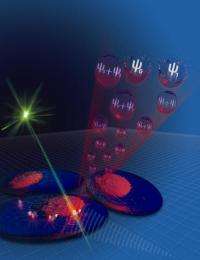
The image illustrates the quantum measurement carried out on a single atom quantum sensor in a living human HeLa cell. The atom sensor is encased in a nanodiamond particle and is controlled by external microwaves and laser light, and tracked by its emission of red light. The information gleaned is of a quantum nature, where the states of the atom exist in two quantum states at the same time prior to measurement. The measurement and control of the atom sensor provides information about the nanoscale environment of the cell and the motion and orientation of the nanoparticle, which could be used in the development of new drugs and delivery systems for nanomedicine. Credit: David Haworth

(PhysOrg.com) -- Groundbreaking research has shown a quantum atom has been tracked inside a living human cell and may lead to improvements in the testing and development of new drugs.

Professor Lloyd Hollenberg from the University of Melbourne’s School of Physics who led the research said it is the first time a single atom encased in nanodiamond has been used as a sensor to explore the nanoscale environment inside a living human cell.

“It is exciting to see how the atom experiences the biological environment at the nanoscale,” he said.

“This research paves the way towards a new class of used for biological research into the development of and nanomedicine.”

The sensor is capable of detecting biological processes at a molecular level, such as the regulation of chemicals in and out of the cell, which is critical in understanding how drugs work.

The paper has been published in the journal .

Funded by the ARC Centre of Excellence for Quantum Computation and Communication Technology, the research was conducted by a cross-disciplinary team from the University of Melbourne’s Physics, Chemistry, and Chemical and Biomolecular Engineering departments.

The researchers developed state of the art technology to control and manipulate the atom in the nanodiamond before inserting it into the human cells in the lab.

Biologist Dr Yan Yan of the University’s Department of Chemical and Biomolecular Engineering who works in the field of nanomedicine, said the sensor provides critical information about the movement of the nanodiamonds inside the living cell.

“This is important for the new field of nanomedicine where drug delivery is dependant on the uptake of similar sized nanoparticles into the cell.”

Quantum physicist and PhD student Liam McGuinness from the University’s School of Physics said that monitoring the atomic sensor in a living cell was a significant achievement. “Previously, these atomic level quantum measurements could only be achieved under carefully controlled conditions of a physics lab,” he said.

It is hoped in the next few years, that following these proof of principle experiments, the researchers will be able to develop the technology and provide a new set of tools for drug discovery and nanomedicine.

Provided by University of Melbourne search and more info website


Rank 5 /5 (1 vote)
Relevant PhysicsForums posts
  • The Global Positioning System !
    created1 hour ago
  • A Question relating Power
    created2 hours ago
  • Writing a book so im learning about things, i have some general questions please read
    created4 hours ago
  • Question about induced E field.
    created5 hours ago
  • Charging a capacitor in a tesla coil
    created5 hours ago
  • Water Rocket
    created9 hours ago
  • More from Physics Forums - General Physics

More news stories

Dopant gives graphene solar cells highest efficiency yet

(Phys.org) -- By taking advantage of graphene’s favorable electrical and optical properties, and then adding an organic dopant, researchers have achieved the highest power conversion efficiency yet for ...

Nanotechnology / Nanophysics

created May 21, 2012 | popularity 5 / 5 (10) | comments 14 | with audio podcast feature

Nanomedicine: Quantum dots appear safe in pioneering study on primates

A pioneering study to gauge the toxicity of quantum dots in primates has found the tiny crystals to be safe over a one-year period, a hopeful outcome for doctors and scientists seeking new ways to battle diseases ...

Nanotechnology / Bio & Medicine

created May 20, 2012 | popularity 4.3 / 5 (3) | comments 8 | with audio podcast

In nanorod crystal growth, nanoparticles seen as artificial atoms

In the growth of crystals, do nanoparticles act as "artificial atoms" forming molecular-type building blocks that can assemble into complex structures? This is the contention of a major but controversial theory ...

Nanotechnology / Nanophysics

created May 24, 2012 | popularity 4.8 / 5 (6) | comments 0 | with audio podcast

First direct observation of oriented attachment in nanocrystal growth

Berkeley Lab researchers have reported the first direct observation of nanoparticles undergoing oriented attachment, the critical step in biomineralization and the growth of nanocrystals. A better understanding ...

Nanotechnology / Nanophysics

created May 24, 2012 | popularity 4.7 / 5 (3) | comments 0 | with audio podcast

Synthetic nano-waste does not disappear

(Phys.org) -- Tiny particles of cerium oxide do not burn or change in the heat of a waste incineration plant. They remain intact on combustion residues or in the incineration system, as a new study by Swiss ...

Nanotechnology / Bio & Medicine

created May 25, 2012 | popularity 5 / 5 (2) | comments 1 | with audio podcast


Browser wars flare in mobile space

The browser wars are heating up again, but this time the fight is for dominance of the mobile Internet.

Scientist: Evolution debate will soon be history

(AP) -- Richard Leakey predicts skepticism over evolution will soon be history. Not that the avowed atheist has any doubts himself.

Dell tablet leak: 10.1-inch display, two-battery choice

(Phys.org) -- Headline after headline talks about vendors’ tablets in the wings as likely number-one contenders for the iPad. Such claims have justifiably been taken with a grain of salt, considering ...

SpotterRF debuts Radar Backpack Kit (w/ Video)

(Phys.org) -- SpotterRF has announced a special radar backpack kit designed to enhance situational awareness for soldiers on the ground. The company says its special radar is designed for warfighters as part ...

SpaceX capsule has 'new car' smell, astronauts say (Update)

SpaceX's Dragon cargo vessel smells like a new car, said astronauts at the International Space Station after opening the hatches Saturday following the spacecraft's landmark mission to the orbiting lab.

Thousands of shellfish found dead in Peru

Thousands of crustaceans were found dead off the coast of Lima following the mystery mass death of dolphins and pelicans, the Peruvian Navy said Friday.