Up close and personal with snakes
May 3, 2011

Up close and personal with snakes

Enlarge

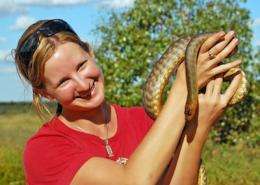
Melissa Bruton with a woma python (Aspidites ramsayi) out in the southern Brigalow Belt of Queensland and New South Wales.

A death adder has a face only a mother could love, but that hasn't stopped PhD student Melissa Bruton, from the University of Queensland's School of Geography, Planning and Environmental Management from getting up close and personal.

Ms Bruton was recently awarded a grant by the Wildlife Preservation Society of Queensland to support her research into in the southern Brigalow Belt region of Queensland and New South Wales.

“The Brigalow Belt is a well-known reptile diversity hotspot and there are a large number of species present, including some that are endemic to the region,” Ms Bruton said.

“The main goal of my project is to work out how different habitats affect reptile diversity and abundance out here and why some species have declined while others have increased in altered habitats.”

Like much of Australia, The Brigalow Belt has been subject to widespread agricultural clearing.

“It is important to understand how different ecosystem types at different stages of recovery (i.e. cleared, regrowth, uncleared) influence the reptile communities, so recovery efforts and future clearing legislation can be guided by accurate information,” she said.

So far Ms Bruton has observed not only death adders, but also pale-headed snakes, Brigalow Scaley-foots, the shy freckled monitor, and several other species in the area.

Melissa has a particular interest in the elusive woma python.

“The second aim of my project is to work out how often and how far woma pythons move and the habitats they use. To do this, I will be implanting radio-transmitters into the body cavity of several larger pythons and radio-tracking them for one year each.”

After finishing just one summer of trapping Ms Bruton already has 8 woma pythons to study. They range from Big Bobby, over 2m and James weighing in at 3.5 kilos to a petit 1kg python yet to be named.

So far, she has learned that woma pythons like to travel, but there's no place like home, even right on her own doorstep.

“I have 2 womas in the same burrow - Katie and James - about 300m from my quarters,” she said.

“The tracked womas are quite mobile but early indications are that they return to preferred burrow sites”.

“Each woma will be tracked every second day for a minimum of 12 months so we will know a lot more about these elusive in 12 months' time.”

Provided by University of Queensland search and more info website


Rank not rated yet
Relevant PhysicsForums posts

More news stories

Scientist: Evolution debate will soon be history

(AP) -- Richard Leakey predicts skepticism over evolution will soon be history. Not that the avowed atheist has any doubts himself.

Biology / Evolution

created 11 hours ago | popularity 3.5 / 5 (11) | comments 26

Thousands of shellfish found dead in Peru

Thousands of crustaceans were found dead off the coast of Lima following the mystery mass death of dolphins and pelicans, the Peruvian Navy said Friday.

Biology / Ecology

created 21 hours ago | popularity 4.8 / 5 (4) | comments 6

More plant species responding to global warming than previously thought

(Phys.org) -- Far more wild plant species may be responding to global warming than previous large-scale estimates have suggested.

Biology / Ecology

created May 22, 2012 | popularity 4.6 / 5 (14) | comments 18 | with audio podcast

Totally rad: Scientists create rewritable digital data storage in DNA

(Phys.org) -- Scientists from Stanford's Department of Bioengineering have devised a method for repeatedly encoding, storing and erasing digital data within the DNA of living cells.

Biology / Biotechnology

created May 21, 2012 | popularity 4.9 / 5 (17) | comments 11 | with audio podcast

For monogamous sparrows, it doesn't pay to stray (but they do it anyway)

It's quite common for a female song sparrow to stray from her breeding partner and mate with the male next door, but a new study shows that sleeping around can be costly.

Biology / Plants & Animals

created May 22, 2012 | popularity 5 / 5 (1) | comments 7 | with audio podcast


Browser wars flare in mobile space

The browser wars are heating up again, but this time the fight is for dominance of the mobile Internet.

Dell tablet leak: 10.1-inch display, two-battery choice

(Phys.org) -- Headline after headline talks about vendors’ tablets in the wings as likely number-one contenders for the iPad. Such claims have justifiably been taken with a grain of salt, considering ...

SpotterRF debuts Radar Backpack Kit (w/ Video)

(Phys.org) -- SpotterRF has announced a special radar backpack kit designed to enhance situational awareness for soldiers on the ground. The company says its special radar is designed for warfighters as part ...

SpaceX capsule has 'new car' smell, astronauts say (Update)

SpaceX's Dragon cargo vessel smells like a new car, said astronauts at the International Space Station after opening the hatches Saturday following the spacecraft's landmark mission to the orbiting lab.

Australia hails surprise super-telescope decision

Australia has hailed a surprise decision giving it a role in a radio telescope project aimed at revolutionising astronomy, vowing to draw on its decades of experience in space science.

Astronomers seize last chance in lifetime for Venus Transit

Astronomers are gearing for one the rarest events in the Solar System: an alignment of Earth, Venus and the Sun that will not be seen for another 105 years.