NIH grant ratchets up ASU research in molecular motors
May 30, 2011

NIH grant ratchets up ASU research in molecular motors

Enlarge

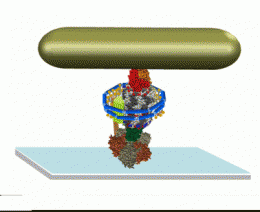
Viewing molecular motor motion: The FoF1 synthase is oriented so that the F1 component attached via histidine linkages to a nickel-coated microscope slide (gray rectangle). A gold nanorod is bound by avidin-biotin to the c-subunit ring of the Fo complex (represented by light and dark gray bands), which rotate relative to subunit-a (bright green dowels). An axel (dark green) connects the FoF1 motors. The stabilizing nanodisc is portrayed with blue segments and brown lipid bilayer dumbells.

Empowered by a $1.2 million grant from the National Institutes of Health (NIH), Arizona State University scientist Wayne Frasch is deciphering how one of the world’s smallest molecular motors works in living cells. In the process, he is also casting light on a physics puzzle that has perplexed scientists for more than 40 years.

Frasch, a professor in the School of Life Sciences, examines the Fo , its mechanism of action and how it partners with the F1 motor as part of the FoF1 ATP synthase. At about 10 nanometers in diameter, each motor is 10,000 times smaller than the width of a piece of paper. In living things, Fo and F1 are attached by a common rotary axel that allows the two motors to work together and supply energy to cells in the form of adenosine triphosphate (ATP).

Research of nanoscale motors is not just complicated by size. Molecular motors operate via extremely small motions that occur on time scales that have been extraordinarily difficult to measure. The Fo molecular motor is also embedded in a living cell’s lipid membrane, which is only two molecules thick. Adding to the experimental challenge is the fact that the molecular motors’ rotational energy arises from the flow of protons, positively-charged atomic particles, across that membrane.

The Frasch lab is among only a few laboratories equipped to visualize how a single molecule of the Fo motor rotates. Frasch and his ASU College of Liberal Arts and Sciences colleagues have developed an experimental system that embeds the Fo motor in an artificial phospholipid bilayer laid down in nanodiscs, which help to stabilize the molecular complexes. Frasch’s group then devised an imaging strategy, using gold nanorods attached to Fo to monitor the rotation of the single FoF1 molecules.

“Knowing more about these tiny, but extraordinarily efficient –nearly 100 percent – molecular motors offers an avenue to development new technologies, such as power sources for fuel-efficient nanodevices and nanotechnology applications like molecular detection, computing and biomedicine,” Frasch says.

One early outcome of Frasch and the ASU team’s FoF1 experiments, recently published in EMBO Journal, provides enticing new clues into an old conundrum: a Brownian ratchet first proposed by physicist Richard Feynman more than 40 years ago.

“Previous studies of the Fo motor led researchers to propose that Fo contains a molecular ratchet capable of biasing Brownian motion, the random motion of molecules, in a way that favors rotation in the direction of ATP synthesis,” says Frasch. “However, little evidence existed for the type of periodic interruptions in rotation consistent with this type of ratcheting mechanism.”

What was known is that the flow of protons across the membrane through Fo channels in a static subunit-“a” drives clockwise rotation of the “c”-ring rotor comprised of 10 c-subunits that each shuttle a single proton. This clockwise rotation in turn drives ATP synthesis, which occurs in the F1 motor because the c-ring attaches to one end of the axle that links units Fo and F1.

Using a gold nanorod attached to the c-ring of a single FoF1 molecule, Frasch’s group can examine the motor’s rotation in more depth. The group measures changes in light intensity from the gold nanorod as it (and the c-ring) rotates, which allows the ASU team to “see” that the rotary motion of the c-ring is periodically interrupted. “When subunit-a grabbed onto subunit-c, the interaction behaved as a leash, allowing the c-ring to rotate, but at a limit of 36 degree increments while engaged – like a ratchet,” Frasch says, “This periodic interruption only occurred under conditions in which there was sufficient drag on the nanorod to slow the motor, similar to conditions found in a living cell where ATP is maintained at a high level.”

With the new NIH funding, Frasch’s School of Life Sciences research group will examine if the leash is a component of the long sought after Browning ratchet. Understanding how or if Brownian motion is harnessed in a molecular ratchet has the potential for use in the development of synthetic molecular motors with low energy consumption and nanoscale energy production.

Provided by Arizona State University search and more info website

Filter


Move the slider to adjust rank threshold, so that you can hide some of the comments.


Display comments: newest first

Vendicar_Decarian
May 31, 2011

Rank: not rated yet
How sad it is that American Libertarians are calling for the abolishment of the National Institute of Health.
Rank 5 /5 (3 votes)
Relevant PhysicsForums posts
  • The Global Positioning System !
    created1 hour ago
  • A Question relating Power
    created2 hours ago
  • Writing a book so im learning about things, i have some general questions please read
    created4 hours ago
  • Question about induced E field.
    created5 hours ago
  • Charging a capacitor in a tesla coil
    created5 hours ago
  • Water Rocket
    created9 hours ago
  • More from Physics Forums - General Physics

More news stories

Dopant gives graphene solar cells highest efficiency yet

(Phys.org) -- By taking advantage of graphene’s favorable electrical and optical properties, and then adding an organic dopant, researchers have achieved the highest power conversion efficiency yet for ...

Nanotechnology / Nanophysics

created May 21, 2012 | popularity 5 / 5 (10) | comments 14 | with audio podcast feature

Nanomedicine: Quantum dots appear safe in pioneering study on primates

A pioneering study to gauge the toxicity of quantum dots in primates has found the tiny crystals to be safe over a one-year period, a hopeful outcome for doctors and scientists seeking new ways to battle diseases ...

Nanotechnology / Bio & Medicine

created May 20, 2012 | popularity 4.3 / 5 (3) | comments 8 | with audio podcast

In nanorod crystal growth, nanoparticles seen as artificial atoms

In the growth of crystals, do nanoparticles act as "artificial atoms" forming molecular-type building blocks that can assemble into complex structures? This is the contention of a major but controversial theory ...

Nanotechnology / Nanophysics

created May 24, 2012 | popularity 4.8 / 5 (6) | comments 0 | with audio podcast

First direct observation of oriented attachment in nanocrystal growth

Berkeley Lab researchers have reported the first direct observation of nanoparticles undergoing oriented attachment, the critical step in biomineralization and the growth of nanocrystals. A better understanding ...

Nanotechnology / Nanophysics

created May 24, 2012 | popularity 4.7 / 5 (3) | comments 0 | with audio podcast

Synthetic nano-waste does not disappear

(Phys.org) -- Tiny particles of cerium oxide do not burn or change in the heat of a waste incineration plant. They remain intact on combustion residues or in the incineration system, as a new study by Swiss ...

Nanotechnology / Bio & Medicine

created May 25, 2012 | popularity 5 / 5 (2) | comments 1 | with audio podcast


Browser wars flare in mobile space

The browser wars are heating up again, but this time the fight is for dominance of the mobile Internet.

Scientist: Evolution debate will soon be history

(AP) -- Richard Leakey predicts skepticism over evolution will soon be history. Not that the avowed atheist has any doubts himself.

Dell tablet leak: 10.1-inch display, two-battery choice

(Phys.org) -- Headline after headline talks about vendors’ tablets in the wings as likely number-one contenders for the iPad. Such claims have justifiably been taken with a grain of salt, considering ...

SpotterRF debuts Radar Backpack Kit (w/ Video)

(Phys.org) -- SpotterRF has announced a special radar backpack kit designed to enhance situational awareness for soldiers on the ground. The company says its special radar is designed for warfighters as part ...

SpaceX capsule has 'new car' smell, astronauts say (Update)

SpaceX's Dragon cargo vessel smells like a new car, said astronauts at the International Space Station after opening the hatches Saturday following the spacecraft's landmark mission to the orbiting lab.

Thousands of shellfish found dead in Peru

Thousands of crustaceans were found dead off the coast of Lima following the mystery mass death of dolphins and pelicans, the Peruvian Navy said Friday.