May 3, 2011 report
Neolithic humans lived a communal life: study
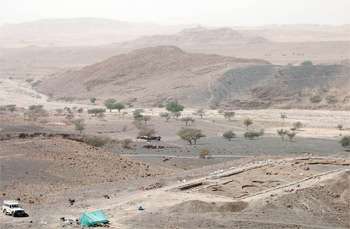
(PhysOrg.com) -- A recent study published in the Proceedings of the National Academy of Sciences finds evidence that the previous assumption that stone and mud-brick buildings built nearly 12,000 years ago were the homes and settlements of the first farmers may not have been homes at all, but community centers.
A team of researchers led by Bill Finlayson, the director of the Council for British Research in the Levant, and Steven Mithen, an archaeologist from the University of Reading, have discovered a site in southern Jordan named Wadi Faynan 16. They believe that early farmers created the buildings between 11,600 and 10,200 years ago. Three buildings have been uncovered and have been named Structure O75, O45, and O12.
Structure O75 is the largest of the three, measuring 72 by 62 feet. It was made with mud-brick and has a floor made of mud plaster. There is a central area surrounded by long benches in a tiered structure, similar to that of a theater. It is the researchers belief that this building was used for food related rituals and food processing.
Structure O45 measured 18 by 15 feet and was elliptical in shape. The walls and pit were created by rammed earth, or pise. The structure was divided into several compartments and the researchers believe this building was used for community storage of food.
Structure O12 was the smallest and measured 16.5 by 11 feet. Like O45, it was also elliptical in shape. It was around 6.5 feet into the ground and had freestanding walls that created an inner division of two rooms. Researchers believe this was also used for some sort of storage.
These three buildings were found within a cluster of other small buildings, though none of these buildings appear to be individual family homes. The researchers suggest that in this time period there may have been little distinction between ritual and household activities and that people lived and worked as a community.
More information: Bill Finlayson et al. Architecture, sedentism, and social complexity at Pre-Pottery Neolithic A WF16, Southern Jordan, PNAS, Published online before print May 2, 2011, doi: 10.1073/pnas.1017642108
Abstract
Recent excavations at Pre-Pottery Neolithic A (PPNA) WF16 in southern Jordan have revealed remarkable evidence of architectural developments in the early Neolithic. This sheds light on both special purpose structures and “domestic” settlement, allowing fresh insights into the development of increasingly sedentary communities and the social systems they supported. The development of sedentary communities is a central part of the Neolithic process in Southwest Asia. Architecture and ideas of homes and households have been important to the debate, although there has also been considerable discussion on the role of communal buildings and the organization of early sedentarizing communities since the discovery of the tower at Jericho. Recently, the focus has been on either northern Levantine PPNA sites, such as Jerf el Ahmar, or the emergence of ritual buildings in the Pre-Pottery Neolithic B of the southern Levant. Much of the debate revolves around a division between what is interpreted as domestic space, contrasted with “special purpose” buildings. Our recent evidence allows a fresh examination of the nature of early Neolithic communities.
© 2010 PhysOrg.com


