NASA sees Tropical Storm Songda singing of rain and gusty winds for the Philippines
May 24, 2011

NASA sees Tropical Storm Songda singing of rain and gusty winds for the Philippines

Enlarge

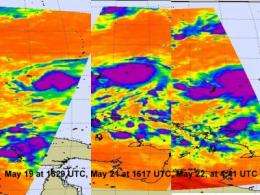
This series of three infrared images shows the strengthening of Tropical Storm Songda over the period of May 19-22, 2011. Notice that the area with strongest convection (purple) has expanded over that time. That area has the coldest, highest thunderstorm cloud tops near -63 F/-52C, and heaviest rainfall. Over those four days, Songda took on a more rounded shape. Credit: NASA/JPL, Ed Olsen

"Rainy days and Mondays" is the song that the residents of the northern Philippines do not want to hear if it involves the approaching Tropical Storm Songda. The Carpenters song was a hit, but a hit from Songda is making residents of the Philippines nervous as NASA's Aqua satellite has been watching the progression and intensification of the storm over the last several days.

In a series of three from the period of May 19-22, 2011, NASA's Atmospheric Infrared Sounder (AIRS) instrument revealed the strengthening of Tropical Storm Songda. The area with strongest convection has expanded and organized over that time. That area of strongest convection has the coldest, highest tops near -63 F/-52C, and heaviest rainfall. The time series of imagery over those four days also shows that Songda took on a more rounded shape as it continued to strengthen from a to a tropical storm. Today, May 23, shows a strong band of deep convection is persisting along the southern edge of Songda.

On May 21, Tropical Storm 04W still had maximum sustained winds near 40 mph (35 knots/64 kmh). On Sunday, May 22, the maximum sustained winds increased to 52 mph (45 knots/83 kmh) and the storm was renamed "Tropical Storm Songda." At that time the center of the storm was near 10.0 N and 136.4 E, or 190 miles north-northeast of Palau. By 2100 UTC on May 22, Songda's winds again increased to 55 knots as it continued moving north-northwest.

On May 23, Songda's have again increased and are now clocked at 69 mph (60 knots/111 kmh). extend out 100 miles (161 km) from the center. Further strengthening is expected by the forecasters at the Joint Typhoon Warning Center. Songda's center was located about 295 miles (475 km) northwest of Palau, near 11.5 North and 131.8 East, and it was moving west-northwest near 12 mph (10 knots/~18 kmh). Songda is kicking up high waves in the Northwestern Pacific, up to 22 feet (6/7 meters) high.

Songda is expected to continue intensifying over the next couple of days, but its center is forecast stay offshore from Luzon, Philippines and track east of land. However, the western side of the storm is expected to bring gusty winds, heavy rainfall and rough surf to Luzon over the next couple of days as it approaches and sweeps north toward Taiwan.

Provided by NASA's Goddard Space Flight Center search and more info website


Rank not rated yet
Relevant PhysicsForums posts

More news stories

SpaceX capsule has 'new car' smell, astronauts say (Update)

SpaceX's Dragon cargo vessel smells like a new car, said astronauts at the International Space Station after opening the hatches Saturday following the spacecraft's landmark mission to the orbiting lab.

Space & Earth / Space Exploration

created 21 hours ago | popularity 4.5 / 5 (20) | comments 1

Australia hails surprise super-telescope decision

Australia has hailed a surprise decision giving it a role in a radio telescope project aimed at revolutionising astronomy, vowing to draw on its decades of experience in space science.

Space & Earth / Astronomy

created 21 hours ago | popularity 5 / 5 (4) | comments 2

Astronomers seize last chance in lifetime for Venus Transit

Astronomers are gearing for one the rarest events in the Solar System: an alignment of Earth, Venus and the Sun that will not be seen for another 105 years.

Space & Earth / Astronomy

created 21 hours ago | popularity 5 / 5 (3) | comments 2

Astronauts enter world's 1st private supply ship

(AP) -- Space station astronauts floated into the Dragon on Saturday, a day after its heralded arrival as the world's first commercial supply ship.

Space & Earth / Space Exploration

created 21 hours ago | popularity 5 / 5 (6) | comments 0

Sophisticated simulations predict future warming

The chances of our planet being hit by a global warming of 3 degrees Celsius by 2050 is as likely as it being hit by an increase of 1.4 degrees, new research shows. Presented in the journal Nature Geoscience, the British study ...

Space & Earth / Earth Sciences

created May 22, 2012 | popularity 4.4 / 5 (9) | comments 51


Browser wars flare in mobile space

The browser wars are heating up again, but this time the fight is for dominance of the mobile Internet.

Scientist: Evolution debate will soon be history

(AP) -- Richard Leakey predicts skepticism over evolution will soon be history. Not that the avowed atheist has any doubts himself.

Dell tablet leak: 10.1-inch display, two-battery choice

(Phys.org) -- Headline after headline talks about vendors’ tablets in the wings as likely number-one contenders for the iPad. Such claims have justifiably been taken with a grain of salt, considering ...

SpotterRF debuts Radar Backpack Kit (w/ Video)

(Phys.org) -- SpotterRF has announced a special radar backpack kit designed to enhance situational awareness for soldiers on the ground. The company says its special radar is designed for warfighters as part ...

Thousands of shellfish found dead in Peru

Thousands of crustaceans were found dead off the coast of Lima following the mystery mass death of dolphins and pelicans, the Peruvian Navy said Friday.

Keep food safety in mind this memorial day weekend

(HealthDay) -- Picnics, parades and cookouts are as much a part of Memorial Day weekend as tributes to the United States' war veterans.