NASA satellites see Typhoon Songda weaken and move past Japan
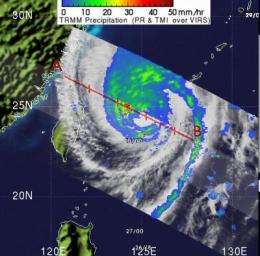
NASA's Tropical Rainfall Measuring Mission and Aqua satellite provided forecasters some insights into the behavior of Super Typhoon Songda over the past weekend. Former Super typhoon Songda brought rainfall to parts of Japan over the weekend and today marine warnings for high surf remain in several Sub-prefecture regions as extra-tropical depression Sondga's remnants push further out to sea.
Sub-prefecture regions of Nemuro Chiho, Kushiro Chiho, and Tokachi Chiho still have high wave advisories in place today, May 31, 2011, from the Japanese Meteorological Agency as Sondga's remnants continue moving into the open waters of the Northwestern Pacific Ocean.
On Sunday, May 30, BBC News reported that as Songda continued its northeasterly journey past Japan, the work at the Fukushima nuclear plant was suspended until the storm had passed.
On Saturday, May 29 at 1500 UTC (11 a.m. EDT) Songda had weakened to a depression with maximum sustained winds near 30 knots (34 mph/55 kmh). It was located 300 miles (482 km) west-southwest of Yokosuka, Japan near 34.4 North and 136.6 East. It was moving to the northeast at 26 knots (30 mph/48 kmh).
Earlier, Songda made landfall over the Wakayama prefecture and weakened. It then reemerged over water and moved east-northeast while transitioning into an extra-tropical storm.
According to Stars and Stripes newspaper, the Kadena Air Base (island) issued an "all clear" on Sunday May 29 at 7:56 a.m. local/Japan time for most areas of Okinawa. Down powerlines were reported at Marine Corps Air Station Futenma due to downed power lines.
On Saturday, May 28, Kadena Air Base experienced strong winds and a lot of rainfall in a short period of time as it Songda moved north-northeast. At 1500 UTC (11 a.m. EDT), Kadena Air Base reported sustained winds of 52 knots (60 mph/96 kmh), gusting to 61 knots (70 mph/113 kmh). Rainfall totals were as much as 21 inches (52 centimeters) in 3 hours!
At that time, Songda's center was just 60 miles (96 km) west of Kadena Air Base, Japan, so its center did not cross the island. At that time its maximum sustained winds around the low-level center were near 75 knots (86 mph/139 kmh) and it was still a Category 1 typhoon. It was generating very rough seas at the time reported wave heights were near 37 feet (~11 meters).
Typhoon Sondga's rainfall was captured by NASA's TRMM satellite on Saturday, May 28 at 0613 UTC (1:13 a.m. EDT). At that time, the outer fringes of the storm brushed by Taiwan. The strongest rainfall (about 2 inches/50 mm per hour) remained at sea and was mostly confined to the northwestern quadrant of the storm. Most of the rainfall in the storm was moderate, falling at a rate between .78 and 1.57 inches (20 and 40 mm) per hour.
Stars and Stripes newspaper reported that before Songda approached Kadena Air Base the "Navy's 7th Fleet has moved assets out of port at Yokosuka Naval Base. That fleet included a number of ships including flagship USS Blue Ridge and four destroyers: Fitzgerald, McCain, Mustin and Curtis Wilbur." The newspaper reported that two vessels stayed in port for maintenance and others at sea shifted their navigation away from the storm.
On May 27 at 2100 UTC (5 p.m. EDT) Typhoon Songda was 385 miles (619 km) southwest of Kadena Air Base, Japan and its maximum sustained winds were near 115 knots (132 mph/213 kmh).
The Moderate Resolution Imaging Spectroradiometer (MODIS) instrument onboard NASA's Aqua satellite captured a visible image of Songda on May 27 at 05:10 UTC (1:10 a.m. EDT) when it was a super typhoon off shore from the northern Philippines. At that time, Songda still had an eye.
By 17:11 UTC (1:11 p.m. EDT) another satellite image showed a changing story. At that time, an infrared image was taken by the Atmospheric Infrared Sounder (AIRS) instrument onboard NASA's Aqua satellite as Songda's center was parallel to the southern tip of Taiwan, but far to the east at Sea. At that time, the eye was no longer visible in this image, indicating that the storm is weakening. Fortunately increased wind shear kicked up and continued weakening the storm by the time it approached Kadena Air Base.
One aspect of the infrared imagery that was impressive is the extent of the clouds connected to Songda. The infrared imagery shows what looks like a tail of clouds extending to the northeast that stretches from Taiwan into northern Japan.
Provided by NASA's Goddard Space Flight Center


