'Nanowire' measurements could improve computer memory
May 19, 2011

'Nanowire' measurements could improve computer memory

Enlarge

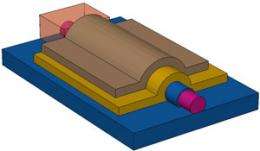
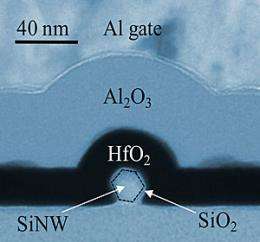
In this schematic image (top) and transmission electron micrograph, a silicon nanowire is shown surrounded by a stack of thin layers of material called dielectrics, which store electrical charge. NIST scientists determined the best arrangement for this dielectric stack for the optimal construction of silicon nanowire-based memory devices. Credit: Schematic Zhu, GMU. TEM Bonevich, NIST.

(PhysOrg.com) -- A recent study at the National Institute of Standards and Technology may have revealed the optimal characteristics for a new type of computer memory now under development. The work, performed in collaboration with researchers from George Mason University (GMU), aims to optimize nanowire-based charge-trapping memory devices, potentially illuminating the path to creating portable computers and cell phones that can operate for days between charging sessions.

The nascent technology is based on silicon formed into tiny wires, approximately 20 in diameter. These "nanowires" form the basis of that is non-volatile, holding its contents even while the power is off—just like the flash memory in USB thumb drives and many mp3 players. Such nanowire devices are being studied extensively as the possible basis for next-generation because they hold the promise to store information faster and at lower voltage.

Nanowire also hold an additional advantage over flash memory, which despite its uses is unsuitable for one of the most crucial memory banks in a computer: the local cache memory in the central processor.
'Nanowire' measurements could improve computer memory
Enlarge


"Cache memory stores the information a microprocessor is using for the task immediately at hand," says NIST physicist Curt Richter. "It has to operate very quickly, and flash memory just isn't fast enough. If we can find a fast, non-volatile form of memory to replace what chips currently use as cache memory, computing devices could gain even more freedom from power outlets—and we think we've found the best way to help nanowires do the job."

While the research team is by no means the only lab group in the world working on nanowires, they took advantage of NIST's talents at measurement to determine the best way to design charge-trapping memory devices based on nanowires, which must be surrounded by thin layers of material called dielectrics that store electrical charge. By using a combination of software modeling and electrical device characterization, the NIST and GMU team explored a wide range of structures for the dielectrics. Based on the understanding they gained, Richter says, an optimal device can be designed.

"These findings create a platform for experimenters around the world to further investigate the nanowire-based approach to high-performance non-volatile memory," says Qiliang Li, assistant professor of Electrical and Computer Engineering at GMU. "We are optimistic that nanowire-based memory is now closer to real application."

More information: X. Zhu, Q. Li, D. Ioannou, D. Gu, J.E. Bonevich, H. Baumgart, J. Suehle and C.A. Richter. Fabrication, characterization and simulation of high performance Si nanowire-based non-volatile memory cells. Nanotechnology, May 16, 2011, 22 254020. doi: 10.1088/0957-4484/22/25/254020

Provided by National Institute of Standards and Technology search and more info website

4.7 /5 (6 votes)  

Rank 4.7 /5 (6 votes)
Relevant PhysicsForums posts
  • The Global Positioning System !
    created59 minutes ago
  • A Question relating Power
    created2 hours ago
  • Writing a book so im learning about things, i have some general questions please read
    created4 hours ago
  • Question about induced E field.
    created5 hours ago
  • Charging a capacitor in a tesla coil
    created5 hours ago
  • Water Rocket
    created9 hours ago
  • More from Physics Forums - General Physics

More news stories

Dopant gives graphene solar cells highest efficiency yet

(Phys.org) -- By taking advantage of graphene’s favorable electrical and optical properties, and then adding an organic dopant, researchers have achieved the highest power conversion efficiency yet for ...

Nanotechnology / Nanophysics

created May 21, 2012 | popularity 5 / 5 (10) | comments 14 | with audio podcast feature

Nanomedicine: Quantum dots appear safe in pioneering study on primates

A pioneering study to gauge the toxicity of quantum dots in primates has found the tiny crystals to be safe over a one-year period, a hopeful outcome for doctors and scientists seeking new ways to battle diseases ...

Nanotechnology / Bio & Medicine

created May 20, 2012 | popularity 4.3 / 5 (3) | comments 8 | with audio podcast

In nanorod crystal growth, nanoparticles seen as artificial atoms

In the growth of crystals, do nanoparticles act as "artificial atoms" forming molecular-type building blocks that can assemble into complex structures? This is the contention of a major but controversial theory ...

Nanotechnology / Nanophysics

created May 24, 2012 | popularity 4.8 / 5 (6) | comments 0 | with audio podcast

First direct observation of oriented attachment in nanocrystal growth

Berkeley Lab researchers have reported the first direct observation of nanoparticles undergoing oriented attachment, the critical step in biomineralization and the growth of nanocrystals. A better understanding ...

Nanotechnology / Nanophysics

created May 24, 2012 | popularity 4.7 / 5 (3) | comments 0 | with audio podcast

Synthetic nano-waste does not disappear

(Phys.org) -- Tiny particles of cerium oxide do not burn or change in the heat of a waste incineration plant. They remain intact on combustion residues or in the incineration system, as a new study by Swiss ...

Nanotechnology / Bio & Medicine

created May 25, 2012 | popularity 5 / 5 (2) | comments 1 | with audio podcast


Browser wars flare in mobile space

The browser wars are heating up again, but this time the fight is for dominance of the mobile Internet.

Scientist: Evolution debate will soon be history

(AP) -- Richard Leakey predicts skepticism over evolution will soon be history. Not that the avowed atheist has any doubts himself.

Dell tablet leak: 10.1-inch display, two-battery choice

(Phys.org) -- Headline after headline talks about vendors’ tablets in the wings as likely number-one contenders for the iPad. Such claims have justifiably been taken with a grain of salt, considering ...

SpotterRF debuts Radar Backpack Kit (w/ Video)

(Phys.org) -- SpotterRF has announced a special radar backpack kit designed to enhance situational awareness for soldiers on the ground. The company says its special radar is designed for warfighters as part ...

SpaceX capsule has 'new car' smell, astronauts say (Update)

SpaceX's Dragon cargo vessel smells like a new car, said astronauts at the International Space Station after opening the hatches Saturday following the spacecraft's landmark mission to the orbiting lab.

Thousands of shellfish found dead in Peru

Thousands of crustaceans were found dead off the coast of Lima following the mystery mass death of dolphins and pelicans, the Peruvian Navy said Friday.