Nanometer-scale layers between materials have both solid and liquid characteristics
May 23, 2011 By Kevin Hattori
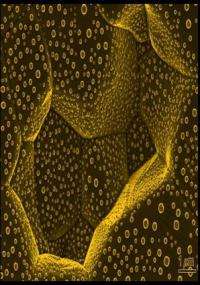
Gold crystals equilibrated on a polycrystalline sapphire(aluminum oxide) surface.
Researchers at the Technion have discovered the nature of nanometer-thick layers between different materials and found that they have both solid and liquid properties. By doing so, the researchers made a crucial addition to Gibbs' theory which describes the fundamental aspects of the thermodynamics of interfaces.
The recently published paper in Science experimentally demonstrates that the formation of a very thin layer (of the order of one nanometer in thickness) at interfaces reduces the interface energy, and promotes adhesion and interface stability. The thin layer is not a conventional state of matter, in that it is neither a solid nor a liquid, but rather something in between.
The results could enable scientists to improve the resilience of the bond between ceramic materials and metals, two types of materials that do not like to come into contact. The many real-world applications include cutting tools for metal-working; composites for brake pads; the joins between metal conducting wires and chips in computers; and the application of protective ceramic coatings on jet engine blades.
Until now, no one had been able to understand why these thin layers exist, or if they were a temporary or an equilibrium state, explains Prof. Wayne D. Kaplan, Dean of the Department of Materials Engineering at the Technion. While their existence at interfaces between ceramic crystals and on the surface of ice was known, there was an ongoing debate about the cause of this phenomenon and its properties."
Through a long series of experiments, Dr. Mor Baram proved that a thin layer exists at the interface between metals and ceramic materials, which reduces the interface energy. The research was Dr. Barams doctoral work, and was carried out under the supervision of Prof. Kaplan in cooperation with Dr. Dominique Chatain of CNRS in France.
This phenomenon enables us to ice-skate, reduces the mechanical properties of ceramic materials at high temperatures, affects the morphology of crystals in modern polycrystalline engineering materials, and contributes to the stability of modern micro-electronic devices, says Prof. Kaplan.
The team conducted novel experiments at the Technion using the new Titan electron microscope and a focused ion beam (FIB). This included plating sapphire with a thin (0.6 micron thick) film of gold (for comparison, a single strand of hair is 80-100 microns thick), and heating the samples until they reached equilibrium (i.e. until the gold film broke-up into billions of tiny gold crystals on the sapphire). The researchers also included a source of elements on the sapphire known to play a role in forming the layer between different materials (in this case, silicon and calcium). As the samples reached equilibrium, the calcium and silicon moved to the interface between the gold and sapphire, and a thin (0.0012 microns, or 1.2 nanometers thick) layer was created.
The researchers were then able to successfully measure the energy stored between the gold and sapphire in the presence of the thin layer. By doing so, they proved that its presence decreases the energy of the interface, and therefore improves its stability.
Provided by American Technion Society
-
From lemons to lemonade: Reaction uses carbon dioxide to make carbon-based semiconductor,
32 comments
-
Thioridazine kills cancer stem cells in human while avoiding toxic side-effects of conventional cancer treatments,
3 comments
-
SpaceX private rocket blasts off for space station (Update),
42 comments
-
Climate scientists say they have solved riddle of rising sea,
31 comments
-
Research team claims to have found evidence Lake Cheko is impact crater for Tunguska Event,
18 comments
-
The Global Positioning System !
59 minutes ago
-
A Question relating Power
2 hours ago
-
Writing a book so im learning about things, i have some general questions please read
4 hours ago
-
Question about induced E field.
5 hours ago
-
Charging a capacitor in a tesla coil
5 hours ago
-
Water Rocket
9 hours ago
- More from Physics Forums - General Physics
More news stories
Dopant gives graphene solar cells highest efficiency yet
(Phys.org) -- By taking advantage of graphenes favorable electrical and optical properties, and then adding an organic dopant, researchers have achieved the highest power conversion efficiency yet for ...
Nanomedicine: Quantum dots appear safe in pioneering study on primates
A pioneering study to gauge the toxicity of quantum dots in primates has found the tiny crystals to be safe over a one-year period, a hopeful outcome for doctors and scientists seeking new ways to battle diseases ...
Nanotechnology / Bio & Medicine
May 20, 2012 |
4.3 / 5 (3) |
8
|
In nanorod crystal growth, nanoparticles seen as artificial atoms
In the growth of crystals, do nanoparticles act as "artificial atoms" forming molecular-type building blocks that can assemble into complex structures? This is the contention of a major but controversial theory ...
May 24, 2012 |
4.8 / 5 (6) |
0
|
First direct observation of oriented attachment in nanocrystal growth
Berkeley Lab researchers have reported the first direct observation of nanoparticles undergoing oriented attachment, the critical step in biomineralization and the growth of nanocrystals. A better understanding ...
May 24, 2012 |
4.7 / 5 (3) |
0
|
Synthetic nano-waste does not disappear
(Phys.org) -- Tiny particles of cerium oxide do not burn or change in the heat of a waste incineration plant. They remain intact on combustion residues or in the incineration system, as a new study by Swiss ...
Nanotechnology / Bio & Medicine
May 25, 2012 |
5 / 5 (2) |
1
|
Browser wars flare in mobile space
The browser wars are heating up again, but this time the fight is for dominance of the mobile Internet.
Scientist: Evolution debate will soon be history
(AP) -- Richard Leakey predicts skepticism over evolution will soon be history. Not that the avowed atheist has any doubts himself.
Dell tablet leak: 10.1-inch display, two-battery choice
(Phys.org) -- Headline after headline talks about vendors tablets in the wings as likely number-one contenders for the iPad. Such claims have justifiably been taken with a grain of salt, considering ...
SpotterRF debuts Radar Backpack Kit (w/ Video)
(Phys.org) -- SpotterRF has announced a special radar backpack kit designed to enhance situational awareness for soldiers on the ground. The company says its special radar is designed for warfighters as part ...
SpaceX capsule has 'new car' smell, astronauts say (Update)
SpaceX's Dragon cargo vessel smells like a new car, said astronauts at the International Space Station after opening the hatches Saturday following the spacecraft's landmark mission to the orbiting lab.
Thousands of shellfish found dead in Peru
Thousands of crustaceans were found dead off the coast of Lima following the mystery mass death of dolphins and pelicans, the Peruvian Navy said Friday.