Forecast calls for nanoflowers to help return eyesight
May 5, 2011

Forecast calls for nanoflowers to help return eyesight

Enlarge

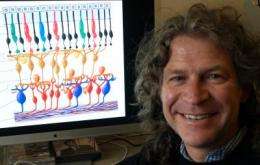
Richard Taylor, physics professor and director of the University of Oregon Material Science Institute, is leading an effort to design a fractal-based retinal implant to help return vision to the blind. Credit: Photo by Jim Barlow

(PhysOrg.com) -- University of Oregon researcher Richard Taylor is on a quest to grow flowers that will help people who've lost their sight, such as those suffering from macular degeneration, to see again.

These flowers are not roses, tulips or columbines. They will be nanoflowers seeded from nano-sized particles of metals that grow, or self assemble, in a natural process -- diffusion limited aggregation. They will be fractals that mimic and communicate efficiently with neurons.

Fractals are "a trademark building block of nature," Taylor says. Fractals are objects with irregular curves or shapes, of which any one component seen under magnification is also the same shape. In math, that property is self-similarity. Trees, clouds, rivers, galaxies, lungs and neurons are fractals, Taylor says. Today's commercial are not fractals, he adds.

Eye surgeons would implant these fractal devices within the eyes of blind patients, providing interface circuitry that would collect light captured by the retina and guide it with almost 100 percent efficiency to neurons for relay to the to process vision.

In an article titled "Vision of beauty" for Physics World, Taylor, a physicist and director of the UO Materials Science Institute, describes his envisioned approach and how it might overcome the problems occurring with current efforts to insert photodiodes behind the eyes. Current chip technology is limited, because it doesn't allow sufficient connections with neurons.

This video is not supported by your browser at this time.

Soundbite: Taylor's vision

"The wiring -- the neurons -- in the retina is fractal, but the chips are not fractal," Taylor says. "They are just little squares of electrodes that provide too little overlap with the neurons."

Beginning this summer, Taylor's doctoral student Rick Montgomery will begin a yearlong collaboration with Simon Brown at the University of Canterbury in New Zealand to experiment with various metals to grow the fractal flowers on implantable chips.

The idea for the project emerged as Taylor was working under a Cottrell Scholar Award he received in 2003 from the Research Corporation for Science Advancement. His vision is now beginning to blossom under grants from the Office of Naval Research (ONR), the U.S. Air Force and the National Science Foundation.

Taylor's theoretical concept for fractal-based photodiodes also is the focus of a U.S. patent application filed by the UO's Office of Technology Transfer under Taylor's and Brown's names, the UO and University of Canterbury.

The project, he writes in the article, is based on "the striking similarities between the eye and the digital camera."

"The front end of both systems," he writes, "consists of an adjustable aperture within a compound lens, and advances bring these similarities closer each year." Digital cameras, he adds, are approaching the capacity to capture the 127 megapixels of the human eye, but current chip-based implants, because of their interface, are only providing about 50 pixels of resolution.

Among the challenges, Taylor says, is determining which metals can best go into body without toxicity problems. "We're right at the start of this amazing voyage," Taylor says. "The ultimate thrill for me will be to go to a blind person and say, we're developing a chip that one day will help you see again. For me, that is very different from my previous research, where I've been looking at electronics to go into computers, to actually help somebody ... if I can pull that off that will be a tremendous thrill for me."

Taylor also is working under a Research Corp. grant to pursue fractal-based solar cells.

More information: http://physicsworl … ndepth/45840

Provided by University of Oregon search and more info website

Filter


Move the slider to adjust rank threshold, so that you can hide some of the comments.


Display comments: newest first

NANOBRAIN
May 06, 2011

Rank: not rated yet
YOUR GREAT! YOUR THE MAN!

NANOBRAIN!
PAUL KREBS
NANOBRAIN
May 06, 2011

Rank: not rated yet
VERY VERY GREAT!!
Cal_Sailor
May 06, 2011

Rank: not rated yet
Would this be able to work in a wider spectrum than just the visible range? Interesting. I hope it works.
Na_Reth
May 06, 2011

Rank: not rated yet
Would be interesting to add some UV spectrum, imagine the things you could see... Even better if you could turn it down or up...
Rank 5 /5 (9 votes)
Relevant PhysicsForums posts
  • The Global Positioning System !
    created1 hour ago
  • A Question relating Power
    created2 hours ago
  • Writing a book so im learning about things, i have some general questions please read
    created4 hours ago
  • Question about induced E field.
    created5 hours ago
  • Charging a capacitor in a tesla coil
    created5 hours ago
  • Water Rocket
    created9 hours ago
  • More from Physics Forums - General Physics

More news stories

Is a classical electrodynamics law incompatible with special relativity?

(Phys.org) -- The laws of classical electromagnetism that were developed in the 19th century are the same laws that scientists use today. They include Maxwell’s four equations along with the Lorentz la ...

Physics / General Physics

created May 24, 2012 | popularity 4.7 / 5 (15) | comments 40 | with audio podcast feature

Landmark calculation clears the way to answering how matter is formed

(Phys.org) -- An international collaboration of scientists, including Thomas Blum, associate professor of physics, is reporting in landmark detail the decay process of a subatomic particle called a kaon – ...

Physics / General Physics

created May 25, 2012 | popularity 4.2 / 5 (21) | comments 47 | with audio podcast

Lying in wait for WIMPs: Researchers seek to dramatically increase sensitivity of Large Underground Xenon detector

Although it's invisible, dark matter accounts for at least 80 percent of the matter in the universe. No one knows what it is, but most scientists would bet on weakly interacting massive particles, or WIMPs.

Physics / General Physics

created May 23, 2012 | popularity 4 / 5 (7) | comments 15 | with audio podcast

Hall effect at the speed of light: How can you demonstrate relativistic effects with your mobile phone?

The relativistic Hall effect describing objects rotating at speeds comparable with the speed of light has been reported.

Physics / General Physics

created May 21, 2012 | popularity 4.3 / 5 (3) | comments 8

Cloak of invisibility: Engineers use plasmonics to create an invisible photodetector

A team of engineers at Stanford and the University of Pennsylvania has for the first time used "plasmonic cloaking" to create a device that can see without being seen - an invisible machine that detects light. It is the first ...

Physics / General Physics

created May 21, 2012 | popularity 4.8 / 5 (16) | comments 7 | with audio podcast


Browser wars flare in mobile space

The browser wars are heating up again, but this time the fight is for dominance of the mobile Internet.

Scientist: Evolution debate will soon be history

(AP) -- Richard Leakey predicts skepticism over evolution will soon be history. Not that the avowed atheist has any doubts himself.

Dell tablet leak: 10.1-inch display, two-battery choice

(Phys.org) -- Headline after headline talks about vendors’ tablets in the wings as likely number-one contenders for the iPad. Such claims have justifiably been taken with a grain of salt, considering ...

SpotterRF debuts Radar Backpack Kit (w/ Video)

(Phys.org) -- SpotterRF has announced a special radar backpack kit designed to enhance situational awareness for soldiers on the ground. The company says its special radar is designed for warfighters as part ...

SpaceX capsule has 'new car' smell, astronauts say (Update)

SpaceX's Dragon cargo vessel smells like a new car, said astronauts at the International Space Station after opening the hatches Saturday following the spacecraft's landmark mission to the orbiting lab.

Thousands of shellfish found dead in Peru

Thousands of crustaceans were found dead off the coast of Lima following the mystery mass death of dolphins and pelicans, the Peruvian Navy said Friday.