Monkeys can play Monday morning quarterback too
May 25, 2011

Monkeys can play Monday morning quarterback too

Enlarge

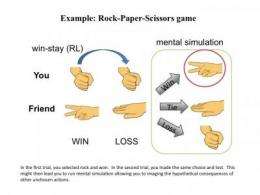
Yale researchers show that monkeys can make the same sort of "what if" mental notes that humans do, such as in this game of rock paper scissors. Credit: Courtesy of Yale University

Regret has long been viewed as an exclusively human thought, one which helps prevent us from repeating bad choices but becomes debilitating when it triggers obsessive thoughts about past actions.

Now a new study by Yale University researchers shows that monkeys also can be Monday morning quarterbacks and visualize alternative, hypothetical outcomes. The findings, reported in the May 26 issue of the journal Neuron, pinpoint areas of the brain where this process takes place and may give scientists new clues into how to treat diseases such as depression and schizophrenia.

"Regret serves us well most of the time, by helping us recognize choices that lead to bad outcomes," said Daeyeol Lee, professor of neurobiology at Yale School of Medicine and the Kavli Institute for Neuroscience and co-author of the study. "But sometimes regret can be very damaging."

Regret essentially is the ability to recognize that alternate courses of action could have led to more favorable outcome. For instance, someone who bought a home at the height of the envisions a better outcome if she or he had rented a home or moved to a healthier market. We don't only learn by being rewarded or punished for specific actions, the way many psychologists once believed, Lee noted.

"Our brain is wired to run these hypothetical simulations all the time," Lee said. "If you try to learn only from the actual outcomes of your own experience, this represents only a tiny fraction of information you can get from your world."

Lee and co-author Hiroshi Abe, in the Department of , recorded in as they played a modified game of rock-paper-scissors, receiving large juice rewards for winning games, smaller rewards for tying and nothing for losing. Monkeys were more likely in the subsequent round to pick the winning symbol in the previous game – for instance selecting paper if a rock smashed scissors. In other words, they were able to imagine a different outcome.

The Yale team also found that neural activity in the brain area known as the prefrontal cortex reflects both rational and emotional aspects of regret. One of its subdivisions is the dorsolateral prefrontal cortex, an area previously implicated for other complex cognitive functions, such as working memory, and the in this area signal what action would have led to a better outcome. By contrast, the orbitofrontal cortex, another region in the prefrontal cortex, focuses more on the emotional aspects of regret. Knowing the neural home of regret may help researchers find drugs to treat mental illnesses in which patients obsess over past decisions that have led to poor outcomes, Lee said. He also notes that hallucination common in the patients of schizophrenia – sometimes losing the ability to discriminate the sources of voices – may be caused by the loss of ability to learn from both actual and hypothetical outcomes simultaneously.

Provided by Yale University search and more info website

4.5 /5 (2 votes)  

Rank 4.5 /5 (2 votes)
Relevant PhysicsForums posts

More news stories

Scientist: Evolution debate will soon be history

(AP) -- Richard Leakey predicts skepticism over evolution will soon be history. Not that the avowed atheist has any doubts himself.

Biology / Evolution

created 11 hours ago | popularity 3.5 / 5 (11) | comments 26

Thousands of shellfish found dead in Peru

Thousands of crustaceans were found dead off the coast of Lima following the mystery mass death of dolphins and pelicans, the Peruvian Navy said Friday.

Biology / Ecology

created 21 hours ago | popularity 4.8 / 5 (4) | comments 6

More plant species responding to global warming than previously thought

(Phys.org) -- Far more wild plant species may be responding to global warming than previous large-scale estimates have suggested.

Biology / Ecology

created May 22, 2012 | popularity 4.6 / 5 (14) | comments 18 | with audio podcast

Totally rad: Scientists create rewritable digital data storage in DNA

(Phys.org) -- Scientists from Stanford's Department of Bioengineering have devised a method for repeatedly encoding, storing and erasing digital data within the DNA of living cells.

Biology / Biotechnology

created May 21, 2012 | popularity 4.9 / 5 (17) | comments 11 | with audio podcast

For monogamous sparrows, it doesn't pay to stray (but they do it anyway)

It's quite common for a female song sparrow to stray from her breeding partner and mate with the male next door, but a new study shows that sleeping around can be costly.

Biology / Plants & Animals

created May 22, 2012 | popularity 5 / 5 (1) | comments 7 | with audio podcast


Browser wars flare in mobile space

The browser wars are heating up again, but this time the fight is for dominance of the mobile Internet.

Dell tablet leak: 10.1-inch display, two-battery choice

(Phys.org) -- Headline after headline talks about vendors’ tablets in the wings as likely number-one contenders for the iPad. Such claims have justifiably been taken with a grain of salt, considering ...

SpotterRF debuts Radar Backpack Kit (w/ Video)

(Phys.org) -- SpotterRF has announced a special radar backpack kit designed to enhance situational awareness for soldiers on the ground. The company says its special radar is designed for warfighters as part ...

SpaceX capsule has 'new car' smell, astronauts say (Update)

SpaceX's Dragon cargo vessel smells like a new car, said astronauts at the International Space Station after opening the hatches Saturday following the spacecraft's landmark mission to the orbiting lab.

Australia hails surprise super-telescope decision

Australia has hailed a surprise decision giving it a role in a radio telescope project aimed at revolutionising astronomy, vowing to draw on its decades of experience in space science.

Astronomers seize last chance in lifetime for Venus Transit

Astronomers are gearing for one the rarest events in the Solar System: an alignment of Earth, Venus and the Sun that will not be seen for another 105 years.