Modern EU agriculture jeopardizes biodiversity in new member states
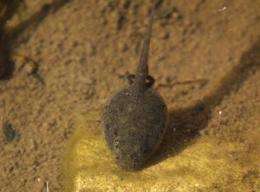
All in all, the scientists found 10 amphibian species in the surveyed ponds, including EU-wide protected species. Credit: Photo: Tilo Arnhold/ UFZ
Traditional agricultural practices can make a major contribution to preserving biodiversity in the EU's new member states in Central and Eastern Europe. By contrast, the construction of roads and the intensification of agriculture currently encouraged by EU farming subsidies pose a threat to amphibians. The rich natural environment still extant in many accession countries is under threat, according to scientists writing in the journal Biological Conservation.
The researchers from Romania, Germany and the Netherlands investigated amphibians for their study in the Romanian province of Transylvania. They spent nine years studying the populations of various species of newts, frogs and toads in 54 ponds and related their performance to nearby land use.
All in all, the scientists found 10 amphibian species in the surveyed ponds, including EU-wide protected species like the Great Crested Newt and the Yellow Bellied Toad. Statistical evaluation revealed that roads had the biggest impact on their populations. Other factors like the size of ponds, building development, farmland, pasture, woodland and marshlands proved to be far less important. "Roads have a direct negative effect on many species of amphibians, which can get run over by cars. But roads also have an indirect impact, for example by the destruction and isolation of the critical habitats for amphibians such as breeding, summering and overwintering habitats" explained Dr Tibor Hartel from Babeş-Bolyai University, Cluj-Napoca (Romania).
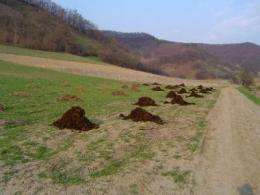
Instead of fertilizer manure is used in the fields around Malancrav in Transylvania .The comparatively extensive agriculture in the study region with little machinery and hardly any chemicals provides conditions which are still suitable for many amphibian species. Credit: Photo: Tibor Hartel/Babes-Bolyai University, Cluj-Napoca
The study area was the "Saxon area" of Southern Transylvania along the Târnava Mare basin in Romania. The agriculture is still largely traditional in this region, sometimes with little changes through the centuries. The landscape is dominated by pasture and deciduous forest, while the arable lands are small sized and scattered across the native grassland vegetation. Mankind's negative impact on biological diversity is statistically still far lower in Eastern Europe than in the West but this traditional cultural landscape and hence its unique biodiversity could soon disappear if agriculture were to be intensified. "We believe that the comparatively extensive agriculture in the study region with little machinery and hardly any chemicals provides conditions which are still suitable for many amphibian species," explains Dr Oliver Schweiger from UFZ.The findings could have important consequences for protective measures for amphibians in regions of Central and Eastern Europe, where farming has remained largely traditional. Preserving traditional, extensive land management could be the key factor in protecting these species. However, that could be a tough challenge, for many regions, joining the EU will lead to more intensive land use and infrastructure expansion. And that in turn will result in the fragmentation of the landscape and the general deterioration of the remaining habitats. Researchers are now calling for a balance to be struck between the legitimate desire for improved infrastructure and higher agricultural yields on the one hand and the beneficial effects of extensive land use on the other. In their view, this challenge should be regarded as an opportunity for Eastern Europe not to repeat the mistakes made in the West.
More information: Hartel T, Schweiger O, Öllerer K, Cogălniceanu D, Arntzen JW (2010). Amphibian distribution in a traditionally managed rural landscape of Eastern Europe: probing the effect of landscape composition. Biological Conservation 143: 1118. http://www.ufz.de/ … 01012444.pdf
Provided by
Helmholtz Association of German Research Centres
-
From lemons to lemonade: Reaction uses carbon dioxide to make carbon-based semiconductor,
32 comments
-
Thioridazine kills cancer stem cells in human while avoiding toxic side-effects of conventional cancer treatments,
3 comments
-
SpaceX private rocket blasts off for space station (Update),
42 comments
-
Climate scientists say they have solved riddle of rising sea,
31 comments
-
Research team claims to have found evidence Lake Cheko is impact crater for Tunguska Event,
18 comments
-
What would stain as translucent on light-coloured fabric?
12 hours ago
-
How do I identify different bacteria on culture plates?
22 hours ago
-
Why Do Dogs do Strange things...
May 25, 2012
-
What does exophillic and endophillic mean in terms of mosquito and their control?
May 24, 2012
-
Semen stains glows under black lights (uv light)?
May 23, 2012
-
Question on Human Chromosome 2
May 23, 2012
- More from Physics Forums - Biology
More news stories
Scientist: Evolution debate will soon be history
(AP) -- Richard Leakey predicts skepticism over evolution will soon be history. Not that the avowed atheist has any doubts himself.
11 hours ago |
3.5 / 5 (11) |
26
Thousands of shellfish found dead in Peru
Thousands of crustaceans were found dead off the coast of Lima following the mystery mass death of dolphins and pelicans, the Peruvian Navy said Friday.
21 hours ago |
4.8 / 5 (4) |
6
More plant species responding to global warming than previously thought
(Phys.org) -- Far more wild plant species may be responding to global warming than previous large-scale estimates have suggested.
May 22, 2012 |
4.6 / 5 (14) |
18
|
Totally rad: Scientists create rewritable digital data storage in DNA
(Phys.org) -- Scientists from Stanford's Department of Bioengineering have devised a method for repeatedly encoding, storing and erasing digital data within the DNA of living cells.
May 21, 2012 |
4.9 / 5 (17) |
11
|
For monogamous sparrows, it doesn't pay to stray (but they do it anyway)
It's quite common for a female song sparrow to stray from her breeding partner and mate with the male next door, but a new study shows that sleeping around can be costly.
May 22, 2012 |
5 / 5 (1) |
7
|
Browser wars flare in mobile space
The browser wars are heating up again, but this time the fight is for dominance of the mobile Internet.
Dell tablet leak: 10.1-inch display, two-battery choice
(Phys.org) -- Headline after headline talks about vendors tablets in the wings as likely number-one contenders for the iPad. Such claims have justifiably been taken with a grain of salt, considering ...
SpotterRF debuts Radar Backpack Kit (w/ Video)
(Phys.org) -- SpotterRF has announced a special radar backpack kit designed to enhance situational awareness for soldiers on the ground. The company says its special radar is designed for warfighters as part ...
SpaceX capsule has 'new car' smell, astronauts say (Update)
SpaceX's Dragon cargo vessel smells like a new car, said astronauts at the International Space Station after opening the hatches Saturday following the spacecraft's landmark mission to the orbiting lab.
Australia hails surprise super-telescope decision
Australia has hailed a surprise decision giving it a role in a radio telescope project aimed at revolutionising astronomy, vowing to draw on its decades of experience in space science.
Astronomers seize last chance in lifetime for Venus Transit
Astronomers are gearing for one the rarest events in the Solar System: an alignment of Earth, Venus and the Sun that will not be seen for another 105 years.
