Mini black holes that look like atoms could pass through Earth daily
May 13, 2011 by Lisa Zyga
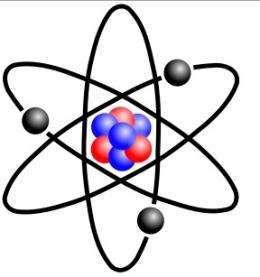
Similar to how electrons orbit an atomic nucleus without collapsing inward, mini black holes below a certain mass may cause surrounding matter to orbit without falling into the black hole. Image credit: Halfdan, Wikimedia Commons.
(PhysOrg.com) -- In a new study, scientists have proposed that mini black holes may interact with matter very differently than previously thought. If the proposal is correct, it would mean that the time it would take for a mini black hole to swallow the Earth would be many orders of magnitude longer than the age of the Universe.
In their paper, which is posted at arXiv.org, Aaron P. VanDevender from Halcyon Molecular in Redwood City, California, and J. Pace VanDevender from Sandia National Laboratories in Albuquerque, New Mexico, wanted to find a way to detect the mini black holes that are thought to exist in nature. Their calculations suggest that mini black holes may be passing through the Earth on a daily basis, and pose a very minimal threat to the planet.
Orbiting matter
Mini black holes are different than the ordinary astrophysical black hole in terms of how theyre formed and their size. Whereas astrophysical black holes are formed by the collapse of giant stars, mini black holes are thought to have formed during the Big Bang, which is why theyre also called primordial black holes. And while an astrophysical black hole has a minimum mass of 1030 kg, the mass of mini black holes range from the tiny Planck mass to trillions of kilograms or more, but are still much smaller than astrophysical black holes. (Although physics should allow for black holes of all sizes, scientists don't yet know of any mechanism that could produce objects in the intermediate range.) The expected mass of laboratory-produced mini black holes is on the small side, about 10-23 kg. Because of their extreme density, even the most massive mini black hole is microscopic in size.
The conventional view of a black hole is one of an object that is so dense that its powerful gravity pulls in all nearby matter past a critical point called the event horizon, from where it cannot escape. But the VanDevenders have suggested that something different happens with mini black holes with masses below 1012 kg. Instead of absorbing matter, these mini black holes may gravitationally bind matter, so that matter orbits the black holes at a certain distance. Because matter atoms orbiting a black hole due to gravity are reminiscent of the way that electrons orbit a nucleus due to electrostatic forces - both without collapsing inward - the physicists call this theoretical system the Gravitational Equivalent of an Atom (GEA).
Although this may seem purely theoretical, the concept could provide a way to test the current theory of how mini black holes age and die, called quantum evaporation. In this process, mini black holes lose mass until they eventually disappear. As they lose mass, they should produce X-rays. However, attempts to observe the X-ray signature of the final stages of evaporation have so far been unsuccessful. This lack of evidence suggests that either mini black holes were not created in large numbers as predicted, or that they do not evaporate.
Assuming the latter explanation, the VanDevenders propose that, instead of searching only for evaporation effects, researchers should search for evidence of the actual existence of the mini black holes, as well. If their theory of mini black holes as GEAs is correct, then the gravitationally bound matter in a GEA should produce emissions that could be detected with current detectors, even though the chance of detecting these emissions would be slim.
Quantum evaporation has been a major cornerstone of quantum gravity theories for three decades, yet it has never been experimentally confirmed, Aaron VanDevender told PhysOrg.com. Our study asks, what if small back holes do not evaporate? We have shown that if they do not evaporate, they may interact with matter and be detected. If we are able to observe such objects, it will have a significant impact on our understanding of black hole evaporation, and quantum gravity in general.
How a GEA works
In their paper, the researchers mathematically describe how a black hole can exist on Earth without consuming all of the surrounding mass. Such a mini black hole has constraints on its Schwarzschild radius, which is the closest an object can be to a black hole before it is absorbed, never to escape. Any object smaller than its Schwarzschild radius is a black hole. But because mini black holes with masses below 1012 kg are so small, they can have a Schwarzschild radius that is much smaller than the orbit of the gravitationally bound matter particles. As long as these matter particles stay beyond the mini black holes Schwarzschild radius, they will orbit rather than be absorbed. (Black holes with masses of 1012 kg have a Schwarzschild radius that equals the ground state radius at which the nearest matter particles orbit, so this mass is the upper limit for a GEA.) The researchers compare the GEAs risk of collapse with that of real atoms.
The concern that a terrestrial GEA might absorb the earth is similar to the early 20th century expectation that electrons orbiting a nucleus should radiate their energy away and fall into the nucleus, the researchers wrote in their study. Since the electron energy levels are quantized and the expectation value of the radius of the ground state is much larger than the radius of the nucleus, the probability of an electron being captured by the nucleus is vanishingly small. Similarly, particles of mass m are unlikely to fall into the black hole at the center of a GEA; however, those few that do could, in principle, provide energy for observable emissions.
Up close
The scientists calculated that mini black holes with a mass of about 100,000 kg may be of particular interest, since they could be candidates for dark matter. They estimated that, if dark matter is composed primarily of mini black holes and is evenly distributed throughout the galaxy, then about 40 million kg of mini black holes should pass through the Earth every year. The researchers calculated that about 400 mini black holes per year could be detectable through their strong electromagnetic emissions from their gravitationally bound matter.
If a particle on Earth approaches a GEA while its passing through the planet, the particle could either scatter off, be captured in orbit, or strip an already bound particle off. Due to the mini black holes high velocity compared to the binding energy required to capture a particle, the researchers predict that the mini black hole would quickly be stripped of its particles as it passes through the Earth. Therefore, the search for the emissions should be focused on space-based sources.
It would be difficult, but not impossible [to detect one of the mini black holes passing through the Earth], Aaron VanDevender said. The available power of a GEA to emit detectable radiation is small but not negligible. It would likely be substantially easier to observe a GEA in orbit around the Earth, rather than one that is passing through at a tremendous velocity. Also, the larger GEA will likely be much easier to detect, so it is worth focusing our observational efforts on objects in the range of 104 to 106 kg.
The researchers also noted that black holes created at the LHC would be too small and not have sufficient binding energy to bind matter into quantum orbitals that might emit detectable radiation.
In any case, according to this theory, mini black holes of any size would not absorb large amounts of matter very quickly. The scientists calculated that, for a black hole with a mass of 1 kg, it would take 1033 years to swallow the Earth. For comparison, the Universe is about 13.7 x 10⁹ years old. And for smaller black holes like those that might be formed at the LHC, the time it would take to absorb the Earth would be even longer.
More information: A. P. VanDevender and J. Pace VanDevender. Structure and Mass Absorption of Hypothetical Terrestrial Black Holes. arXiv:1105.0265v1 [gr-qc]
© 2010 PhysOrg.com
-
From lemons to lemonade: Reaction uses carbon dioxide to make carbon-based semiconductor,
32 comments
-
Thioridazine kills cancer stem cells in human while avoiding toxic side-effects of conventional cancer treatments,
3 comments
-
SpaceX private rocket blasts off for space station (Update),
42 comments
-
Climate scientists say they have solved riddle of rising sea,
31 comments
-
Research team claims to have found evidence Lake Cheko is impact crater for Tunguska Event,
18 comments
-
The Global Positioning System !
1 hour ago
-
A Question relating Power
2 hours ago
-
Writing a book so im learning about things, i have some general questions please read
4 hours ago
-
Question about induced E field.
5 hours ago
-
Charging a capacitor in a tesla coil
5 hours ago
-
Water Rocket
9 hours ago
- More from Physics Forums - General Physics
More news stories
Is a classical electrodynamics law incompatible with special relativity?
(Phys.org) -- The laws of classical electromagnetism that were developed in the 19th century are the same laws that scientists use today. They include Maxwell’s four equations along with the Lorentz la ...
Landmark calculation clears the way to answering how matter is formed
(Phys.org) -- An international collaboration of scientists, including Thomas Blum, associate professor of physics, is reporting in landmark detail the decay process of a subatomic particle called a kaon ...
May 25, 2012 |
4.2 / 5 (21) |
47
|
Lying in wait for WIMPs: Researchers seek to dramatically increase sensitivity of Large Underground Xenon detector
Although it's invisible, dark matter accounts for at least 80 percent of the matter in the universe. No one knows what it is, but most scientists would bet on weakly interacting massive particles, or WIMPs.
May 23, 2012 |
4 / 5 (7) |
15
|
Hall effect at the speed of light: How can you demonstrate relativistic effects with your mobile phone?
The relativistic Hall effect describing objects rotating at speeds comparable with the speed of light has been reported.
May 21, 2012 |
4.3 / 5 (3) |
8
Cloak of invisibility: Engineers use plasmonics to create an invisible photodetector
A team of engineers at Stanford and the University of Pennsylvania has for the first time used "plasmonic cloaking" to create a device that can see without being seen - an invisible machine that detects light. It is the first ...
May 21, 2012 |
4.8 / 5 (16) |
7
|
Browser wars flare in mobile space
The browser wars are heating up again, but this time the fight is for dominance of the mobile Internet.
Scientist: Evolution debate will soon be history
(AP) -- Richard Leakey predicts skepticism over evolution will soon be history. Not that the avowed atheist has any doubts himself.
Dell tablet leak: 10.1-inch display, two-battery choice
(Phys.org) -- Headline after headline talks about vendors tablets in the wings as likely number-one contenders for the iPad. Such claims have justifiably been taken with a grain of salt, considering ...
SpotterRF debuts Radar Backpack Kit (w/ Video)
(Phys.org) -- SpotterRF has announced a special radar backpack kit designed to enhance situational awareness for soldiers on the ground. The company says its special radar is designed for warfighters as part ...
SpaceX capsule has 'new car' smell, astronauts say (Update)
SpaceX's Dragon cargo vessel smells like a new car, said astronauts at the International Space Station after opening the hatches Saturday following the spacecraft's landmark mission to the orbiting lab.
Thousands of shellfish found dead in Peru
Thousands of crustaceans were found dead off the coast of Lima following the mystery mass death of dolphins and pelicans, the Peruvian Navy said Friday.
May 13, 2011
Rank: 1.6 / 5 (14)
May 13, 2011
Rank: 1.5 / 5 (22)
Mind blowing. What passes as science today is becoming indistinguishable from fantasy or simple madness.
May 13, 2011
Rank: 1 / 5 (11)
It would make sence of Gr, account for the Higgs, makes sence of the spin of electrons, dark energy, and makes sence of the reaction of atoms to absolut zero.
May 13, 2011
Rank: 5 / 5 (8)
May 13, 2011
Rank: 2.3 / 5 (12)
Nope. The event horizon is not the outer limit of the black hole's gravitational field, it is the surface of an imaginary sphere (it's not a point) surrounding the singularity of the hole which encloses the region of spacetime whose escape velocity is greater than the speed of light.
May 13, 2011
Rank: 4 / 5 (12)
Only because you dont understand it does not mean it is fantasy or madness.
May 13, 2011
Rank: 1.8 / 5 (16)
Why do you think I don't understand? It is because I am capable of reading and comprehending that I likened this to fantasy or madness.
May 13, 2011
Rank: 1.2 / 5 (58)
May 13, 2011
Rank: 4.7 / 5 (15)
What currently passes as a comment on an intellectual site is becoming increasingly indistinguishable from nonsense.
That being said, look at all the current technologies and tell me what about these technologies is fantasy? If seeing isn't believing, what is? Without modern physics much of what you now probably take for granted would not exist.
May 13, 2011
Rank: 5 / 5 (11)
Wow. Talk about completely failing to comprehend what was written. They're saying the event horizon is the place at which matter cannot escape the gravity, which is correct. They're not saying it's a "point" as in a single . And where exactly are they saying the event horizon is the limit of the black hole's gravitational field? Oh wait, they don't.
May 13, 2011
Rank: 1 / 5 (7)
Suggesting that atoms in orbit about a black hole would follow quantum rules (notably unspecified) is total fantasy. We think there may be primordial black holes. We have not detected any and have no reason to think that normal matter would follow quantum rules when in orbit about a black hole.
May 13, 2011
Rank: 5 / 5 (1)
Mind blowing. What passes as science today is becoming indistinguishable from fantasy or simple madness.
What currently passes as a comment on an intellectual site is becoming increasingly indistinguishable from nonsense.
That being said, look at all the current technologies and tell me what about these technologies is fantasy? If seeing isn't believing, what is? Without modern physics much of what you now probably take for granted would not exist"
I can only agree that some science facts are not well presented on the site, that aside. Some things are conceivable while some things aren't. So far they do not violate any known laws of physics. While i like to enjoy science fiction i say, welcome to a critical step forward to the synthesis of the hypothetical red matter of star trek. If Quantum orbital can be detected in the near future. Scientists may be able to created this phenomenon and expand the scale for military purposes.
May 13, 2011
Rank: 4.4 / 5 (7)
They also apparently post on physorg.
May 13, 2011
Rank: 1.1 / 5 (9)
May 13, 2011
Rank: 5 / 5 (5)
Please trevor, criticle reading skills. the article doesn't claim gravity stops anywhere. The point at which you cross the scharzschild raduis is the point where YOU cross it, the radius of the event horizon by definition is not a point.
@tabula - now I'm not going to debate whether the theoretical physics of black holes are correct. There are competing theories that are fundamentally different (But arrive at similar conclusions)
However the MOST accepted definition of a black hole is essentially a completely collapsed piece of matter (a singularity) I don't see how your point is valid?
May 13, 2011
Rank: 1 / 5 (4)
http://www.univer...-matter/
May 13, 2011
Rank: 1 / 5 (4)
May 14, 2011
Rank: 5 / 5 (1)
Why! The person on the other side of the conversation when using cell phones is a fantasy! Voice transmission using light thet you can't see! Good grief!
Light being emitted outta glass tubes is a fantasy! Pattern of dots stored as patterns of puny magnets on what looks like a rotating mirror is a fantasy. Don't you know? We've been had! These black and coloured shadows that look like words that you're reading is a fantasy! Wake up!
May 14, 2011
Rank: 3.6 / 5 (5)
Excuse me sir. A gentle thought. Just because you do not understand a concept does not make it madness or fantasy. I find this article quite straightforward and easy to understand. It is a simple extension of what we can expect from current models of the universe, and the big bang.
May 14, 2011
Rank: 5 / 5 (6)
That's always been true for quantum mechanics. If you think it makes sense you don't understand it. But read a book by Hofstadter: Gödel, Escher, Bach, an Eternal Golden Braid. It can be found on-line for download here: http://ebookee.or...611.html But you may want to buy it--if you can work through it in less than a year you either have a graduate math or computer science degree, or a lot of free time.
The type of programming I did before I retired ran right into
Gödel's Incompleteness Theorem. The idea that there are mathematical theorems that cannot be proven true or false doesn't phase many people. But the idea that the halting problem for computers can be stated and proved undecidable in less than a page is much more disturbing. That any compiler for any major programming language must have a bug in it is frightening.
May 14, 2011
Rank: 1 / 5 (4)
May 14, 2011
Rank: 4 / 5 (3)
A black hole with mass 10^5 kg is about 10^-23 metres in size. It'll pass right through without a hitch! Its tinier than the tiniest gamma ray photons. It might bust a DNA or two, though.
May 14, 2011
Rank: 5 / 5 (4)
May 14, 2011
Rank: 2 / 5 (6)
Here, they're proposing that particles will arbitrarily be gravitationally captured by a passing micro black hole.
Gravity doesn't work like that. A single gravitational body cannot capture another without a gravitational assist from at least one additional body. Even then, it's likely to be a highly elliptical and unstable orbit.
It's not like the particles have little rocket boosters on them to steer them into an orbit, or anything...
I mean seriously. Where are the physicists who really know physics?
May 14, 2011
Rank: 1 / 5 (1)
One guess goes like this: First, a point-shaped quark comes close enough to the minihole to get gravitationally captured if some third body (a confinement-partner perhaps) absorbs part of the joint angular momentum. An in-spiralling motion could then set in for the captured partner on a scale of 1027 cm. The circling charge would generate a strong magnetic field orthogonal to the disk. A nuclear electron could be magnetically attracted along the axis to stick close to the minihole during the time the quark circles down the upper part of the funnel after passing the Zeldovich threshold. During this period, the minihole would be effectively negatively charged attracting the next positively charged quark with a force 20 or 30 orders of magnitude stronger than its gravitational pull.
May 14, 2011
Rank: 2 / 5 (1)
Unless there spin increase by factors as they get smaller. ( angular momentum )
what other propertys of throretical micro black holes would change if there rotational speed increased. What would be the speed limit befefore it didnt/couldnt take on mater anymore.
May 14, 2011
Rank: 5 / 5 (2)
Good question, but not an insurmountable problem. If these GEA things [I would like to say "gravatom"] came into existence during the big bang then, within the first picosecond or so there would presumably have been vast numbers of quarks and what-have-you all the black holes. All those other things would have been slowing down from light speed, the breaking effect provided mostly by collisions with other particles. Thus plenty of opportunity for reverse sling shots to occur. Once a mini black hole had acquired one planeton [:)] this presumably would allow for further reverse slingshots at much later times after T-zero.
2 B cont ....
May 14, 2011
Rank: 3 / 5 (1)
As for elliptical orbits: good thinking, but by analogy with electron orbitals, potentially very many energy levels must be possible. These would be based on the various multiples of the wave length of the moving matter wave.
The authors gave a theoretical rough estimate of the upper mass limit for gravatoms but I can't see an estimate of their cross section - the Schwarzschild radius. I'm assuming this is much smaller than a quark-made nucleus but I have no way of working it out.
I say full marks to the authors for bringing this idea up. I can't believe they are the first to do so however. I mean I never thought of it even with having tried many times to imagine what a mini black hole eating the Earth would do.
Surely this gravatom line of thinking adds to the possible ways of reconciling QM with relativity?
Also, if these guys are right, it should produce predictions about the cosmic microwave background radiation.
May 14, 2011
Rank: 1 / 5 (4)
There may be a connection between these mini blackholes and human death.
Only time will tell. You heard it here first.
May 14, 2011
Rank: 1.2 / 5 (5)
How about neutrinos, etc..
May 14, 2011
Rank: 5 / 5 (3)
Seriously, I think some of you are simultaneously over thinking and underthinking this thing. Please read up on PBH or take the guy at his word that the idea could work in theory.
It is just a theory, and a testable theory. The physicist is just throwing it out there as a possibility, and is asking that the capable experiments do a check. Sorry you guys are so insulted by science trying to test the possibilities - even if they aren't the most probable ones.
@tabula - I personally don't see a need for a 5th force to allow for the existence of PBH. *But* it is a certainty that we are missing a lot of key information on black holes, singularities (If they exist as such), quantum forces, etc.
To debate if another force is needed for something that is hypothetical, based of physics theories that are still unproven (No one has actually looked inside any BH)...we just start at too many levels of assumptions for a meaningful exchange.
May 14, 2011
Rank: 3.5 / 5 (2)
Why did they forget to say they might not exist at all, such certainty is not science, but helps get funding.
rgds
James
May 14, 2011
Rank: 1.8 / 5 (6)
May 14, 2011
Rank: 5 / 5 (4)
There is strong theoretical support for PBH based on theories that have performed well in other areas. That's why scientists think there's a good chance they'll find them.
@tabula - true. It's just in this case we would have to build on several layers that already have a high chance of errors (theoretically speaking) - so it would get to the point that a conversation could be completely invalid for one of the theories underneath.
But, speaking of your fifth force, have you heard of the possibility of a discovery of it at the Tevatron?
But Mr. Oliver Manuel will tell us that it was his neutron repulsive force all along.
May 14, 2011
Rank: 1.8 / 5 (5)
Additionally, the binary MBH system's orbit would decay. And since the gravity gradient is rather steep, this should happen fairly quickly.
http://en.wikiped...al_decay
So, I just don't see how this hypothesis is viable. And I haven't even started on charged MBH's (should they exist) and such.
It's related to an old idea that some (or all) particles may be MBH's.
http://www.techno...v/23530/
So it's not exactly new.
May 15, 2011
Rank: 1 / 5 (1)
For a blackhole of appropriate size coupling with energy takes place. Energy flows in the blackholes space-time. Light bends around mass. Light actually doesn't bend it is the contorted space that is mass. Light travels straight but bending of space is mass so light goes straight around mass. Em energy with correct properties combines with correct mass to produce matter. Dark matter is uncoupled mass.
May 15, 2011
Rank: 1 / 5 (1)
Insufficiently suppressed waves survive blackhole interaction.
May 15, 2011
Rank: 5 / 5 (4)
May 15, 2011
Rank: 1.5 / 5 (4)
May 15, 2011
Rank: not rated yet
I was not particularly pointing to MBH binary systems although I did think of this. It is certainly possible that 'planetons' orbiting MBH binaries would quickly by swept up by one or other of the MBH or, more likely, slingshotted out. Once again we need details of the Schwarzschild radius of MBHs before we can say anything more.
My point about planeton capture was that the Big Bang conditions near T zero would have provided ample opportunities for quarks and/or electrons to be captured in orbits around MBHs. Later on such captures would be much rarer.
May 15, 2011
Rank: not rated yet
Another thing is that 'orbital decay' will only occur down to a "circumference" that fits in an integer multiple of the wave length of the planeton's matter wave. That I think is the underlying concept for their whole article. Perhaps, in time, all such gravatoms have a half life related to quantum indeterminacy and the possibility of the planeton tunneling its way into the MBH.
Re near circular orbits of planetary systems, I thought it was the effect of tidal deformation of the rotating planet and the rotating star which caused circularising of the planet's orbit. I mean the angular momentum of rotation of the two individual bodies is converted to angular momentum of the system; ie increase of orbital speed with most significant effect when the planet is at apogee because there it is moving slower so spends more time in that region of its orbital path.
May 15, 2011
Rank: 1 / 5 (2)
May 15, 2011
Rank: 1 / 5 (1)
Not at all. Within the event horizon the force of gravity is strong. Square law. About the singularity gravity is infinite. As we get further from the point of mass the strong force weakens. Take a single point and draw lines going through it. When an object is centered about the point all lines influence the object. Take the object and offset it. The further the object gets from the singular point the less lines intersect it. The influence of gravity is lessened with distance. What exactly is making you think that I overlooked the gravitational influence of a massive body? You're misinterpreting something I said.
May 15, 2011
Rank: 1 / 5 (1)
What I was illustrating was that if a particle or wave after compression was bigger in diameter or wave height than the diameter of the blackhole the blackhole would be unable to ingest it.
May 15, 2011
Rank: 1 / 5 (2)
There's the case where any random particle could be captured, which in turn can attract others - blowing the whole system apart - leading to a chain reaction of destruction.
The MBH is strictly dominant (it controls the orbitals and the system's momentum, the orbitals have no counter influence on it), it's inherently unstable as any disturbance will cause the MBH to shed its orbitals.
And, they might only exist as single entities. They cannot form, or be a part of, a molecular structure (as the MBH isn't captured by it's orbitals).
cont...
May 15, 2011
Rank: 1.8 / 5 (5)
And, they go on to state that it can't absorb anything beyond its event horizon (EH), which ignores the fact that gravity extends beyond the EH and therefore this statement is reliant on the case of sufficient angular momentum.
Sure, but the masses must be similar, rotating, and elastic. Do point particles and MBH's? meet these criteria?
May 16, 2011
Rank: not rated yet
May 16, 2011
Rank: not rated yet
May 16, 2011
Rank: 5 / 5 (1)
May 20, 2011
Rank: not rated yet
The event horizon isn't the only thing can kill you. Tidal forces would rip you in half for the billion kg + mini black holes.
Gravitational acceleration at 1 meter distance:
100,000kg object: A = 6.67E-6m/s^2
10,000,000kg object: A = 0.000667m/s^2.
1E9kg object: A = 0.0667m/s^2.
1E10kg object: A = 0.667m/s^2.
1E11kg object: A = 6.67m/s^2.
1E12kg object: A = 66.7m/s^2.
The Sun makes 0.00589 m/s^2 of acceleration on the Earth, and because the earth is far from the Sun's CoG, the solar tidal forces weak. Same goes for the moon.
May 20, 2011
Rank: 5 / 5 (1)
So even if this object passed 10m distance above your head, the tidal force between your head and feet, that is the difference in gravity, would be: 0.293m/s^2.
This is probably enough to break your back.
Worse, if it passed through your body, the tidal forces across distances of centimeters, decimeters, and 1 meter would liquify your organs (or for that matter steel or concrete too.)
1E12kg object @ 100m: A = 0.0667m/s^2
1E12kg object @ 1km: A = 0.000667m/s^2.
If a trillion kilogram micro black hole entered earth's atmosphere, it would produce a tsunami scale high tide below it as it falls through the lower atmosphere, and alter air pressure and gravity directly below it by so so much that water would boil at normal surface temperatures.
Below, I will show the tidal forces between different metric scales for a trillion kilogram point mass object passing through a body, or very near.
May 20, 2011
Rank: 1 / 5 (1)
Tidal force is the difference in gravity acceleration towards an object from one distance to another.
0.1nm: A = 6.67E21m/s^2
1nm: A = 6.67E19m/s^2
At this scale, the gravity acceleration directly is enough to break nuclear bonds or fuse adjacent atoms.
it has a gravity acceleration far higher than a neutron star's surface gravity.
1 micrometer: A = 6.67E13m/s^2
still similar to surface of a neutron star. Still fuse atoms to neutrons.
1 millimeter: A = 6.67E7m/s^2
1 centimeter: A = 6.67E5m/s^2 = 68,000g
Even if it passed outside your body, missing your skin by 1cm, you would be spaghettified.
10 centimeters: A = 6.67E3m/s^2 = 680 g.
Similar to the surface gravity of the Sun.
You would lose a limb, or would die if it passed within 10cm of your head or torso.
May 20, 2011
Rank: 1 / 5 (1)
Most people would be knocked unconscious and possibly suffer serious brain damage if it passed within 1 meter of your head or heart.
3.16 meter distance: A = 6.67m/s^2 = 0.68g.
Enough to knock most people to the ground within one second.
This range of encounter would derail trains, sink ships, knock aircraft out of the sky, break dams and levees and high rise buildings by changing their center of gravity, pulling them over under their own weight.
If this hit in a crowd, it could potentially kill several people instantly and injure several others severely through gravitational waves and direct tidal forces alone, not counting atmospheric compression waves, earthquakes, or tidal waves.
When it hits the earth, even if it never absorbs 1 atom into it's event horizon, it will rupture fault lines, magma chambers, wells, pipelines, dams, levees, bridges, landslides, etc.
May 20, 2011
Rank: 1 / 5 (1)
You would still be spaghettified from the indied out along a tubular path perhaps 1mm in radius.
If it's moving 20km/s that's 20,000m/s, which means if you are 2 meters tall, it would be from 0 to 1 meter distance for 1/20,000th of a second before and after impact. It would be from one end of your body to the other for 1/10,000th of a second.
You can see that if you apply 1/10,000 of a second to the acceleration numbers above, that would accelerate the surrounding matter within the 1mm range by 6670m/s (half earth's escape velocity.) This would rip a 1mm radius tube through your body inside out and literally eject some of it with enough velocity to reach the other side of the planet.
May 20, 2011
Rank: 1 / 5 (1)
Because of the insane gravity which would instantly obtain particle accelerator speeds for atoms orbiting it at the sub-millimeter radius range, the nuclear effects would be far reaching, and far greater than the gravitational effects.
As it entered teh atmosphere it would encounter a healthy supply of oxygen, nitrogen, carbon, hydrogen, which it will easil capture anything within 1 meter, and yank it down into the sub-millimeter range. Here, it will accelerate it to near light speeds and eventually collide it with other atoms, or directly fuse it to neutronium. This will release a continuous, gravity-sustained nuclear fireball into the atmosphere, which would be brighter than the sun, though not necessarily very large, as well as gamma rays and x-rays. If the black hole is moving at solar system or stellar velocities, then it will be in the atmosphere for about 20 to 40 seconds, depending on exact speed and approach angle.
May 21, 2011
Rank: 1 / 5 (2)
Your style seems familiar. Do/did you have another handle here?
Anyway, it's nice to see someone else actually understand there's more to a black hole than its event horizon.
May 21, 2011
Rank: 1 / 5 (1)
Almost everyone totally ignores the effects beyond the event horizon, because that has unfortunately become the main statistic tht scientists talk about.
The earth would still experiece a total gravitational collapse to neutronium and other exotic matter, even if not so much as one atom ever actually fell into the event horizon.
The accretion disks of micro black holes inside a dense atmosphere or solid body behave quite differently than the accretion disks of stellar black holes in relatively empty space for two reasons:
1) the "Surface" of the event horizon is so much smaller so that the material above it orbits the black hole a hundreds of billions of times per second.
2) The pressure gradient created by the vaccuum inside a given range smashes more matter into the gravity well due to normal Earth atmosperic or lithospere pressure dynamic
May 21, 2011
Rank: 1 / 5 (1)
1) When it hits the thermosphere, during the first few seconds it will begin compressing air into it's accretion disk, smashing it to neutronium and/or matter-anti-matter annihilations.
2) During the next few seconds, the back pressure created by the vaccuum caused by the gravitational compression would create a super-sonic pressure gradient at all layers of the atmosphere. This will created a pressure enhanced gravity vortex above and below the black hole, which will feed into the accretion disk at hypercane velocities, because of normal earth atmospheric dynamics.
An example of a normal pressure enhanced gravity vortex is when you flush a toilet. The drain is like the black hole, and the tank is like the atmosphere, and the pipe between the drain and the tank would be like the lift in the eye-wall of the hypercane.
May 21, 2011
Rank: 1 / 5 (1)
4) When the black hole hits the solid surface of the earth moving near earth escape velocity, it will be consuming around 10,000kg of soil per 1/10,000th of a second, converting it to neutronium and/or matter-anti-matter anihilations in the accretion disk. This will release energy equivalent of 5,000 to 10,000 Czar bombas PER 1/10,000th of a second, or 50 MILLION to 100 MILLION Czar Bombas PER second: Game over for all life.
May 22, 2011
Rank: not rated yet
May 22, 2011
Rank: 1 / 5 (1)
The answer to that is pretty obvious.
Once you have a mini-black hole, and regardless of whether quantum gravity orbitals exist, then whenever the mass in the quantum gravity orbitals plus the accretion disk reaches a certain threshold, this matter will develop an event horizon of it's own. At this point, all quantum gravity orbitals would be contained by an event horizon, and you would have an intermediate mass black hole.
A trillion kg micro-black hole, the escape velocity exceeds interstellar speeds at a super-scribed sphere about half micrometer from the CoG. This means the disk presented through which it would pass in the atmosphere is large enough that for every meter of propagation through atmoshere, the accretion disk would permanently pick up average of 471 nano-grams of air which could never escape.
May 22, 2011
Rank: 1 / 5 (1)
Based on density of soil or rock, the sphere of escape velocity >= 20km/s would ballistically collide with 4 milligrams of rock per meter propagation, or 50,000kg of material on a complete blow-through of the earth.
This material would ultimately end up in particle collisions inside the microscopic accretion disk.
Clearly the faster the black hole moves, the less material it would interact with, but even at 20km/s, it would pick up huge amounts of material in the accretion disk just outside the event horizon.