Mediterranean Sea invaded by alien species
May 23, 2011

Mediterranean Sea invaded by alien species

Enlarge

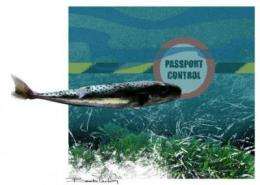
The poisonous pufferfish (Latin: Lagocephalus sceleratus) is one of the species that have invaded the coastal environments of the eastern Mediterranean Sea. Credit: Vangelis Pavlidis

More than 900 new alien species have been encountered in the coastal environments of the eastern Mediterranean Sea in recent decades, including the poisonous pufferfish. The invasion of alien species has had the consequence that the whole food chain is changing, while there is a lack of knowledge on which to base relevant risk assessments, a four-year study conducted at the University of Gothenburg shows.

"The Mediterranean is the world's most invaded sea, but our understanding of how affect ecosystems is inhibited by a lack of basic knowledge of the animal and plant communities on the coast. Once species have become established in the Mediterranean it is almost impossible to eradicate them," says Stefan Kalogirou of the Department of at the University of Gothenburg.

When the Suez Canal was completed in 1869, a corridor was created for the spread of alien species to the Mediterranean Sea, which is now undergoing great changes in animal and plant communities. In recent years, regular reports of alien species from several of the coastal environments of the eastern Mediterranean have caused concern over what will happen to indigenous species and ecosystems.

Over a period of four years Kalogirou, in cooperation with the Hellenic Centre for Marine Research, has studied the structure and function of in meadows and on sandy bottoms in two important coastal environments on the island of Rhodes in south-eastern Greece. This has provided important insights into invasion biology, that is to say possible of alien species in the food chain.

"The results show a clear when alien species either become dominant, like pufferfish, or are piscivores, like barracuda and cornetfish. It is evident that the food chain is being restructured, but the lack of previous studies limited our conclusions."

The poisonous pufferfish is one of the alien species that have recently been introduced. The pufferfish toxin, tetrodotoxin, causes muscle paralysis, which can lead to respiratory arrest. In the worst case the outcome can be fatal. In the coastal environments that Kalogirou has studied, the pufferfish has become a dominant species, which has led to both ecological and social effects.

"There does seem to be an awareness at the European level of how quickly species spread into new areas, but there is a lack of basic knowledge of monitoring methodology, specific life characteristics of alien species and . The impact of alien species, known as biological contamination, is something that must be taken into account in environmental impact assessments,"Kaligirou notes.

Provided by University of Gothenburg search and more info website

4.5 /5 (2 votes)  

Rank 4.5 /5 (2 votes)
Relevant PhysicsForums posts

More news stories

Scientist: Evolution debate will soon be history

(AP) -- Richard Leakey predicts skepticism over evolution will soon be history. Not that the avowed atheist has any doubts himself.

Biology / Evolution

created 11 hours ago | popularity 3.5 / 5 (11) | comments 26

Thousands of shellfish found dead in Peru

Thousands of crustaceans were found dead off the coast of Lima following the mystery mass death of dolphins and pelicans, the Peruvian Navy said Friday.

Biology / Ecology

created 21 hours ago | popularity 4.8 / 5 (4) | comments 6

More plant species responding to global warming than previously thought

(Phys.org) -- Far more wild plant species may be responding to global warming than previous large-scale estimates have suggested.

Biology / Ecology

created May 22, 2012 | popularity 4.6 / 5 (14) | comments 18 | with audio podcast

Totally rad: Scientists create rewritable digital data storage in DNA

(Phys.org) -- Scientists from Stanford's Department of Bioengineering have devised a method for repeatedly encoding, storing and erasing digital data within the DNA of living cells.

Biology / Biotechnology

created May 21, 2012 | popularity 4.9 / 5 (17) | comments 11 | with audio podcast

For monogamous sparrows, it doesn't pay to stray (but they do it anyway)

It's quite common for a female song sparrow to stray from her breeding partner and mate with the male next door, but a new study shows that sleeping around can be costly.

Biology / Plants & Animals

created May 22, 2012 | popularity 5 / 5 (1) | comments 7 | with audio podcast


Browser wars flare in mobile space

The browser wars are heating up again, but this time the fight is for dominance of the mobile Internet.

Dell tablet leak: 10.1-inch display, two-battery choice

(Phys.org) -- Headline after headline talks about vendors’ tablets in the wings as likely number-one contenders for the iPad. Such claims have justifiably been taken with a grain of salt, considering ...

SpotterRF debuts Radar Backpack Kit (w/ Video)

(Phys.org) -- SpotterRF has announced a special radar backpack kit designed to enhance situational awareness for soldiers on the ground. The company says its special radar is designed for warfighters as part ...

SpaceX capsule has 'new car' smell, astronauts say (Update)

SpaceX's Dragon cargo vessel smells like a new car, said astronauts at the International Space Station after opening the hatches Saturday following the spacecraft's landmark mission to the orbiting lab.

Australia hails surprise super-telescope decision

Australia has hailed a surprise decision giving it a role in a radio telescope project aimed at revolutionising astronomy, vowing to draw on its decades of experience in space science.

Astronomers seize last chance in lifetime for Venus Transit

Astronomers are gearing for one the rarest events in the Solar System: an alignment of Earth, Venus and the Sun that will not be seen for another 105 years.