Matter-matter entanglement at a distance
May 27, 2011 By Olivia Meyer-Streng

Matter-matter entanglement at a distance

Enlarge

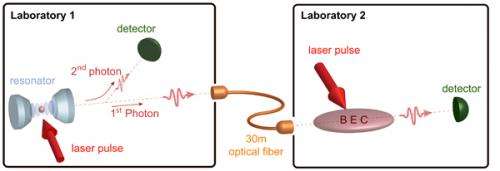
A single atom and a BEC in two separate laboratories serve as nodes in a basic quantum network. To prepare entanglement between these systems, a laser pulse is used to stimulate the atom to emit a single photon which is entangled with the single atom. The photon is used to transport the entanglement through an optical fibre into a neighbouring laboratory. Here, the photon is stored in the BEC. This procedure establishes entanglement between the single atom and the BEC. After some delay, the photon is retrieved from the BEC and the state of the single atom is mapped onto a second photon. The observation of entanglement between these two photons proves that all steps of the experiment were performed successfully.

(PhysOrg.com) -- Scientists at the Max Planck Institute of Quantum Optics prepare quantum mechanical entanglement of two remote quantum systems.

Because of its strange consequences the quantum mechanical phenomenon of has been called “spooky action at a distance” by Albert Einstein. For several years physicists have been developing concepts how to use this phenomenon for practical applications such as absolutely safe data transmission. For this purpose, the entanglement which is generated in a local process has to be distributed among remote quantum systems. A team of scientists around Prof. Gerhard Rempe, Director at the Max Planck Institute of and head of the Quantum Dynamics Division, has now demonstrated that two remote atomic quantum systems can be prepared in a shared “entangled” state (Physical Review Letters, Advance Online Publication, 26 May 2011): one system is a single atom trapped in an optical resonator, the other one a Bose-Einstein condensate consisting of hundreds of thousands of ultracold atoms. With the hybrid system thus generated, the researchers have realized a fundamental building block of a quantum network.
 
In the quantum mechanical phenomenon of “entanglement” two quantum systems are coupled in such a way that their properties become strictly correlated. This requires the particles to be in close contact. For many applications in a quantum network, however, it is necessary that entanglement is shared between two remote nodes (“stationary” quantum bits). One way to achieve this is to use photons (“flying” quantum bits) for transporting the entanglement. This is somewhat analogous to classical telecommunication, were light is used to transmit information between computers or telephones. In the case of a quantum network, however, this task is much more difficult as entangled quantum states are extremely fragile and can only survive if the particles are well isolated from their environment.
 
The team of Professor Rempe has now taken this hurdle by preparing two atomic quantum systems located in two different laboratories in an entangled state: on the one hand a single rubidium atom trapped inside an optical resonator formed by two highly reflective mirrors, on the other hand an ensemble of hundreds of thousands of ultracold rubidium atoms which form a Bose Einstein condensate (BEC). In a BEC, all particles have the same quantum properties so that they all act as a single “superatom”.
 
First, a laser pulse stimulates the single atom to emit a single photon. In this process, internal degrees of freedom of the atom are coupled to the polarisation of the photon, so that both particles become entangled. The photon is transported through a 30 m long optical fibre into a neighbouring laboratory where it is directed to the BEC. There, it is absorbed by the whole ensemble. This process converts the photon into a collective excitation of the BEC. “The exchange of quantum information between photons and atomic quantum systems requires a strong light-matter interaction”, explains Matthias Lettner, a doctoral student working on the experiment. “For the single atom, we achieve this by multiple reflections between the two resonator mirrors, whereas for the BEC the light-matter interaction is enhanced by the large number of atoms.”
 
In a subsequent step, the physicists prove that the single atom and the BEC are really entangled. To this end, the photon absorbed in the BEC is retrieved with the help of a laser pulse and the state of the single atom is read out by generating a second photon. The entanglement of the two photons reaches 95 % of the maximally possible value, thus showing that the entanglement of the two atomic must have been equally good, or even better. Moreover, the entanglement is detectable for approximately 100 microseconds.
 
“A BEC is very well suited as a quantum memory because this exotic state does not suffer from any disturbances caused by thermal motion”, says Matthias Lettner. “This makes it possible to store and retrieve quantum information with high efficiency and to conserve this state for a long time.”
 
In this experiment, the team of Professor Rempe has realized a building block for a quantum network consisting of two remote, entangled, stationary nodes. This is a milestone on the way to large-scale quantum networks in which, for example, quantum information can be transmitted absolutely safe. In addition, such networks might help realizing a universal quantum computer in which quantum bits can be exchanged with photons between nodes designed for information storage and processing.

More information: M. Lettner, et al., “Remote Entanglement between a Single Atom and a Bose-Einstein Condensate,” Physical Review Letters, Advance Online Publication, 26 May 2011. DOI:10.1103/PhysRevLett.106.210503

Abstract
Entanglement between stationary systems at remote locations is a key resource for quantum networks. We report on the experimental generation of remote entanglement between a single atom inside an optical cavity and a Bose-Einstein condensate (BEC). To produce this, a single photon is created in the atom-cavity system, thereby generating atom-photon entanglement. The photon is transported to the BEC and converted into a collective excitation in the BEC, thus establishing matter-matter entanglement. After a variable delay, this entanglement is converted into photon-photon entanglement. The matter-matter entanglement lifetime of 100  μs exceeds the photon duration by 2 orders of magnitude. The total fidelity of all concatenated operations is 95%. This hybrid system opens up promising perspectives in the field of quantum information.

Provided by Max-Planck-Gesellschaft search and more info website

4.4 /5 (15 votes)  

Filter


Move the slider to adjust rank threshold, so that you can hide some of the comments.


Display comments: newest first

Unquantum
May 27, 2011

Rank: 2 / 5 (7)
It helps to define BEC, Bose Einstein Condensate. This is an empty article and explains nothing. Their "photon" source does NOT emit single pairs of "your photons." Very misleading. I disproved the photon model in 2003 by splitting the gamma-ray to make a single gamma go to two detectors in coincidence. To find my work all you need is "unquantum."
holoman
May 27, 2011

Rank: 1 / 5 (1)
Controlling Gamma Rays, rigggggght, not.
Na_Reth
May 27, 2011

Rank: 1 / 5 (4)
Uhm how exactly does this prove entanglement? What state of a photon? how does a photon entangle with an atom?
What a load of nonsense... care to explain it to me if i am missing something here?
yogurtforthesoul
May 28, 2011

Rank: not rated yet
Start at qubits and then theory then entanglement. Realize it may be a force. Terse, deal.
AnneOminous
May 28, 2011

Rank: not rated yet
It isn't a very good article, as the first commenter pointed out by saying "What is a BEC?"

On the other hand, I don't think his other objections are very coherent with reality. But I won't make judgment yet... I have found the website and I will read further before commenting on any unusual claims.

There are a lot of missing pieces to this article. I think we can all agree on that.

kevinrtrs
May 28, 2011

Rank: 3 / 5 (2)
Either the writer of the article is unsure how to present a difficult topic - or one s/he has difficulty understanding and therefore cannot convey it OR the researchers want to keep their methods secret for later commercial exploitation. Take your pick.
dzifo
Jun 01, 2011

Rank: not rated yet
Found the article on arXiv. I really do not understand why it is considered matter-matter entanglement. It seems like photon-photon entanglement. BEC serves only as memory, no measurement is performed on it.

Magnette
Jun 29, 2011

Rank: not rated yet
As an amateur and an engineer not a scientist trying to self learn this subject could somebody suggest a starting point for reading?
The articles that I've been reading on here and other sites are becoming just plain confusing with conflicting information.
Rank 4.4 /5 (15 votes)
Relevant PhysicsForums posts
  • eyeglasses with smallest chromatic abberation
    created1 hour ago
  • Linear momentum converted to angular momentum?!
    created1 hour ago
  • Physics laboratory project - bumpers/crash tests
    created1 hour ago
  • How to open a winebottle with a shoe
    created1 hour ago
  • magnetic field from stream of protons
    created11 hours ago
  • Force on a particle constrained to move on the surface of a sphere
    created12 hours ago
  • More from Physics Forums - Classical Physics

More news stories

Is a classical electrodynamics law incompatible with special relativity?

(Phys.org) -- The laws of classical electromagnetism that were developed in the 19th century are the same laws that scientists use today. They include Maxwell’s four equations along with the Lorentz la ...

Physics / General Physics

created May 24, 2012 | popularity 4.7 / 5 (15) | comments 40 | with audio podcast feature

Landmark calculation clears the way to answering how matter is formed

(Phys.org) -- An international collaboration of scientists, including Thomas Blum, associate professor of physics, is reporting in landmark detail the decay process of a subatomic particle called a kaon – ...

Physics / General Physics

created May 25, 2012 | popularity 4.2 / 5 (21) | comments 47 | with audio podcast

Lying in wait for WIMPs: Researchers seek to dramatically increase sensitivity of Large Underground Xenon detector

Although it's invisible, dark matter accounts for at least 80 percent of the matter in the universe. No one knows what it is, but most scientists would bet on weakly interacting massive particles, or WIMPs.

Physics / General Physics

created May 23, 2012 | popularity 4 / 5 (7) | comments 15 | with audio podcast

Hall effect at the speed of light: How can you demonstrate relativistic effects with your mobile phone?

The relativistic Hall effect describing objects rotating at speeds comparable with the speed of light has been reported.

Physics / General Physics

created May 21, 2012 | popularity 4.3 / 5 (3) | comments 8

Cloak of invisibility: Engineers use plasmonics to create an invisible photodetector

A team of engineers at Stanford and the University of Pennsylvania has for the first time used "plasmonic cloaking" to create a device that can see without being seen - an invisible machine that detects light. It is the first ...

Physics / General Physics

created May 21, 2012 | popularity 4.8 / 5 (16) | comments 7 | with audio podcast


Browser wars flare in mobile space

The browser wars are heating up again, but this time the fight is for dominance of the mobile Internet.

Scientist: Evolution debate will soon be history

(AP) -- Richard Leakey predicts skepticism over evolution will soon be history. Not that the avowed atheist has any doubts himself.

Dell tablet leak: 10.1-inch display, two-battery choice

(Phys.org) -- Headline after headline talks about vendors’ tablets in the wings as likely number-one contenders for the iPad. Such claims have justifiably been taken with a grain of salt, considering ...

SpotterRF debuts Radar Backpack Kit (w/ Video)

(Phys.org) -- SpotterRF has announced a special radar backpack kit designed to enhance situational awareness for soldiers on the ground. The company says its special radar is designed for warfighters as part ...

SpaceX capsule has 'new car' smell, astronauts say (Update)

SpaceX's Dragon cargo vessel smells like a new car, said astronauts at the International Space Station after opening the hatches Saturday following the spacecraft's landmark mission to the orbiting lab.

Thousands of shellfish found dead in Peru

Thousands of crustaceans were found dead off the coast of Lima following the mystery mass death of dolphins and pelicans, the Peruvian Navy said Friday.