Massive hydroelectric project faces test in Chile
May 9, 2011 by Roser Toll

Chile's hydroelectric project will join existing energy sources

Enlarge

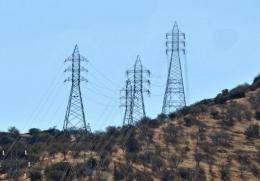
Electricity towers such as these in Santiago in 2008 will work with a new hydroelectric power system to help meet Chile's growing energy needs. Chile's $3.2 billion hydroelectric project -- seen as a key to new development in the South American nation but questioned for its environmental impact -- faces a key test this week.

A $3.2 billion hydroelectric project billed as key to satisfying Chile's growing energy needs faces a major hurdle Monday as an environmental panel decides whether or not to give it the green light.

The HidroAysen project would see the construction of five hydroelectric power stations, two along the Baker River and three on the Pascua River, in an area some 1,600 kilometers (1,000 miles south of Santiago).

Under consideration for 50 years, it would generate 2.75 of electricity -- or 20 percent of current capacity -- to help meet Chile's energy needs, which are expected to increase 80 percent by 2025.

Approval by the regional environmental panel is widely expected despite stiff opposition from green activists seeking to protect the Patagonia region.

The paths used for some 2,000 kilometers (1,200 miles) of power cables and towers would still be subject to a separate environmental review and could require another $4.0 billion dollars in investment.

A coalition called "Chilean Patagonia Without Dams" contends the project is unnecessary and would endanger pristine forests in a region that includes widely admired and lakes.

The opponents claim that the project would disfigure of Patagonia, with the flooding of some 5,900 hectares (14,000 acres).

They argue that the energy would be used mainly for the mining sector, that the environmental review has been inadequate, and that Chile would do better with less damaging such as solar and wind.

One poll in April showed 61 percent of Chileans opposed the project, but the consortium of Chile's Endesa and the Spanish firm Colbun SA has launched its own public relations effort, claiming the project would produce clean, renewable energy that would reduce demand for imported .

Opponents plan marches against the project and may file appeals if it wins approval, a spokesman said.

But President Sebastian Pinera said the country, which is seeing economic growth estimated at 6.5 percent and has had to ration electricity, has few better alternatives, especially with nuclear power being reconsidered in the wake of the disaster in Japan.

"If HidroAysen is approved it would be 100 percent in compliance with environmental legislation," Pinera said over the weekend. "If we don't have hydroelectric , there will be more coal-fired power plants."

(c) 2011 AFP

Filter


Move the slider to adjust rank threshold, so that you can hide some of the comments.


Display comments: newest first

Quantum_Conundrum
May 09, 2011

Rank: 5 / 5 (1)
They argue that the energy would be used mainly for the mining sector, that the environmental review has been inadequate, and that Chile would do better with less damaging energy sources such as solar and wind.


No they can't.

Even with solar boilers, it would cost about DOUBLE that figure just in materials alone, not counting buying, clearing, and leveling a patch of land of 2.6km by 2.6km, etc, in order to be able to produce the equivalent of round the clock 2.75gigawatts power.

The activists are unreasonable. Not even renewable energy is "perfect" for everyone and everything. "Something" has to give.

They don't want coal or hydrocarbons.
They don't want nuclear.

"Ok, we'll make a dam. One time build plus some maintenance, and the 'fuel' is free in the form of gravitational potential..."

Wait, the environmentalists don't want hydroelectric...

The price of wind turbines to do the same job is around $8 billion, with only a 30 year lifetime...
Quantum_Conundrum
May 09, 2011

Rank: 5 / 5 (1)
Not counting that if you did wind turbines, that is the least energy dense option, and therefore requires the power company to buy or lease even more land, about ten times as much land as would be needed for Solar actually.

the price of transmisson lines will be about the same for each project, but slightly more for solar, and the most for wind...

so for the primary systems you have:

$3.2 billion for a 50 year dam.

or

$6.5 billion for a huge 30 year solar trough plant

or

$8 billion for about 20 square miles worth of wind turbines which will last 30 years.
unknownorgin
May 10, 2011

Rank: not rated yet
It is the same old story, everyone fighting the dam uses electrical power and none of them would go back to living in a hut in the jungle. They always claim there will be environmental damage but show me a dam site that has no wildlife ,trees ect. It is really all about stopping progress.
Rank not rated yet
Relevant PhysicsForums posts

More news stories

Browser wars flare in mobile space

The browser wars are heating up again, but this time the fight is for dominance of the mobile Internet.

Technology / Software

created 2 minutes ago | popularity not rated yet | comments 0

SpotterRF debuts Radar Backpack Kit (w/ Video)

(Phys.org) -- SpotterRF has announced a special radar backpack kit designed to enhance situational awareness for soldiers on the ground. The company says its special radar is designed for warfighters as part ...

Technology / Hi Tech & Innovation

created 21 hours ago | popularity 5 / 5 (5) | comments 12 | with audio podcast report

Probability of contamination from severe nuclear reactor accidents is higher than expected: study

Catastrophic nuclear accidents such as the core meltdowns in Chernobyl and Fukushima are more likely to happen than previously assumed. Based on the operating hours of all civil nuclear reactors and the number ...

Technology / Energy & Green Tech

created May 22, 2012 | popularity 3.6 / 5 (21) | comments 56 | with audio podcast

Delphi gasoline-injection engine technique rivals hybrid's edge

(Phys.org) -- Running a diesel like engine on gasoline is something Delphi is doing in notable fashion. They claim they are on to a promising way to enjoy an engine that gives the vehicle owner high efficiency ...

Technology / Energy & Green Tech

created May 21, 2012 | popularity 4.7 / 5 (18) | comments 38 | with audio podcast report

HyperSolar shows dirty water no barrier to power world

(Phys.org) -- The Santa Barbara, California, company, HyperSolar, is set to transparently share the ups and downs of its research experiences toward the company’s ultimate vision, successfully producing ...

Technology / Energy & Green Tech

created May 24, 2012 | popularity 4.8 / 5 (15) | comments 17 | with audio podcast report


Scientist: Evolution debate will soon be history

(AP) -- Richard Leakey predicts skepticism over evolution will soon be history. Not that the avowed atheist has any doubts himself.

Dell tablet leak: 10.1-inch display, two-battery choice

(Phys.org) -- Headline after headline talks about vendors’ tablets in the wings as likely number-one contenders for the iPad. Such claims have justifiably been taken with a grain of salt, considering ...

SpaceX capsule has 'new car' smell, astronauts say (Update)

SpaceX's Dragon cargo vessel smells like a new car, said astronauts at the International Space Station after opening the hatches Saturday following the spacecraft's landmark mission to the orbiting lab.

Thousands of shellfish found dead in Peru

Thousands of crustaceans were found dead off the coast of Lima following the mystery mass death of dolphins and pelicans, the Peruvian Navy said Friday.

Australia hails surprise super-telescope decision

Australia has hailed a surprise decision giving it a role in a radio telescope project aimed at revolutionising astronomy, vowing to draw on its decades of experience in space science.

Astronomers seize last chance in lifetime for Venus Transit

Astronomers are gearing for one the rarest events in the Solar System: an alignment of Earth, Venus and the Sun that will not be seen for another 105 years.