Massey scientist's software finds 'orphan' planets
May 19, 2011
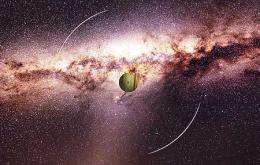
A computer generated image of a microlensing event.

Software developed by a Massey University computer scientist and astrophysicist has led to the discovery of free-floating ‘orphan’ planets – once the subject of science fiction.

Dr. Ian Bond, based at the Institute of Information and Mathematical Sciences in Albany, says the discovery has major implications for understanding the dynamics of solar systems. He has analysed data from telescopic camera recordings by a 1.8 metre telescope at Mount John University observatory at Lake Tekapo. It has captured variations in the brightness of some 50 million stars in the Milky Way galaxy.

He is part of an international astronomy study called MOA (Microlensing Observations in Astrophysics) involving researchers from Massey, Auckland, Canterbury and Victoria Universities, as well as from Japan and the United States. The study found evidence of ten Jupiter-sized free floating gas giant , also described as “orphan” or “rogue” planets, that are not believed to be orbiting stars. A report on the discovery has just been published in the latest Nature online science journal. The article is titled Unbound or distant planetary mass population detected by gravitational microlensing.

This video is not supported by your browser at this time.

“It’s a big deal. It’s like finding a needle in a haystack – the sense of discovery is hugely exciting,” Dr. Bond says.

The discovery has led to speculation that smaller, Earth-sized free-floating planets – yet to be detected –may be more common than stars, and that Earth may have a long-lost ‘sibling’ once part of our solar system. Study authors say drifting, stray planets are likely to have been “ejected” from solar systems because of close gravitational encounters with other planets or stars. Another scenario is that they form like brown dwarf stars, and are labelled “sub-brown dwarfs”, which are thought to grow from collapsing balls of gas and dust but without the mass to ignite their nuclear fuel and produce their own starlight.

Dr. Bond is the principal investigator for the study, which was initiated by Auckland University physicist Associate Professor Philip Yock. Fellow collaborators are Canterbury University Professor of Astronomy John Hearnshaw and Victoria University Professor of Physics Denis Sullivan.

Computer software to process 50 gigabytes of images per night can analyse and chart gravitational microlensing events – the distortion and observable magnification of a star’s brightness when another planetary body passes in front of it. Variations in the timing and duration of microlensing patterns led to the discovery, he says.

Gravitational microlensing is an astronomical phenomenon which allows the study of planetary bodies that emit little or not light, and refers to the bending of light, first discussed by Albert Einstein in 1915, that occurs when a distant star gets aligned with a massive foreground object.

“The microlensing effect is very recognisable,” says Dr. Bond. “The time scale of a lensing effect depends on the mass of the lens [planetary body]. If the ‘lens’ is a star, it takes 10 to 20 days to pass in front of the star, and if it's a planet, it’s a much shorter time.”

He has detected around 3000 microlensing events since 2006, and analysed 500 of them. The MOA study focuses on a segment of roughly 50 million stars at the centre of the Milky Way, which are 25,000 light years away and are a fragment of the estimated 100-400 billion and 50 billion planets in the galaxy.

Explore further: Detection of the cosmic gamma ray horizon: Measures all the light in the universe since the Big Bang

add to favorites email to friend print save as pdf

Related Stories

Catch a new planet

Jul 01, 2008

Is there anybody out there? Could the Universe contain lots of other planets like ours? Are there new worlds yet to be discovered?

First four exoplanet systems imaged

Dec 13, 2010

Among one of the first exoplanet systems imaged was HR 8799. In 2008, a team led by Christian Marois at the Herzberg Institute of Astrophysics in Canada, took a picture of the system directly imaging three ...

T-dwarf stars finally reveal their mysterious secrets

Nov 23, 2010

Astronomers have recently discovered an exotic star system which has shed some light on the mass and age of one of the systems rare stellar components. Using data from World’s largest optical telescope, ...

Recommended for you

Galaxies fed by funnels of fuel

8 hours ago

(Phys.org) —Computer simulations of galaxies growing over billions of years have revealed a likely scenario for how they feed: a cosmic version of swirly straws.

Hubble reveals the ring nebula's true shape

May 23, 2013

(Phys.org) —The Ring Nebula's distinctive shape makes it a popular illustration for astronomy books. But new observations by NASA's Hubble Space Telescope of the glowing gas shroud around an old, dying, ...

User comments : 5

Adjust slider to filter visible comments by rank

Display comments: newest first

omatumr
3 / 5 (4) May 19, 2011
Massey scientist's software finds 'orphan' planets"


If 'orphan' planets actually exist, that will be a major discovery.

However many scientists may doubt software findings, unless there is observational evidence too.

With kind regards,
Oliver K. Manuel
Former NASA Principal
Investigator for Apollo
Greene
4 / 5 (1) May 19, 2011
Given the definition of a planet that the astronomers came up with that eliminated Pluto as a planet, can we truly call these objects "planets"? Guess they will have to come up with another stupid definition.
Greene
not rated yet May 19, 2011
What do you call a rogue planet? How about a generation starship. Catch a ride with one in a large orbiting space station/ship and use that gas giant's atmosphere as fuel for your fusion reactors to keep warm and wait until you pass another star. Think about it!
eachus
5 / 5 (1) May 19, 2011
What do you call a rogue planet? How about a generation starship. Catch a ride with one in a large orbiting space station/ship and use that gas giant's atmosphere as fuel for your fusion reactors to keep warm and wait until you pass another star. Think about it!


Sorry, I keep thinking about all the kids in the back seat asking, "Are we there yet?"
RobertKarlStonjek
not rated yet May 20, 2011
Would we let the inhabitants of an Earth-like rogue planet drawn toward our sun and bound to collide with it settle here?
Well, if the highest form of life on that planet was the chicken then I guess the answer is greatly compounded ~ how long before an intelligent talking chicken pickets KFC???

More news stories

Galaxies fed by funnels of fuel

(Phys.org) —Computer simulations of galaxies growing over billions of years have revealed a likely scenario for how they feed: a cosmic version of swirly straws.

Dark, massive asteroid to fly by Earth on May 31

It's 1.7 miles long. Its surface is covered in a sticky black substance similar to the gunk at the bottom of a barbecue. If it impacted Earth it would probably result in global extinction. Good thing it is ...

Source of life running out: water scientists

The majority of people on Earth people will face severe water shortages within a generation or two if pollution and waste continues unabated, scientists warned at a conference in Bonn Friday.

Google eyes emerging markets networks

Google has become deeply involved in a series of projects to build and operate wireless networks in emerging markets including sub-Saharan Africa and Southeast Asia, a report said Friday.