Mars science laboratory mission status report
May 25, 2011 By Guy Webster
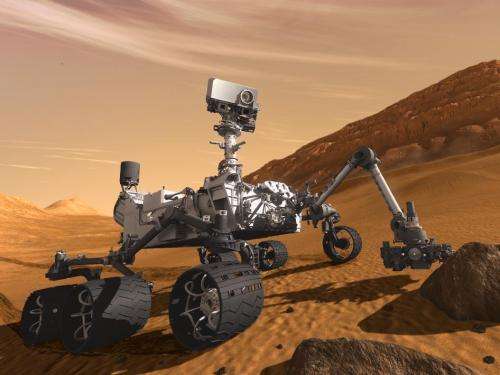
This artist concept features NASA's Mars Science Laboratory Curiosity rover, a mobile robot for investigating Mars' past or present ability to sustain microbial life. Credit: NASA/JPL-Caltech

During processing of NASA's Mars Science Laboratory at NASA's Kennedy Space Center, Fla., an incident occurred on Friday, May 20, involving the spacecraft's back shell.

A crane lift of the hardware caused unexpected on interfaces between the back shell and its ground support equipment. These interfaces are used during ground operations in preparation for launch. A structural assessment of the back shell was performed in the area of these interfaces.

Inspections and analyses through Monday, May 23, have not identified any damage. Flight processing is expected to continue this week.

The back shell is used to protect the rover and descent stage during entry in Mars' .

Mars Science Laboratory will launch during the period from Nov. 25 to Dec. 18, 2011, taking its rover, Curiosity, to an August 2012 landing. During a two-year mission on Mars, Curiosity will investigate whether a selected area of Mars has offered environmental conditions favorable for and for preserving evidence about life.

The spacecraft's back shell, and cruise stage were delivered to Kennedy Space Center on May 12. The rover and descent stage will be delivered in June.

Explore further: British astronaut 'Major Tim' to fly to ISS

add to favorites email to friend print save as pdf

Related Stories

Next Mars rover nears completion

Apr 07, 2011

(PhysOrg.com) -- Assembly and testing of NASA's Mars Science Laboratory spacecraft is far enough along that the mission's rover, Curiosity, looks very much as it will when it is investigating Mars.

Mars mission components delivered to Florida

May 16, 2011

(PhysOrg.com) -- An Air Force C-17 transport plane delivered the heat shield, back shell and cruise stage of the Mars Science Laboratory spacecraft to NASA's Kennedy Space Center, Fla., on May 12, 2011.

Next Mars rover stretches robotic arm

Sep 06, 2010

(PhysOrg.com) -- Curiosity, the Mars Science Laboratory rover that will be on Mars two years from now, has been flexing the robotic arm that spacecraft workers at NASA's Jet Propulsion Laboratory attached ...

Recommended for you

Mice, gerbils perish in Russia space flight

23 hours ago

A number of mice and eight gerbils sent into space in a Russian capsule destined to find out how well organisms can withstand extended flights perished during their journey, scientists said Sunday as the ...

Mars rover Opportunity examines clay clues in rock

May 18, 2013

(Phys.org) —NASA's senior Mars rover, Opportunity, is driving to a new study area after a dramatic finish to 20 months on "Cape York" with examination of a rock intensely altered by water.

NASA's STEREO detects a CME from the sun

May 17, 2013

On 5:24 a.m. EDT on May 17, 2013, the sun erupted with an Earth-directed coronal mass ejection or CME, a solar phenomenon that can send billions of tons of solar particles into space that can reach Earth ...

Nine-year-old Mars rover passes 40-year-old record

May 17, 2013

While Apollo 17 astronauts Eugene Cernan and Harrison Schmitt visited Earth's moon for three days in December 1972, they drove their mission's Lunar Roving Vehicle 19.3 nautical miles (22.210 statute miles ...

User comments : 1

Adjust slider to filter visible comments by rank

Display comments: newest first

gmurphy
not rated yet May 25, 2011
Cannot wait for this thing to get going, I wish the team involved the best of success.

More news stories

Cracking the ice code

(Phys.org) —What happened the last time a vegetated Earth shifted from an extremely cold climate to desert-like conditions? And what does it tell us about climate change today?

Engineers' nanoantennas improve infrared sensing

(Phys.org) —A team of University of Pennsylvania engineers has used a pattern of nanoantennas to develop a new way of turning infrared light into mechanical action, opening the door to more sensitive infrared ...

Mapping a route to stem cell therapies

Monash University researchers are shedding light on the complex processes that underpin the creation and differentiation of stem cells, bringing closer the promise of 'miracle' therapies.

Lymphatic fluid takes detour

When tumours metastasise, they can block lymphatic vessels, as researchers from ETH Zurich have discovered using a new method. The lymphatic fluid subsequently has to find a new path through the tissue. Such ...

Tiny ancient bandicoot shines light on future

(Phys.org) —A 20 million-year-old fossil skull identified as a 'pocket-sized' ancestor of the bandicoot will give insights into the future of Australia's modern endangered animals.