JPL facility has built famed spacecraft for 50 years
May 13, 2011 By Guy Webster
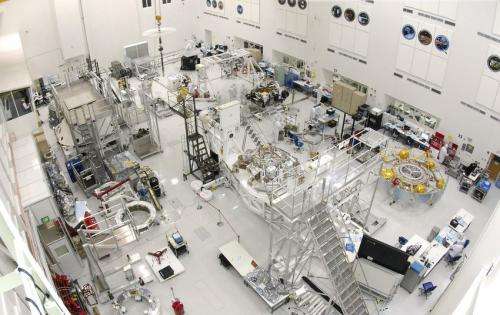
This wide-angle view shows the High Bay 1 cleanroom inside the Spacecraft Assembly Facility at NASA's Jet Propulsion Laboratory, Pasadena, Calif. Specialists are working on components of the Mars Science Laboratory spacecraft in this image from January 2011. Credit: NASA/JPL-Caltech
(PhysOrg.com) -- The Spacecraft Assembly Facility of NASA's Jet Propulsion Laboratory in Pasadena, Calif., was constructed in 1961 to support NASA's Ranger and Mariner missions to the moon, Venus and Mars.
America had entered the Space Age just three years earlier, with the launch of the JPL-built Explorer 1 spacecraft.
The Spacecraft Assembly Facility, also known as JPL Building 179, originally had just one high bay, the large chamber now named High Bay 1. It is about 80 feet by 120 feet (about 24 by 36 meters). In contrast to the cleanliness standards for spacecraft assembly today, in the early days of the facility, personnel were even permitted to smoke inside this high bay.
All JPL-built spacecraft through the Viking Orbiters (launched to Mars in 1975) were built in High Bay 1. At times during the 1960s, as many as five different spacecraft were being assembled at the same time in the facility.
After the original construction of the high bay, the System Test Complex on the south side of the high bay's windows was added. A second high bay, about 70 feet by 70 feet (21 meters by 21 meters) was finished in 1976 to support the Voyager Project. Spacecraft assembled in High Bay 2 have included Voyager 1 and 2, Galileo and Cassini.
The project being assembled and tested in High Bay 1 in spring 2011 is the Mars Science Laboratory, including its rover, Curiosity. The mission is scheduled for launch in November 2011. Mars rovers Spirit and Opportunity were also built in High Bay 1.
Emblems on the wall of High Bay 1 represent all the missions (spacecraft and instruments) that were assembled in the Spacecraft Assembly Facility, regardless of which high bay was used. These include the first successful missions to Venus, Mars, Jupiter, Saturn, Uranus and Neptune, as well as Earth's moon. The facility has also built Earth-science instruments, plus Wide Field and Planetary Cameras that flew on the Hubble Space Telescope.
Both of the high bays are certified to a cleanliness level of Class 10,000, which means that there are less than 10,000 particles of 0.5 micron (half a millionth of a meter or yard) or larger in size per cubic foot of air volume. It is a great place to work if you have allergies. The filtration systems in the high bays are effective in reducing both particulates as well as hydrocarbons. The system maintained acceptable levels even when a brush fire raged near JPL in 2009.
Personnel working in the high bay wear protective clothing to minimize particles and bacteria reaching the spacecraft and the facility. All the equipment that enters the high bay is cleaned first with approved solvents (usually isopropyl alcohol). Both high bays are equipped with continuous remote monitoring for environmental conditions and cleanliness levels to ensure system safety and quick response to anomalous conditions.
Provided by
JPL/NASA
-
From lemons to lemonade: Reaction uses carbon dioxide to make carbon-based semiconductor,
32 comments
-
Thioridazine kills cancer stem cells in human while avoiding toxic side-effects of conventional cancer treatments,
3 comments
-
SpaceX private rocket blasts off for space station (Update),
42 comments
-
Climate scientists say they have solved riddle of rising sea,
31 comments
-
SpaceX capsule has 'new car' smell, astronauts say (Update),
2 comments
-
revamping general concept and cosmological principle
May 25, 2012
-
Transiting Exoplanet Light Curve
May 25, 2012
-
Math behind Theoretical Physics
May 24, 2012
-
Do we know whats at the center of galaxies yet?
May 23, 2012
-
Structure of the Milky Way?
May 20, 2012
-
What would it take to terraform Pluto and Charon?
May 19, 2012
- More from Physics Forums - General Astronomy
More news stories
SpaceX capsule has 'new car' smell, astronauts say (Update)
SpaceX's Dragon cargo vessel smells like a new car, said astronauts at the International Space Station after opening the hatches Saturday following the spacecraft's landmark mission to the orbiting lab.
Space & Earth / Space Exploration
22 hours ago |
4.5 / 5 (20) |
2
Australia hails surprise super-telescope decision
Australia has hailed a surprise decision giving it a role in a radio telescope project aimed at revolutionising astronomy, vowing to draw on its decades of experience in space science.
22 hours ago |
5 / 5 (4) |
2
Astronomers seize last chance in lifetime for Venus Transit
Astronomers are gearing for one the rarest events in the Solar System: an alignment of Earth, Venus and the Sun that will not be seen for another 105 years.
22 hours ago |
5 / 5 (3) |
2
Astronauts enter world's 1st private supply ship
(AP) -- Space station astronauts floated into the Dragon on Saturday, a day after its heralded arrival as the world's first commercial supply ship.
Space & Earth / Space Exploration
22 hours ago |
5 / 5 (6) |
0
Sophisticated simulations predict future warming
The chances of our planet being hit by a global warming of 3 degrees Celsius by 2050 is as likely as it being hit by an increase of 1.4 degrees, new research shows. Presented in the journal Nature Geoscience, the British study ...
Space & Earth / Earth Sciences
May 22, 2012 |
4.4 / 5 (9) |
51
Nvidia trumpets Tegra 3 phone design wins for 2012
(Phys.org) -- Nvidias competitive war paint has a name, Tegra 3. On the heels of Nvidia announcements about lowering costs of its Tegra 3 processors and Nvidia-enabled tablets running Android Ice Cream ...
Browser wars flare in mobile space
The browser wars are heating up again, but this time the fight is for dominance of the mobile Internet.
Scientist: Evolution debate will soon be history
(AP) -- Richard Leakey predicts skepticism over evolution will soon be history. Not that the avowed atheist has any doubts himself.
Dell tablet leak: 10.1-inch display, two-battery choice
(Phys.org) -- Headline after headline talks about vendors tablets in the wings as likely number-one contenders for the iPad. Such claims have justifiably been taken with a grain of salt, considering ...
SpotterRF debuts Radar Backpack Kit (w/ Video)
(Phys.org) -- SpotterRF has announced a special radar backpack kit designed to enhance situational awareness for soldiers on the ground. The company says its special radar is designed for warfighters as part ...
Thousands of shellfish found dead in Peru
Thousands of crustaceans were found dead off the coast of Lima following the mystery mass death of dolphins and pelicans, the Peruvian Navy said Friday.
May 14, 2011
Rank: not rated yet
May 14, 2011
Rank: not rated yet