After Japan nuclear power plant disaster: How much radioactivity in the oceans?
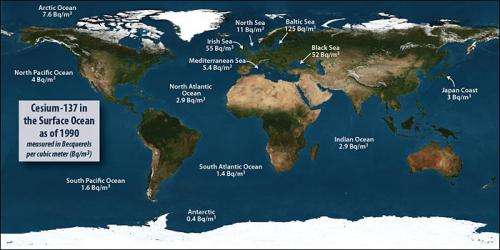
Radiation level in the oceans in 1990, mostly from nuclear weapons testing, measured in Becquerels. Credit: Woods Hole Oceanographic Institution
Among the casualties of the March 11, 2011, earthquake and resulting tsunami in Japan was the country's Fukushima Daiichi nuclear power plant.
A result of the loss of electricity, overheating at the power plant led to significant releases of iodine, cesium and other radioisotopes to the environment.
Japanese officials recently raised the severity of the nuclear power plant incident to level 7, the highest level on the international scale and comparable only to the Chernobyl incident 25 years ago, says Ken Buesseler, a chemical oceanographer at the Woods Hole Oceanographic Institution.
"When it comes to the oceans, however," says Buesseler, "the impact of Fukushima exceeds Chernobyl."
Radionuclides in seawater have been reported from the Fukushima plant's discharge canals, from coastal waters five to ten kilometers south of the plant, and from 30 kilometers offshore.
"Levels of some radionuclides are at least an order of magnitude higher than the highest levels in 1986 in the Baltic and Black Seas, the two ocean water bodies closest to Chernobyl," says Buesseler.
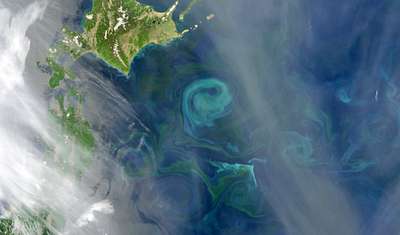
Satellite image from 160 kilometers (100 miles) north of the Fukushima nuclear power plant in Japan. Japan's two large ocean currents--the Kuroshio and the Oyashio--converge here. Credit: NASA
He has been awarded a rapid-response grant from the National Science Foundation's (NSF) Division of Ocean Sciences to establish baseline concentrations of several radionuclides in the Atlantic and Pacific Oceans."Finding this information early on is key to understanding the severity of the releases and related public health issues," says Buesseler.
He and colleagues will establish a baseline radionuclide data set for the Atlantic and Pacific Oceans, using an east-to-west network of sampling stations where the ability to retrieve ocean water samples already exists.
Researchers learned much from Chernobyl about the fate of radioactive fallout delivered to the oceans, and about using that fallout as a "tracer" for how fast ocean waters mix and sediments accumulate.
"After Chernobyl, fallout was measured not only in samples close to the site, such as those in the Black Sea, but as far afield as the north Pacific Ocean," Buesseler says.
Because the atmosphere and oceans are linked, scientists would expect radionuclides present in the atmosphere also to appear in the ocean, albeit at very low levels, says chemical oceanographer Henrieta Dulaiova of the University of Hawaii.
Dulaiova has also been awarded a rapid-response grant from NSF's Division of Ocean Sciences to study the fallout.
She is monitoring ocean waters to establish baseline concentrations of radionuclides, and to determine the spreading of released radionuclides.
"Like the people of Japan--though certainly to a lesser degree--we are dealing with a radiochemical situation that will be with us for a long time," says Don Rice, director of NSF's chemical oceanography program.
"To understand how the ocean and atmosphere have handled this contamination in the years ahead, we must first get a snap-shot of the situation today," says Rice. "Buesseler and Dulaiova are doing just that."
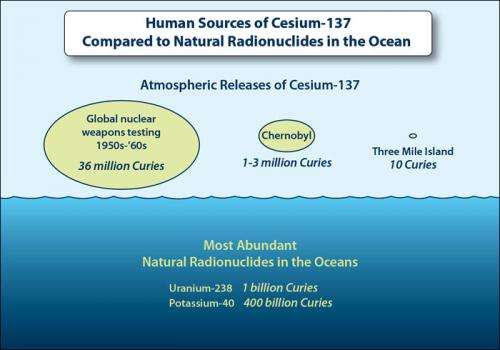
Human sources of radiation in the atmosphere, compared with natural radionuclides in the ocean. Credit: Jack Cook, Woods Hole Oceanographic Institution
Dulaiova's study is focused on the central Pacific Ocean, and includes coastal and offshore waters off Hawaii, Guam and the Midway Islands."Hawaii's proximity to Japan makes it an important monitoring point," says Dulaiova. "We're conducting weekly coastal and monthly offshore water sample collections."
Bi-weekly samples from Guam are also collected, and samples are obtained from ships cruising the western Pacific.
The samples are then analyzed for cesium isotopes, whose signature allows scientists to identify radionuclides released from Fukushima.
Dulaiova is also planning to look at other radionuclides such as iodine, strontium and some actinides that were released.
"The information is needed," she says, "so that any subsequent efforts to understand the severity of the releases, the bioaccumulation of radionuclides in the ocean food web, and ocean processes and spreading patterns of the released radioisotopes, all have good baseline data."
The researchers hope to develop an understanding of marine radionuclides on a global scale.
Provided by
National Science Foundation
-
From lemons to lemonade: Reaction uses carbon dioxide to make carbon-based semiconductor,
32 comments
-
Thioridazine kills cancer stem cells in human while avoiding toxic side-effects of conventional cancer treatments,
3 comments
-
SpaceX private rocket blasts off for space station (Update),
42 comments
-
Climate scientists say they have solved riddle of rising sea,
31 comments
-
Research team claims to have found evidence Lake Cheko is impact crater for Tunguska Event,
18 comments
-
Hypothetical desert earth
9 hours ago
-
More human population = greater mass?
May 25, 2012
-
Conversion from aircraft bearing to normal degrees
May 23, 2012
-
Interpretation/Analysis of the Lab results(HEPA filter)
May 22, 2012
-
Has anyone here attended the The Urbino Summer School in Paleoclimatology?
May 22, 2012
-
Earthquakes: Mag 6 N. Italy and Mag 5.6 W. Bulgaria
May 21, 2012
- More from Physics Forums - Earth
More news stories
SpaceX capsule has 'new car' smell, astronauts say (Update)
SpaceX's Dragon cargo vessel smells like a new car, said astronauts at the International Space Station after opening the hatches Saturday following the spacecraft's landmark mission to the orbiting lab.
Space & Earth / Space Exploration
22 hours ago |
4.5 / 5 (20) |
2
Australia hails surprise super-telescope decision
Australia has hailed a surprise decision giving it a role in a radio telescope project aimed at revolutionising astronomy, vowing to draw on its decades of experience in space science.
22 hours ago |
5 / 5 (4) |
2
Astronomers seize last chance in lifetime for Venus Transit
Astronomers are gearing for one the rarest events in the Solar System: an alignment of Earth, Venus and the Sun that will not be seen for another 105 years.
22 hours ago |
5 / 5 (3) |
2
Astronauts enter world's 1st private supply ship
(AP) -- Space station astronauts floated into the Dragon on Saturday, a day after its heralded arrival as the world's first commercial supply ship.
Space & Earth / Space Exploration
22 hours ago |
5 / 5 (6) |
0
Sophisticated simulations predict future warming
The chances of our planet being hit by a global warming of 3 degrees Celsius by 2050 is as likely as it being hit by an increase of 1.4 degrees, new research shows. Presented in the journal Nature Geoscience, the British study ...
Space & Earth / Earth Sciences
May 22, 2012 |
4.4 / 5 (9) |
51
Nvidia trumpets Tegra 3 phone design wins for 2012
(Phys.org) -- Nvidias competitive war paint has a name, Tegra 3. On the heels of Nvidia announcements about lowering costs of its Tegra 3 processors and Nvidia-enabled tablets running Android Ice Cream ...
Browser wars flare in mobile space
The browser wars are heating up again, but this time the fight is for dominance of the mobile Internet.
Scientist: Evolution debate will soon be history
(AP) -- Richard Leakey predicts skepticism over evolution will soon be history. Not that the avowed atheist has any doubts himself.
Dell tablet leak: 10.1-inch display, two-battery choice
(Phys.org) -- Headline after headline talks about vendors tablets in the wings as likely number-one contenders for the iPad. Such claims have justifiably been taken with a grain of salt, considering ...
SpotterRF debuts Radar Backpack Kit (w/ Video)
(Phys.org) -- SpotterRF has announced a special radar backpack kit designed to enhance situational awareness for soldiers on the ground. The company says its special radar is designed for warfighters as part ...
Thousands of shellfish found dead in Peru
Thousands of crustaceans were found dead off the coast of Lima following the mystery mass death of dolphins and pelicans, the Peruvian Navy said Friday.

May 19, 2011
Rank: 2.6 / 5 (5)
I hope this frightening statement is not just an attempt to get more funding for NSF in the upcoming budget review.
Earth's actual radioactivity has decreased ever since our elements were ejected from the Sun ~5 Gyr ago:
http://www.omatum...Data.htm
Will levels of radioactivity in the ocean now go as high as they were:
a.) 4 Gyr ago?
b.) 1 Gyr ago?
c.) 0.001 Gyr ago?
d.) After nuclear weapons tests?
e.) After nuclear waste was dumped in the oceans?
Which radioactivity should we be most concerned about?
The radioactivity of biological active elements produced by fission, iodine (I) and strontium (Sr)?
Quantitative answers would be appreciated.
With kind regards.,
Oliver K. Manuel
Former NASA Principal
Investigator for Apollo
May 19, 2011
Rank: 1 / 5 (4)
What units of measure are wished?
Any complete and reliable data from Fukushima and/or Chernobyl is welcome, regardless of measure.
Of course you sign non-disclosure with signing on to nuclear.
May 19, 2011
Rank: not rated yet
You're not going to get reliable data just listen to the crap the mainstream media is spewing out and constantly back peddling on! The government of japan too! How on earth is raising radiation tolerances by a thousand fold? The US too. And how responsible is it to shut off almost all your radiation monitoring stations? Canada too!
My only response is this:
it doesn't matter how much radioactivity, it matters what kind first and foremost!
Cesium and strontime are great slow deaths!
May 19, 2011
Rank: 5 / 5 (3)
What are you talking about?
http://www.iaea.o...e01.html
The IAEA has been tracking and releasing information to the public about the Fukushima situation and the radiation levels in the surrounding areas since the earthquake.
Just because you choose not to look for information doesn't mean it's not there.
May 19, 2011
Rank: 1 / 5 (1)
"Instead they simply state the resignation is in protest to Japans handling of the disaster response as a whole."
http://theintelhu...diation/
There. The three words in parenthesis has saved you the embarrassment of appearing sympathetic towards an unrestricted information flow between industry and organization.
May 19, 2011
Rank: 1 / 5 (4)
that the government and news media downplay the gravity of the
situation, while few people believe anything they're told.
May 19, 2011
Rank: 2.3 / 5 (3)
Few people here now believe government reports too.
Why?
Is it because politicians have misused government science in the way that former President Eisenhower warned might happen one day?
www.youtube.com/w...ld5PR4ts
May 19, 2011
Rank: not rated yet
May 20, 2011
Rank: not rated yet
Obviously some information was/is supplied by Tepco, but the IAEA sends its own surveyors and other radiation monitoring personnel to do the monitoring of the radiation levels in the environment and foods away from the plant.
The Tepco information is typically about the condition in the plant at any given time. They were relied on more in the early stages of the accident. The IAEA now has personnel stationed there as well. You should actually read what's on the website I linked you before you immediately dismiss it.
You can't say that no information is provided and then ignore the information you're given.
May 21, 2011
Rank: not rated yet
"Any complete and reliable data from Fukushima...is welcome..."
"You can't say that no information is provided and then ignore the information you're given."
You assert I said:
"...that no information is provided..." and then assert, "then ignore the information you're given"
Why are you making these assertions in regards to the words I wrote - which do not support your assertions or my wording.