Examining the Great Wall
May 10, 2011 By Jon Voisey, Universe Today

Examining the Great Wall

Enlarge

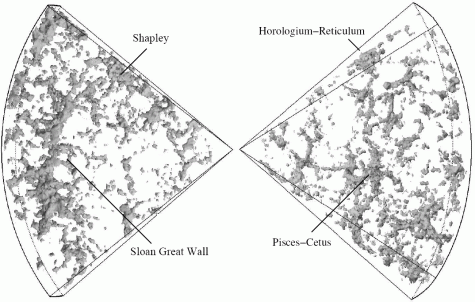
Several superclusters revealed by the 2dF Galaxy Redshift Survey.

Structure exists on nearly all scales in the universe. Matter clumps under its own gravity into planets, stars, galaxies, clusters, and superclusters. Beyond even these in scale are the filaments and voids. The largest of these filaments is known as the Sloan Great Wall. This giant string of galaxies is 1.4 billion light years across making it the largest known structure in the universe. Yet surprisingly, the Great Wall has never been studied in detail. Superclusters within it have been examined, but the wall as a whole has only come into consideration in a new paper from a team led by astronomers at Tartu Observatory in Estonia.

The Sloan Great Wall was first discovered in 2003 from the Sloan (SDSS). The survey mapped the position of hundreds of millions of galaxies revealing the large scale structure of the universe and uncovering the Great Wall.

Within it, the wall contains several interesting superclusters. The largest of these SCl 126 has been shown previously to be unusual compared to superclusters within other large scale structures. SCl 126 is described as having an exceptionally rich core of galaxies with tendrils of galaxies trailing away from it like an enormous “spider”. Typical superclusters have many smaller clusters connected by these threads. This pattern is exemplified by one of the other rich superclusters in the wall, SCl 111. If the wall is examined in only its densest portions, the tendrils extending away from these cores are quite simple, but as the team explored lower densities, sub filaments became apparent.

Another way the team examined the Great Wall was by looking at the arrangement of different types of galaxies. In particular, the team looked for Bright Red Galaxies (BRGs) and found that these galaxies are often found together in groups with at least five BRGs present. These galaxies were often the brightest of the galaxies within their own groups. As a whole, the groups with BRGs tended to have more galaxies which were more luminous, and have a greater variety of velocities. The team suggests that this increased velocity dispersion is a result of a higher rate of interactions among galaxies than in other clusters. This is especially true for SCl 126 where many galaxies are actively merging. Within SCl 126, these BRG groups were evenly distributed between the core and the outskirts while in SCl 111, these groups tended to congregate towards the high density regions. In both of these superclusters, spiral comprised about 1/3 of the BRGs.

The study of such properties will help to test cosmological models that predict galactic structure formation. The authors note that models have generally good job of being able to account for structures similar to SCl 111 and most other superclusters we have observed in the universe. However, they fall short in creating superclusters with the size, morphology and distribution of SCl 126. These formations arise from density fluctuations initially present during the Big Bang. As such, understanding the structures they formed will help astronomers to understand these perturbations in greater detail and, in turn, what physics would be necessary to achieve them. To help achieve this, the authors intend to continue mapping the morphology of the Sloan Great Wall as well as other superclusters to compare their features.

Source: Universe Today

Filter


Move the slider to adjust rank threshold, so that you can hide some of the comments.


Display comments: newest first

SteveL
May 10, 2011

Rank: 5 / 5 (2)
Would not the ejecta from the big bang have to react against "something" in order to create perturbations and density fluctuations?
omatumr
May 10, 2011

Rank: 1.4 / 5 (10)
Does structure exist because matter clumps under its own gravity into planets, stars, galaxies, clusters, and superclusters?


No, structure exists because neutron repulsion [1] causes the universe to fragment and expand.

When the compact, neutron-rich objects at the centers of galaxies and stars have evaporated or fragmented, gravity [2] will cause our infinite, cyclic universe to contract.

[1] Neutron Repulsion", The APEIRON Journal, in press, 19 pages (2011)

http://arxiv.org/...2.1499v1

[2] "Is the Universe Expanding?", The Journal of Cosmology 13, 4187-4190 (2011)

http://journalofc...102.html

With kind regards,
Oliver K. Manuel

Eikka
May 10, 2011

Rank: 4 / 5 (1)
Would not the ejecta from the big bang have to react against "something" in order to create perturbations and density fluctuations?


Against itself, perhaps? Like a spring that is released into the air so that it oscillates around its center of mass.
RealScience
May 10, 2011

Rank: 5 / 5 (2)
SteveL - Quantum mechanics says that there are always tiny perturbations in any field. Any region slightly denser as a result would attract more matter than less-dense regions, amplifying the density differences and attracting still more matter, eventually resulting in the large-scale structures that we see today.

SteveL
May 11, 2011

Rank: 5 / 5 (1)
SteveL - Quantum mechanics says that there are always tiny perturbations in any field. Any region slightly denser as a result would attract more matter than less-dense regions, amplifying the density differences and attracting still more matter, eventually resulting in the large-scale structures that we see today.

Should not these perturbations at the quantum level statistically average out in all three dimentions, again unless "something" prexisted the big bang?
Rank 5 /5 (3 votes)
Relevant PhysicsForums posts
  • revamping general concept and cosmological principle
    createdMay 25, 2012
  • Transiting Exoplanet Light Curve
    createdMay 25, 2012
  • Math behind Theoretical Physics
    createdMay 24, 2012
  • Do we know whats at the center of galaxies yet?
    createdMay 23, 2012
  • Structure of the Milky Way?
    createdMay 20, 2012
  • What would it take to terraform Pluto and Charon?
    createdMay 19, 2012
  • More from Physics Forums - General Astronomy

More news stories

SpaceX capsule has 'new car' smell, astronauts say (Update)

SpaceX's Dragon cargo vessel smells like a new car, said astronauts at the International Space Station after opening the hatches Saturday following the spacecraft's landmark mission to the orbiting lab.

Space & Earth / Space Exploration

created 22 hours ago | popularity 4.5 / 5 (20) | comments 2

Australia hails surprise super-telescope decision

Australia has hailed a surprise decision giving it a role in a radio telescope project aimed at revolutionising astronomy, vowing to draw on its decades of experience in space science.

Space & Earth / Astronomy

created 22 hours ago | popularity 5 / 5 (4) | comments 2

Astronomers seize last chance in lifetime for Venus Transit

Astronomers are gearing for one the rarest events in the Solar System: an alignment of Earth, Venus and the Sun that will not be seen for another 105 years.

Space & Earth / Astronomy

created 22 hours ago | popularity 5 / 5 (3) | comments 2

Astronauts enter world's 1st private supply ship

(AP) -- Space station astronauts floated into the Dragon on Saturday, a day after its heralded arrival as the world's first commercial supply ship.

Space & Earth / Space Exploration

created 22 hours ago | popularity 5 / 5 (6) | comments 0

Sophisticated simulations predict future warming

The chances of our planet being hit by a global warming of 3 degrees Celsius by 2050 is as likely as it being hit by an increase of 1.4 degrees, new research shows. Presented in the journal Nature Geoscience, the British study ...

Space & Earth / Earth Sciences

created May 22, 2012 | popularity 4.4 / 5 (9) | comments 51


Nvidia trumpets Tegra 3 phone design wins for 2012

(Phys.org) -- Nvidia’s competitive war paint has a name, Tegra 3. On the heels of Nvidia announcements about lowering costs of its Tegra 3 processors and Nvidia-enabled tablets running Android Ice Cream ...

Browser wars flare in mobile space

The browser wars are heating up again, but this time the fight is for dominance of the mobile Internet.

Scientist: Evolution debate will soon be history

(AP) -- Richard Leakey predicts skepticism over evolution will soon be history. Not that the avowed atheist has any doubts himself.

Dell tablet leak: 10.1-inch display, two-battery choice

(Phys.org) -- Headline after headline talks about vendors’ tablets in the wings as likely number-one contenders for the iPad. Such claims have justifiably been taken with a grain of salt, considering ...

SpotterRF debuts Radar Backpack Kit (w/ Video)

(Phys.org) -- SpotterRF has announced a special radar backpack kit designed to enhance situational awareness for soldiers on the ground. The company says its special radar is designed for warfighters as part ...

Thousands of shellfish found dead in Peru

Thousands of crustaceans were found dead off the coast of Lima following the mystery mass death of dolphins and pelicans, the Peruvian Navy said Friday.