Google's Street View starts mapping India
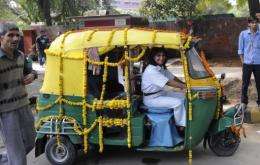
Sunita Choudhury, the city's first woman auto-rickshaw driver, celebrates International Women's Day in New Delhi in March. Internet giant Google on Thursday launched its ambitious "Street View" project in India to provide detailed panoramic images of life in a country of 1.2 billion people.
Google launched its "Street View" project in India on Thursday aiming to collect panoramic images of the vast country ranging from its palaces to its slums.
The 360-degree photographic mapping service, which is already in operation in more than 25 countries, began gathering data in the southern city of Bangalore, a technology hub where many Internet firms are based.
Street View has proved hugely popular since its launch in the United States in 2007, but it has also run into trouble with several governments concerned about privacy.
"Street View is designed to comply with all local laws including those related to security and privacy in India," Google India chief Vinay Goel told reporters in Bangalore.
He said the programme, which allows computer users to simulate walking down streets and around corners, would be useful for "urban development planners, law enforcement agencies, house-hunters, and travellers".
Goel declined to give details about Google's plans to expand the project across India, where cities and villages are often a chaotic jumble of traffic jams, buffalo carts and shanty towns.
The company said that detailed images of Bangalore, which are being collected by special cameras mounted on cars and tricycles, would be made accessible once the data had been processed.
Google said earlier this month that it would appeal against a Swiss ruling ordering it to ensure that all people and cars pictured on Street View were unrecognisable.
France's data privacy regulator imposed a record fine of 100,000 euros ($142,000) on Google in March for collecting private information while compiling photographs for the service.
Google has also agreed to delete private emails and passwords mistakenly picked up from wireless networks in Britain by its Street View cars.
"We have got permission from Bangalore police, and are in touch with state and central governments," a Google spokeswomen told AFP. "We want to map all of the city, but anyone can complain if they are unhappy about coverage."
Street View tricycles have already collected imagery from international tourist sites including Stonehenge in Britain, Pompeii in Italy and Versailles in France.
"In India too, we are planning to collect images of important monuments and tourist spots after getting necessary sanction from the authorities," Goel said.
(c) 2011 AFP
-
From lemons to lemonade: Reaction uses carbon dioxide to make carbon-based semiconductor,
32 comments
-
Thioridazine kills cancer stem cells in human while avoiding toxic side-effects of conventional cancer treatments,
3 comments
-
SpaceX private rocket blasts off for space station (Update),
42 comments
-
Climate scientists say they have solved riddle of rising sea,
31 comments
-
Research team claims to have found evidence Lake Cheko is impact crater for Tunguska Event,
18 comments
-
Need a rigid insulation material???
9 hours ago
-
magnets or EMF in car bumpers to protect from fender bender
May 26, 2012
-
length of wire in a coil of known dimensions?
May 25, 2012
-
India Engineering Powerhouse
May 25, 2012
-
electromagnet core dereference between hard and soft iron
May 25, 2012
-
Measuring water pressure in an open tank
May 24, 2012
- More from Physics Forums - General Engineering
More news stories
Browser wars flare in mobile space
The browser wars are heating up again, but this time the fight is for dominance of the mobile Internet.
1 hour ago |
5 / 5 (1) |
1
SpotterRF debuts Radar Backpack Kit (w/ Video)
(Phys.org) -- SpotterRF has announced a special radar backpack kit designed to enhance situational awareness for soldiers on the ground. The company says its special radar is designed for warfighters as part ...
Probability of contamination from severe nuclear reactor accidents is higher than expected: study
Catastrophic nuclear accidents such as the core meltdowns in Chernobyl and Fukushima are more likely to happen than previously assumed. Based on the operating hours of all civil nuclear reactors and the number ...
Technology / Energy & Green Tech
May 22, 2012 |
3.6 / 5 (21) |
56
|
HyperSolar shows dirty water no barrier to power world
(Phys.org) -- The Santa Barbara, California, company, HyperSolar, is set to transparently share the ups and downs of its research experiences toward the companys ultimate vision, successfully producing ...
Tesla to launch electric sedan in US on June 22
Tesla Motors said Tuesday it would begin deliveries of "the world's first premium electric sedan" on June 22, slightly ahead of schedule.
Technology / Energy & Green Tech
May 22, 2012 |
4.5 / 5 (11) |
18
Nvidia trumpets Tegra 3 phone design wins for 2012
(Phys.org) -- Nvidias competitive war paint has a name, Tegra 3. On the heels of Nvidia announcements about lowering costs of its Tegra 3 processors and Nvidia-enabled tablets running Android Ice Cream ...
Scientist: Evolution debate will soon be history
(AP) -- Richard Leakey predicts skepticism over evolution will soon be history. Not that the avowed atheist has any doubts himself.
Dell tablet leak: 10.1-inch display, two-battery choice
(Phys.org) -- Headline after headline talks about vendors tablets in the wings as likely number-one contenders for the iPad. Such claims have justifiably been taken with a grain of salt, considering ...
SpaceX capsule has 'new car' smell, astronauts say (Update)
SpaceX's Dragon cargo vessel smells like a new car, said astronauts at the International Space Station after opening the hatches Saturday following the spacecraft's landmark mission to the orbiting lab.
Thousands of shellfish found dead in Peru
Thousands of crustaceans were found dead off the coast of Lima following the mystery mass death of dolphins and pelicans, the Peruvian Navy said Friday.
Australia hails surprise super-telescope decision
Australia has hailed a surprise decision giving it a role in a radio telescope project aimed at revolutionising astronomy, vowing to draw on its decades of experience in space science.