Germany to scrap nuclear power by 2022
May 30, 2011 by Frederic Happe

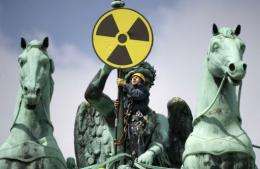
A Greenpeace activist places an anti-nuclear sign on top of the Brandenburg Gate in Berlin

Enlarge

A Greenpeace activist places an anti-nuclear sign on top of the Brandenburg Gate in Berlin on May 29, 2011. Germany will shut down all its nuclear plants by 2022, and eight reactors shut down after Japan's nuclear disaster in March will not be reactivated, the government announced Monday.

Germany on Monday announced plans to become the first major industrialised power to shut down all its nuclear plants in the wake of the disaster in Japan, with a phase-out due to be wrapped up by 2022.

Environment Minister Norbert Roettgen announced the decision by the centre-right coalition, which was prompted by the crisis at Japan's Fukushima plant, in the early hours of Monday morning, describing it as "irreversible".

"After long consultations, there is now an agreement by the coalition to end ," he told reporters after seven hours of into the small hours at Chancellor Angela Merkel's offices.

"This decision is consistent, decisive and clear."

Germany has 17 nuclear reactors on its territory, eight of which are currently off the .

Seven of those offline are the country's oldest nuclear reactors, which the shut down for three months pending a safety probe after the Japanese atomic emergency at Fukushima that began in March.

The eighth is the Kruemmel plant, in northern Germany, which has been mothballed for years because of technical problems.

Monday's decision made Germany the first major industrial power to announce plans to give up entirely.

But it also means that the country will have to find the 22 percent of its electricity needs currently covered by nuclear reactors from another source.

Roettgen insisted there was no danger of blackouts.

"We assure that the will be ensured at all times and for all users," he pledged, but did not provide details.

Already Friday, the environment ministers from all 16 German regional states had called for the temporary order on the seven plants to be made permanent.
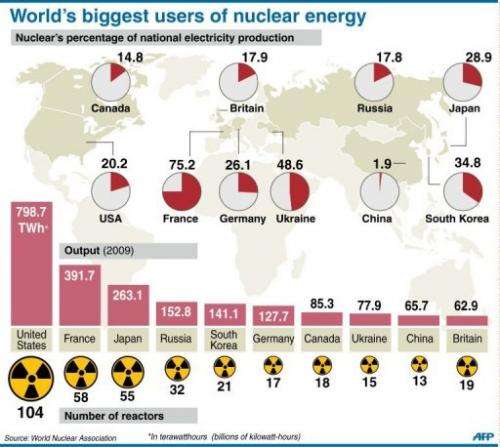
World's biggest users of nuclear energy
Enlarge

Graphic on the countries that rely the most on nuclear power. Germany will have to find the 22 percent of its electricity needs currently covered by nuclear reactors from another source after it scraps its nuclear plants.

Roettgen said Monday that none of the eight reactors offline would be reactivated. Six further reactors would be shut down by the end of 2021 and the three most modern would cease operation by the end of 2022.

Monday's decision is effectively a return to the timetable set by the previous Social Democrat-Green coalition government a decade ago.

And it is a humbling U-turn for Merkel, who at the end of 2010 decided to extend the lifetime of Germany's 17 reactors by an average of 12 years, which would have kept them open until the mid-2030s.

That decision was unpopular in Germany even before the earthquake and tsunami in March that severely damaged the Fukushima nuclear facility in Japan, prompting Merkel's review of nuclear policy.

Her zig-zagging on what has been a highly emotive issue in the country since the 1970s has cost her since at the ballot box.

Merkel herself has blamed the Fukushima nuclear disaster for recent defeats in state elections.

In the latest, on May 23, the anti-nuclear Greens pushed her conservative party into third place in a vote in the northern state of Bremen, the first time they had scored more votes than the conservatives in a regional or federal election.

The late-night wrangling in Merkel's fractious team saw the pro-business Free Democrats (FDP) arguing against a fixed end date for , and to maintain two reserve reactors in case of energy shortages.

FDP sources said there would be a contingency plan with one reactor but did not provide details.

Meanwhile the Christian Social Union, the Bavarian sister party of Merkel's Christian Democrats, fought for an exit within 10 years.

Some coalition members had called for a built-in review clause which could have seen the decision revisited, but this was thrown out in the final round of negotiations.

Roettgen said the government had largely followed the recommendations of an "ethics panel" appointed by Merkel after the disaster, which called for an end to nuclear power in Germany within a decade.

(c) 2011 AFP

3.3 /5 (4 votes)  

Filter


Move the slider to adjust rank threshold, so that you can hide some of the comments.


Display comments: newest first

ShotmanMaslo
May 30, 2011

Rank: 3.3 / 5 (7)
The result of anti-nuclear hysteria and populism, not rational thinking. All they will achieve is burning more dangerous fossil fuels, importing power from abroad and paying more for energy.

Nuclear is the safest source of energy we have, even before renewables.
antialias_physorg
May 30, 2011

Rank: 3.7 / 5 (3)
All they will achieve is burning more dangerous fossil fuels, importing power from abroad and paying more for energy.

Get your facts straight:

- even with the turned off nuclear power plants (currently 8 out of 17) germany is a net exporter of energy

- WORST case scenarios (as calculated by the conservatives - a notoriously nuclear-friendly - party) result in an increase in energy cost to the consumer by 0.5cent/kWh. Hardly tragic.

- The amount of fossil fuels burned will not increase one bit since the energy production from alternative power plants will be increased at the rate at which the nuclear power plants will go off line.
AlwaysRight
May 30, 2011

Rank: 4.7 / 5 (3)
I'm not sure where you collect your facts from antialias but that is an absolutely ridiculous statement. Simply typing in German electric imports into google yields an abundance of articles and sites detailing Germany's electrical generation and imports since they shut down those plants.

There may be cases where Germany will export electricity to neighboring countries while simultaneously importing from yet other countries. Overall however, Germany is a net importer now. I'd guess most of that is in the form of nuclear from France. Germany just exported nuclear out of their country. NIMBY!

Also, prior to installing their renewable energy infrastructure, Germany will most definitely be increasing their fossil fuel burning.
antialias_physorg
May 30, 2011

Rank: 3 / 5 (2)
If you check the numbers for the months since the atomic moratorium (march and april), then germany has imported about the same amount in march and april of the previous years.

Germany still produces more than it needs. It is just that there are price fluctuations (especially in cold months) which make french and czech nuclear energy cheaper - and therefore the big energy companies import that power at those times.

You need to look into things in a little more detail and not rely too much on FOX news et al.

Germany currently has power plants for 120GW and uses about 80GW (the 7 power plants currenly offline account for just under 9GW - so no chance of power outages because they are not available. )

Within just the past 5 years germany has doubled its alternative energy potential (to currently 17%...nuclear is at 22%). With that rate of expansion we can easily compensate for all nuclear powerplants by 2020
Beard
May 30, 2011

Rank: 5 / 5 (1)
Do you think they'll change their tune if thorium becomes viable?
paulthebassguy
May 30, 2011

Rank: 2.6 / 5 (5)
It's good that Germany is taking leadership on this. Anyone of the opinion that nuclear energy is a good source for the future is stuck in cold war mentality.

We need efficient, renewable energy, that doesn't produce emissions or waste. There is plenty of energy available on this planet in the tides, the sun, wind & rivers. All we need is investment in new technology to harness it.
antialias_physorg
May 31, 2011

Rank: 4 / 5 (2)
Do you think they'll change their tune if thorium becomes viable?

I doubt it. Public opinion in germany has been overwhelmingly against nuclear reactors of any kind since 1986 (remember that germany WAS affected by the radioactive cloud as opposed to the US. E.g. you still better test domestic/wild mushrooms before consumption).

Even if somehow one were to swing the opinion towards thorium reactors (extremely unlikely): Germany has no domestic thorium sources - so we'd just be exchanging one type of dependency for another.

Additionally: By the time thorium reactors come out of the testing phase and with the time lag from planning to operation of such plants in any type of numbers that would make a difference we'll be long fully self sufficient using alternative energy only.

And I think everyone agrees that that kind of decentralized energy infrastructure is vastly preferrable to centralized big reactors run by monopolists.
saklat
May 31, 2011

Rank: not rated yet
I don't understand! Is Germany expecting earthquakes? Otherwise, I can't see the link.
antialias_physorg
May 31, 2011

Rank: not rated yet
There are large areas in germany in which there are extinct volcanoes which could flare up.
There are some nuclear reactor along the Rhine (which flows in a fissure which was produced by an earthquake)

The risk may be low, but the population density is very high - and germany does not have land to spare like Russia does.
AlwaysRight
Jun 01, 2011

Rank: 5 / 5 (1)
Extinct volcanoes that could flare up? They wouldn't be extinct then would they. If they are "expected" to flare up the time frame for this expectation would be thousands of years. These arguments are empty and irrelevant to the discussion.

You can never be "self-sufficient" on renewable energy because it's nature is to be intermittent. Germany will always import electricity from neighbors when the sun isn't shining and the wind isn't blowing. All the while paying through the nose for it. Not to mention paying neighbors to take their excess electricity when too much wind is blowing. Sounds like it's pretty costly... I'm guessing Germany will have the highest electricity costs in the world soon enough. Right up there with Denmark... who exports quite a bit of that wind energy.

Anyway, I don't watch Fox news, I just form my own opinion from my knowledge. And what that knowledge says is, there is no one energy source to be relied upon, it has to come from many.
antialias_physorg
Jun 01, 2011

Rank: 4 / 5 (2)
You can never be "self-sufficient" on renewable energy because it's nature is to be intermittent.

Depends on how far you spread your system.
The wind always blows somewhere, the sun always shines somewhere - you never have windless or completely overcast skies over all of europe...and we have a european power grid.

Sometimes we'll buy from them, sometimes they'll buy from us. This is already happening with current power infrastructure. Nothing new here.

Add to that the upcoming potential for storing energy (fjords, granite hydraulic cylinders, hydrocarbons, hydrogen, compressed air, ... ).

Heck, a test run of decentralized alternative power plants showed that with NO storage you can already have full coverage of base and peak loads all year round (using biogas for the short intervals where other sources don't suffice)

It's been tested and proven on a large scale. So that 'never be self sufficient' argument just went out the window.

StandingBear
Jun 04, 2011

Rank: not rated yet
Germany is embarking on an economically ruinous course. In this the hidden strategy may be to use the Oregon, USA experience as a template. In Oregon, a vociferous luddite group infiltrated by middle easterners with another agenda (treason is another subject) effectively shut down its nuclear industry. Litigation financed by hidden interests figured prominently. As a result, for years Oregon power companies did not build any capacity and wrote off the state for industrial development. Power needs DID grow, however, and when brownouts and blackouts threatened, Oregon power companies looked to the Washington Power System to buy its plentiful nuclear power. Washingon State balked at supplying such large amounts to Oregon at cheap prices; and when they raised the prices seeing as Oregon was now a beggar state that did not provide power for itself, Oregon sued in Federal Court. Oregon lost, and has languished ever since while Washington State has prospered. So will go Germany.
DKoncewicz
Jun 05, 2011

Rank: 5 / 5 (1)
I can see that a lot of people in Germany are scared of nuclear power... but if they really wanted to close down the most dangerous sources of energy and replace them with renewables, why not start with coal?

I guess that's a simple answer,
1: Nuclear hysteria: it's in the news; sensationalism is more convincing to the plebs than statistics.
2: Coal related health risks and deaths are not sudden, they kill you over time. It's a lot harder to scare people if they're not in imminent danger that very moment.
3: The coal industry is so tangled in German industry and politics that they probably own enough of parliament to not be in any danger. Any heat directed to them is scapegoated away, usually to nuclear.

I understand when people want to replace current sources of energy with renewables, but I really don't get why coal is never in the news, hardly ever protested, and ultimately, never reduced.
antialias_physorg
Jun 05, 2011

Rank: not rated yet
The reason is that while the dangers from coal may be greater in numbers the dangers from nuclear are more permanent.

It's also not a black an white issue: Once nuclear is out of the race then coal will follow - never you fear. Let's just get one of these issues solved at a time.

You also have to take into account germany's history: For deacdes germany was at risk of being ground zero for nuclear war between east and west. Naturally the people would develop an aversion towards anything 'nuclear'.
Rank 3.3 /5 (4 votes)
Relevant PhysicsForums posts

More news stories

Browser wars flare in mobile space

The browser wars are heating up again, but this time the fight is for dominance of the mobile Internet.

Technology / Software

created 1 hour ago | popularity 5 / 5 (1) | comments 1

SpotterRF debuts Radar Backpack Kit (w/ Video)

(Phys.org) -- SpotterRF has announced a special radar backpack kit designed to enhance situational awareness for soldiers on the ground. The company says its special radar is designed for warfighters as part ...

Technology / Hi Tech & Innovation

created 22 hours ago | popularity 5 / 5 (5) | comments 12 | with audio podcast report

Probability of contamination from severe nuclear reactor accidents is higher than expected: study

Catastrophic nuclear accidents such as the core meltdowns in Chernobyl and Fukushima are more likely to happen than previously assumed. Based on the operating hours of all civil nuclear reactors and the number ...

Technology / Energy & Green Tech

created May 22, 2012 | popularity 3.6 / 5 (21) | comments 56 | with audio podcast

HyperSolar shows dirty water no barrier to power world

(Phys.org) -- The Santa Barbara, California, company, HyperSolar, is set to transparently share the ups and downs of its research experiences toward the company’s ultimate vision, successfully producing ...

Technology / Energy & Green Tech

created May 24, 2012 | popularity 4.8 / 5 (15) | comments 17 | with audio podcast report

Tesla to launch electric sedan in US on June 22

Tesla Motors said Tuesday it would begin deliveries of "the world's first premium electric sedan" on June 22, slightly ahead of schedule.

Technology / Energy & Green Tech

created May 22, 2012 | popularity 4.5 / 5 (11) | comments 18


Nvidia trumpets Tegra 3 phone design wins for 2012

(Phys.org) -- Nvidia’s competitive war paint has a name, Tegra 3. On the heels of Nvidia announcements about lowering costs of its Tegra 3 processors and Nvidia-enabled tablets running Android Ice Cream ...

Scientist: Evolution debate will soon be history

(AP) -- Richard Leakey predicts skepticism over evolution will soon be history. Not that the avowed atheist has any doubts himself.

Dell tablet leak: 10.1-inch display, two-battery choice

(Phys.org) -- Headline after headline talks about vendors’ tablets in the wings as likely number-one contenders for the iPad. Such claims have justifiably been taken with a grain of salt, considering ...

SpaceX capsule has 'new car' smell, astronauts say (Update)

SpaceX's Dragon cargo vessel smells like a new car, said astronauts at the International Space Station after opening the hatches Saturday following the spacecraft's landmark mission to the orbiting lab.

Thousands of shellfish found dead in Peru

Thousands of crustaceans were found dead off the coast of Lima following the mystery mass death of dolphins and pelicans, the Peruvian Navy said Friday.

Australia hails surprise super-telescope decision

Australia has hailed a surprise decision giving it a role in a radio telescope project aimed at revolutionising astronomy, vowing to draw on its decades of experience in space science.