Same fungus, different strains
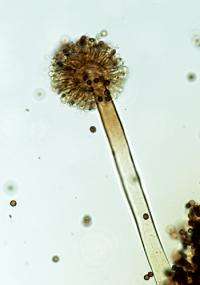
Fungi play key roles in nature and are valued for their great importance in industry. Consider citric acid, a key additive in several foods and pharmaceuticals produced on a large-scale basis for decades with the help of the filamentous fungus Aspergillus niger. While A. niger is an integral player in the carbon cycle, it possesses an arsenal of enzymes that can be deployed in breaking down plant cell walls to free up sugars that can then be fermented and distilled into biofuel, a process being optimized by U.S. Department of Energy researchers.
Published online ahead of print May 4, 2011 in Genome Research, a team led by Scott Baker of the Pacific Northwest National Laboratory compared the genome sequences of two Aspergillus niger strains to, among other things, better harness its industrial potential in biofuels applications. As more than a million tons of citric acid are produced annually, the production process involving A. niger is a well understood fungal fermentation process that could inform the development of a biorefinery where organic compounds replace the chemical building blocks normally derived from petroleum. Learning more about the genetic bases of the behaviors and abilities of these two industrially relevant fungal strains, wrote senior author Baker and his colleagues in the paper, will allow researchers to exploit their genomes towards the more efficient production of organic acids and other compounds, including biofuels.
"Aspergillus niger is an industrial workhouse for enzymes and small molecules such as organic acids," said Baker of the fungus selected for sequencing by the DOE JGI in 2005. "Most of the world's citric acid comes from A. niger. "We know that this single organism is used for production of organic acids and for enzymes, and it can degrade plant cell wall matter for sugar production," said Baker. "For biofuels it's a highly relevant organism since it's already been scaled up, shown to be safe, and used for enzyme production. That's why it was such an important organism to further characterize through DNA sequencing."
The DOE Joint Genome Institute (JGI) generated the 35-million base genome of A. niger ATCC 1015, the wild type strain that was used in research that led to the first patented citric acid process. The other A. niger strain used in the study was sequenced by a company in the Netherlands in 2007 and has undergone mutagenesis and selection for enzyme production.
By analyzing the genomes on several levels—DNA, chromosome, gene and protein—Baker and his colleagues found several hundred unique genes in each strain that are key to their predominant characteristics. For example, A. niger ATCC 1015 had a higher expression of traits involved in high citric acid yields. On the other hand, the induced mutant strain had more elements related to efficient enzyme production. The team also noted that the genes involved in boosting enzyme production in the induced mutant strain of A. niger may have come from another Aspergillus strain via horizontal gene transfer, which allows one organism to acquire and use genes from other organisms.
Of the 47 authors on this paper, 30 are from Europe. "This is an excellent example of international collaboration combining genome sequencing with functional genomics, transcriptomics and metabolomics, which led to a system level study and comparative analysis of two A. niger strains," said study co-author Igor Grigoriev, head of the DOE JGI Fungal Genomics Program. "Nearly a dozen additional Aspergillus strains that are used in industry are either being sequenced or in the queue to be at the DOE JGI. A better understanding of genomic content and organization and how rearrangements and mutations lead to desired traits should facilitate further optimization of these strains for different bio-products."
As of 2007, the global market for citric acid was estimated to be approximately $1.2 billion with more than 500,000 tons produced annually by fermentation. "Having the genetic blueprint for a citric acid-producing fungus will increase our understanding of the organism's metabolic pathways that can be fine-tuned to enhance productivity or alter its metabolism to generate other green chemicals and fuels from renewable and sustainable plant-derived sugars," said Randy Berka, Director, Novozymes, Inc., and one of the publication's authors.
"It was thought that if we understood what makes the citric acid process so productive, then we could start to understand how to make other organic acids that could be commodity chemicals," said Baker. "We now have the tools and the foundation of knowledge to be able to ask some additional important questions that we weren't equipped with the genomic resources to answer before."
Provided by DOE/Joint Genome Institute


