Fujitsu demonstrates new dual-touch resistive touch panel
May 11, 2011
Fujitsu demonstrates new dual-Touch resistive touch panel at display week 2011
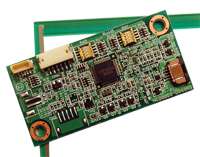
Fujitsu 4-wire USB dual-touch control board

Fujitsu will demonstrate its new, dual-touch (2 point), 4-wire analog resistive touch panel controller at Display Week 2011 in Los Angeles. The new technology promises to expand the capabilities of, and applications for, 4-wire resistive touch panels, which are most commonly used in industrial and other major market applications.

Fujitsu’s latest development consists of a dual-touch (2-point) IC that supports USB and I2C interfaces, and offers Windows7 and Android drivers. This new development makes it possible for 4-wire resistive touch panels to accurately detect two simultaneous touch points, enabling the pinch, expand, rotate, and swipe/flick gestures that have been popularized by more costly, projected capacitive touch panels.

Last year, released Windows 7-certified Multi-Input (10 point) touch panels and controller ICs as series FID1530.

Resistive touch panels are suitable for many different applications because they accept a wide variety of input sources, including a pen, finger, stylus, glove or credit card edge. Adding the 2-point gesturing capability will bring new functionality and flexibility to touch-based medical devices, industrial equipment and controls, and mobile consumer devices, such as eReaders.

Typically, resistive touch panels detect positioning by measuring the voltage on the resistive films where the panel surface is pressed. If two or more points are pressed simultaneously, the detection circuit registers the mean value between those points and identifies it as a single position, making it impossible to accurately detect two or more separate points. Fujitsu’s new, proprietary technology is a hardware and firmware-based method, centered on the dual-touch controller IC and includes supporting electronics that detects two simultaneous touches.

The dual-touch controllers are currently sampling now. Volume production of the controllers and controller boards will begin in summer 2011.

Explore further: PNNL-developed injection molding process recognized with emerging technologies award

Provided by Fujitsu Corporation

3 /5 (1 vote)
add to favorites email to friend print save as pdf

Related Stories

Dell Adds New Touch to Tablet PCs

Dec 11, 2007

Dell is setting new benchmarks for tablet PCs with the addition of the Latitude XT, the thinnest and one of the lightest 12.1-inch convertible tablets available. It is also the brightest in its category with ...

Sharp Releases Notebook PC with Optical Sensor LCD Pad

Apr 21, 2009

Sharp Corporation will release into the Japanese market a new notebook PC employing an optical sensor LCD for the touchpad. Its new touch-sensing recognition method allows handwritten input and intuitive direct-touch ...

Touch screen gamble: which technology to use

Oct 15, 2009

Prompted partly by the iPhone's phenomenal popularity, consumers are demanding and likely to get a wider range of touch screens on many more electronic devices.

Recommended for you

Sensitive bomb detector to rove in search of danger

14 hours ago

European researchers have developed and tested a light-weight device capable of detecting extremely minute quantities of explosives from up to 20 metres away, providing an invaluable law-enforcement tool ...

How soon could car seats enter the 3-D comfort zone?

May 23, 2013

New 3D textiles made of recyclable polyester fibres could contribute help cars be easier to recycle. But recycling technology has yet to progress in separating seat material from other car components.

NASA: Austin, calling Austin. 3-D pizzas to go

May 22, 2013

(Phys.org) —The idea of living with 3-D printed food is neither unthinkable nor new; designers and futurists have been looking to 3-D printing as food's next frontier. In 2012, there was news that the Thiel ...

User comments : 0

More news stories

Google eyes emerging markets networks

Google has become deeply involved in a series of projects to build and operate wireless networks in emerging markets including sub-Saharan Africa and Southeast Asia, a report said Friday.

Facial-recognition technology proves its mettle

(Phys.org) —In a study that evaluated some of the latest in automatic facial recognition technology, researchers at Michigan State University were able to quickly identify one of the Boston Marathon bombing ...

Drones may violate international law

(Phys.org) —As President Obama gives a speech on national security—including defending U.S. use of drones to combat terrorism—Leila Sadat, JD, international law expert and professor of law at Washington University in ...

Galaxies fed by funnels of fuel

(Phys.org) —Computer simulations of galaxies growing over billions of years have revealed a likely scenario for how they feed: a cosmic version of swirly straws.