Could exoplanet be a haven for life?
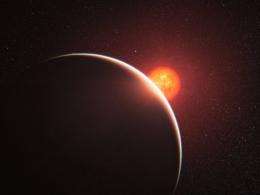
An image released by the European Southern Observatory (ESO) shows an artist's impression of the atmosphere around a super-Earth exoplanet, the name given to rocky exoplanets only a few times larger than our own. Gliese 581d, a rocky world orbiting a nearby star, has been confirmed as the first planet outside our solar system to meet key requirements for sustaining life, scientists say.
Scientists said on Monday a rocky world orbiting a nearby star was confirmed as the first planet outside our solar system to meet key requirements for sustaining life.
Modelling of planet Gliese 581d shows it has the potential to be warm and wet enough to nurture Earth-like life, they said.
It orbits a red dwarf star called Gliese 581, located around 20 light years from Earth, which makes it one of our closest neighbours.
Gliese 581d orbits on the outer fringes of the star's "Goldilocks zone," where it is not so hot that water boils away, nor so cold that water is perpetually frozen. Instead, the temperature is just right for water to exist in liquid form.
"With a dense carbon dioxide atmosphere -- a likely scenario on such a large planet -- the climate of Gliese 581d is not only stable against collapse but warm enough to have oceans, clouds and rainfall," France's National Centre for Scientific Research (CNRS) said in a press release.
More than 500 planets orbiting other stars have been recorded since 1995, detected mostly by a tiny wobble in stellar light.
Exoplanets are named after their star and listed alphabetically, in order of discovery.
Until now, the big interest in Gliese 581's roster of planets focussed on Gliese 581g.
It leapt into the headlines last year as "Zarmina's World," after its observers announced it had roughly the same mass as Earth's and was also close to the Goldilocks zone.
But that discovery has since been discounted by many. Indeed, some experts suspect that the Gliese 581g may not even exist but was simply a hiccup in starlight.
Its big brother, Gliese 581d, has a mass at least seven times that of Earth and is about twice our planet's size, according to the new study, which appears in a British publication, The Astrophysical Journal Letters.
The planet, spotted in 2007, had initially been dismissed as a candidate in the hunt for life.
It receives less than a third of the solar radiation Earth gets, and may be "tidally locked," meaning that one side of it always faces the sun, which would give it permanent dayside and nightside.
But the new model, devised by CNRS climate scientists Robin Wordsworth, Francois Forget and colleagues, showed surprising potential.
Its atmosphere would store heat well, thanks to its dense CO2, a greenhouse gas. And the red light from the star would also penetrate the atmosphere and warm the surface.
"In all cases, the temperatures allow for the presence of liquid water on the surface," say the researchers.
For budding travellers, though, Gliese 581d would "still be a pretty strange place to visit," the CNRS said.
"The denser air and thick clouds would keep the surface in a perpetual murky red twilight, and its large mass means that surface gravity would be around double that on Earth."
Getting to the planet would still require a sci-fi breakthrough in travel for earthlings.
A spaceship travelling close to light speed would take more than 20 years to get there, while our present rocket technology would take 300,000 years.
(c) 2011 AFP
-
From lemons to lemonade: Reaction uses carbon dioxide to make carbon-based semiconductor,
32 comments
-
Thioridazine kills cancer stem cells in human while avoiding toxic side-effects of conventional cancer treatments,
3 comments
-
SpaceX private rocket blasts off for space station (Update),
42 comments
-
Climate scientists say they have solved riddle of rising sea,
31 comments
-
Research team claims to have found evidence Lake Cheko is impact crater for Tunguska Event,
18 comments
-
revamping general concept and cosmological principle
May 25, 2012
-
Transiting Exoplanet Light Curve
May 25, 2012
-
Math behind Theoretical Physics
May 24, 2012
-
Do we know whats at the center of galaxies yet?
May 23, 2012
-
Structure of the Milky Way?
May 20, 2012
-
What would it take to terraform Pluto and Charon?
May 19, 2012
- More from Physics Forums - General Astronomy
More news stories
SpaceX capsule has 'new car' smell, astronauts say (Update)
SpaceX's Dragon cargo vessel smells like a new car, said astronauts at the International Space Station after opening the hatches Saturday following the spacecraft's landmark mission to the orbiting lab.
Space & Earth / Space Exploration
22 hours ago |
4.5 / 5 (20) |
2
Australia hails surprise super-telescope decision
Australia has hailed a surprise decision giving it a role in a radio telescope project aimed at revolutionising astronomy, vowing to draw on its decades of experience in space science.
22 hours ago |
5 / 5 (4) |
2
Astronomers seize last chance in lifetime for Venus Transit
Astronomers are gearing for one the rarest events in the Solar System: an alignment of Earth, Venus and the Sun that will not be seen for another 105 years.
22 hours ago |
5 / 5 (3) |
2
Astronauts enter world's 1st private supply ship
(AP) -- Space station astronauts floated into the Dragon on Saturday, a day after its heralded arrival as the world's first commercial supply ship.
Space & Earth / Space Exploration
22 hours ago |
5 / 5 (6) |
0
Sophisticated simulations predict future warming
The chances of our planet being hit by a global warming of 3 degrees Celsius by 2050 is as likely as it being hit by an increase of 1.4 degrees, new research shows. Presented in the journal Nature Geoscience, the British study ...
Space & Earth / Earth Sciences
May 22, 2012 |
4.4 / 5 (9) |
51
Nvidia trumpets Tegra 3 phone design wins for 2012
(Phys.org) -- Nvidias competitive war paint has a name, Tegra 3. On the heels of Nvidia announcements about lowering costs of its Tegra 3 processors and Nvidia-enabled tablets running Android Ice Cream ...
Browser wars flare in mobile space
The browser wars are heating up again, but this time the fight is for dominance of the mobile Internet.
Scientist: Evolution debate will soon be history
(AP) -- Richard Leakey predicts skepticism over evolution will soon be history. Not that the avowed atheist has any doubts himself.
Dell tablet leak: 10.1-inch display, two-battery choice
(Phys.org) -- Headline after headline talks about vendors tablets in the wings as likely number-one contenders for the iPad. Such claims have justifiably been taken with a grain of salt, considering ...
SpotterRF debuts Radar Backpack Kit (w/ Video)
(Phys.org) -- SpotterRF has announced a special radar backpack kit designed to enhance situational awareness for soldiers on the ground. The company says its special radar is designed for warfighters as part ...
Thousands of shellfish found dead in Peru
Thousands of crustaceans were found dead off the coast of Lima following the mystery mass death of dolphins and pelicans, the Peruvian Navy said Friday.
May 16, 2011
Rank: not rated yet
May 16, 2011
Rank: not rated yet
True if the acceleration was extremely fast, but even if the technology existed to do so, the g-forces would kill most life that was aboard. All that energy to get to speed would be immense as well as the energy required to stop.
May 17, 2011
Rank: 4 / 5 (1)
Can't get there in any case...not in one's own lifetime with current tech...
Interesting, nonetheless.
May 18, 2011
Rank: not rated yet
Run the numbers. An astronaut who accelerates for less than a year at one G in his frame of reference can get anywhere. Presumably, the astronaut will start to decelerate at the halfway point. But still--two years to anywhere if you have the fuel. Twenty years at one-tenth G, and so on.
May 18, 2011
Rank: not rated yet
That's a good point, I never ran any numbers and just instinctually assumed the energy would be immense and the time dialation would decrease too significantly to make a difference. Its quite a sharp curve regarding time dilation and speed. I only figured e=m^2 is it's stored energy since light speed is assumed.