Evolution in reverse: insects recover lost 'wings'
May 5, 2011 by Marlowe Hood
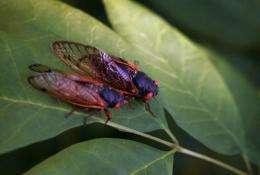
Two cicadas sit on a leaf at a forest preserve in Willow Springs, Illinois. The extravagant headgear of small cicada-like bugs called treehoppers are in fact wing-like appendages that grew back 200 million years after evolution had supposedly cast them aside, according to a study published Thursday in Nature.
The extravagant headgear of small bugs called treehoppers are in fact wing-like appendages that grew back 200 million years after evolution had supposedly cast them aside, according to a study published Thursday in Nature.
That's probably shocking news if you are an entomologist, and challenges some very basic ideas about what makes an insect an insect, the researchers said.
The thorax of all insects is by definition divided into three segments, each with a pair of legs.
In most orders, there are also two pairs of wings, one on the middle segment of the thorax and another at the rear.
Other orders such as flies and mosquitoes have only one set of wings, at the rear, and a few -- most ants, for example -- have no wings at all.
But no insects today have functional flappers in the first segment next to the head.
Their forebear, however, did.
"Primitive insects 350 million years ago had wings on all of their body segments," said Benjamin Prud'homme, a researcher at the Development Biology Institute of Marseille-Luminy in France and lead author of the study.
"We don't know if they were all for flight, but we do know -- from fossil records -- that these wing-like structures were present on each and every body segment."
Over the next 100 million years, he explained, wings on the first segment of the thorax and the abdomen dropped away entirely.
But then, some 50 million years ago, something strange happened to the cicada-like treehoppers: they once again sprouted wing-like structures from the top of the first segment of the thorax.
Some of these wildly divergent extrusions resemble thorns, others look like antlers, and still others like aggressive ants or animal droppings, creating one of Nature's most exotic menageries.
Experts had long assumed that these so-called "helmets" were armour-like expansions of the insects' exoskeletons.
But by carefully observing the treehopper's development into adulthood, Prud'homme and colleagues showed that this headgear began as a pair of buds -- attached at the sides, and articulated like wings -- that fused together as they grew.
Evolution is usually described as linear, but these modified wings suggested the process had come full circle.
"This is the only known example of a modern insect that has grown a third pair of wings," Prud'homme said by phone. "It is a modification of the basic body plan of insects."
Just how this happened remains a mystery. For 200 million years, certain genes prevented wing-like structures from emerging on this part of any insect's anatomy.
The researchers speculated that these genes had lost their inhibiting capacity, but experiments on other insect species demonstrated that their repressive powers remain intact.
However it happened, the evolutionary process found a way to put the renewed appendages to use, the researchers speculate.
"This extra pair of wings was not needed for flight, but nor did it prevent it," Prud'homme said. "So it became raw material for evolution to play with."
Many of the helmets appear to serve as camouflage, helping the insects to avoid predators.
The study shows "how development abilities can be lost or silenced over millions of years, only to be redeployed to contribute to the evolution of a complex and beautiful appendage," commented Armin Moczek, a professor at Indiana University, also writing in Nature.
More information: Body plan innovation in treehoppers through the evolution of an extra wing-like appendage, Nature 473, 8386 (05 May 2011) doi:10.1038/nature09977 http://www.nature. … re09977.html
Abstract
Body plans, which characterize the anatomical organization of animal groups of high taxonomic rank1, often evolve by the reduction or loss of appendages (limbs in vertebrates and legs and wings in insects, for example). In contrast, the addition of new features is extremely rare and is thought to be heavily constrained, although the nature of the constraints remains elusive2, 3, 4. Here we show that the treehopper (Membracidae) helmet is actually an appendage, a wing serial homologue on the first thoracic segment. This innovation in the insect body plan is an unprecedented situation in 250 Myr of insect evolution. We provide evidence suggesting that the helmet arose by escaping the ancestral repression of wing formation imparted by a member of the Hox gene family, which sculpts the number and pattern of appendages along the body axis5, 6, 7, 8. Moreover, we propose that the exceptional morphological diversification of the helmet was possible because, in contrast to the wings, it escaped the stringent functional requirements imposed by flight. This example illustrates how complex morphological structures can arise by the expression of ancestral developmental potentials and fuel the morphological diversification of an evolutionary lineage.
(c) 2011 AFP
-
From lemons to lemonade: Reaction uses carbon dioxide to make carbon-based semiconductor,
32 comments
-
Thioridazine kills cancer stem cells in human while avoiding toxic side-effects of conventional cancer treatments,
3 comments
-
SpaceX private rocket blasts off for space station (Update),
42 comments
-
Climate scientists say they have solved riddle of rising sea,
31 comments
-
Research team claims to have found evidence Lake Cheko is impact crater for Tunguska Event,
18 comments
-
What would stain as translucent on light-coloured fabric?
13 hours ago
-
How do I identify different bacteria on culture plates?
23 hours ago
-
Why Do Dogs do Strange things...
May 25, 2012
-
What does exophillic and endophillic mean in terms of mosquito and their control?
May 24, 2012
-
Semen stains glows under black lights (uv light)?
May 23, 2012
-
Question on Human Chromosome 2
May 23, 2012
- More from Physics Forums - Biology
More news stories
Scientist: Evolution debate will soon be history
(AP) -- Richard Leakey predicts skepticism over evolution will soon be history. Not that the avowed atheist has any doubts himself.
12 hours ago |
3.5 / 5 (11) |
30
Thousands of shellfish found dead in Peru
Thousands of crustaceans were found dead off the coast of Lima following the mystery mass death of dolphins and pelicans, the Peruvian Navy said Friday.
22 hours ago |
4.8 / 5 (4) |
7
More plant species responding to global warming than previously thought
(Phys.org) -- Far more wild plant species may be responding to global warming than previous large-scale estimates have suggested.
May 22, 2012 |
4.6 / 5 (14) |
18
|
For monogamous sparrows, it doesn't pay to stray (but they do it anyway)
It's quite common for a female song sparrow to stray from her breeding partner and mate with the male next door, but a new study shows that sleeping around can be costly.
May 22, 2012 |
5 / 5 (1) |
7
|
Study uncovers secret to speedy burrowing by razor clams
(Phys.org) -- If you look at a razor burrowing clam sitting in a bucket, youd never guess that it could burrow itself down into the soil, much less do it with any speed. Razor clams look like fat straws, ...
Nvidia trumpets Tegra 3 phone design wins for 2012
(Phys.org) -- Nvidias competitive war paint has a name, Tegra 3. On the heels of Nvidia announcements about lowering costs of its Tegra 3 processors and Nvidia-enabled tablets running Android Ice Cream ...
Browser wars flare in mobile space
The browser wars are heating up again, but this time the fight is for dominance of the mobile Internet.
Dell tablet leak: 10.1-inch display, two-battery choice
(Phys.org) -- Headline after headline talks about vendors tablets in the wings as likely number-one contenders for the iPad. Such claims have justifiably been taken with a grain of salt, considering ...
SpotterRF debuts Radar Backpack Kit (w/ Video)
(Phys.org) -- SpotterRF has announced a special radar backpack kit designed to enhance situational awareness for soldiers on the ground. The company says its special radar is designed for warfighters as part ...
SpaceX capsule has 'new car' smell, astronauts say (Update)
SpaceX's Dragon cargo vessel smells like a new car, said astronauts at the International Space Station after opening the hatches Saturday following the spacecraft's landmark mission to the orbiting lab.
Australia hails surprise super-telescope decision
Australia has hailed a surprise decision giving it a role in a radio telescope project aimed at revolutionising astronomy, vowing to draw on its decades of experience in space science.
May 05, 2011
Rank: 1 / 5 (4)
May 05, 2011
Rank: 4.7 / 5 (15)
Evolution doesn't go "backwards" or "forwards"; there's no end goal, no ultimate victory. Evolution just does whatever is best at the timethat's the whole point.
May 05, 2011
Rank: 4 / 5 (3)
Evolution is response to the changing demands of a living world...NOT the reason for existence or the cause of change - this little creature is demonstrating this fact with its own life and lineage.
Evolution is the living expression of change by living things subject to outside forces. We all ADAPT.
-word-to-ya-muthas-
May 06, 2011
Rank: 5 / 5 (3)
IMO, that simple phrase should be the criteria and definition for life, the ability to adapt; would make classifying and the giving of rights to AI a lot easier as well (whenever that happens).
May 06, 2011
Rank: 5 / 5 (5)
Evolution is a passive process in which the unfit have a better chance to die and those that just happen to be mutated in a way that is a better fit have a better chance to survive.
The best summation I've ever seen comes from someone on bash.org:
Some people...have the idea that evolution is a f*ing system of..."oh i need flippers, i'd better grow some" type bs
It's more like "Oh sh*t look at that freak over there with the flippers hahaha OH SH*T I AM DROWNING OH GOD SAVE ME FLIPPER BOY".
(cleaned up for language)
May 06, 2011
Rank: not rated yet
May 06, 2011
Rank: not rated yet
Here read this article: http://www.physor...tic.html
Under intense reproductive inbreeding, under the most controlled environment, lacking predation or rampant disease, living systems amend themselves to their closed environments; They Adapt. Evolution is our 'brother' not our 'parent'.
-word-to-ya-muthas-
May 06, 2011
Rank: 5 / 5 (3)
Except that flipper boy is generally more interested on taking your girl than on saving you :P
May 06, 2011
Rank: 5 / 5 (1)
the point I'm trying to make here is that evolution is the process by which the envoronment adapts us - not by which we adapt to the environment.
The distinction is small but crucial (especially inthe light of people who claim that evolution is guided or has an ultimate goal or even a definite direction): Adaptation by us would mean that we choose a path to go. Adaptation by the environment means that it weeds out the unfit and promotes the fit while we (or better: our offspring) just mutate around the mean.
May 06, 2011
Rank: 1 / 5 (1)
"the point I'm trying to make here is that evolution is the process by which the envoronment adapts us - not by which we adapt to the environment.
Adaptation by us would mean that we choose a path to go."
Your facts are misaligned: here read the article again:http://www.physor...tic.html
The mouse cannot control a thing! WE are in control. Our environment does not "ADAPT" US, WE ADAPT TO IT! Our environment AFFECTS us. U are driving a car, an icy rain starts. Your car starts 2 skid, conditions HAVE CHANGED, so you must adapt/change 2 meet changing conditions. YOU DID NOT CAUSE THE RAIN but it IS AFFECTING you. Overall, and obviously, over time, every gene in the biosphere must aid this adaptive process. So much of D human genome, came from other living systems - this enables/defines "fitness". D capacity 2 adapt is not only the ability of one 2 adapt but 4 the biosphere 2 support adaptation/evolution
-word-
May 06, 2011
Rank: 2 / 5 (1)
I 100% agree in what you said but our current definition of life is limited to organic species only which is why I think the ability to adapt is a better criteria for life. I have thought about it enough to talk to some of my professors with mixed results. But hey, it's a work in progress. With this definition, a virus, android and any organic species would be considered life.
By the ability to adapt I mean when presented with situation A we can change something about ourselves to survive within situation A, whether it is a massive flood or new virus it does not matter. Where as evolution is more like our O2 levels are decreasing which in turn some of us might evolve to better absorb O2 from the atmosphere. Both are a form of adaption that nothing not alive can do. A computer can't change itself if it is damaged or has to run on less power.
As a side note, some organic compounds could be argued to be alive by definition. That seems to be where people draw the line.
May 06, 2011
Rank: not rated yet
A virus by its own functionality, is a virus because IT CANNOT be alive outside a living cell. It will never be a virus and have an independent life.
What definition are you referring to?
Please enlighten, name, one organic compound, not a cell or virus, an organic compound that uses genes or DNA to make copies of its' self. Not fragments of its self broken off by an outside process, but, copies of itself from evident reproductive processes, please?
If one cannot adapt, one cannot evolve; If one can evolve, one had to adapt...to something, to become something else for no reason, WOULD imply conscious consent to genetic controls - something living creatures have not displayed so far -that is, I WANT to become something else, so I tell my genes to become it. That would imply a something or someone had a blueprint and the power to implement it...we humans certainly have no such power or we would charge for its use :-)
May 06, 2011
Rank: not rated yet
May 06, 2011
Rank: not rated yet
Everything I said was based on the premise of life is something that can adapt. Therefore under that definition a virus would be considered to be alive.
A virus cannot reproduce outside a living cell but they can survive outside a cell. Using the standard definition of a virus they are not alive, mainly that is because they need another organism or cell to reproduce.
Obviously there are no organic compounds that use DNA... But as you missed the point of that post I'll leave it at that.
Basically what I am saying is that our basic biochem has been able to develope in our current environment and that it can be argued it is alive on the premise of the ability to adapt. But it is more an interesting thought experiment with concern to how alive are organic compounds. My main focus was on the definition of life.
May 07, 2011
Rank: 1 / 5 (4)