New evidence for natural synthesis of silver nanoparticles
May 11, 2011 By Michael Baum
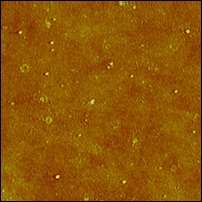
AFM (Atomic force microscopy) image of silver nanoparticles formed from silver ions in solution with humic acid. Color tone in this image indicates height (0 to 10 nanometers) above the base plane, so brighter spots are taller, larger nanoparticles. Image is roughly 1,700 nm on a side. Credit: MacCuspie, NIST
Nanoparticles of silver are being found increasingly in the environmentand in environmental science laboratories. Because they have a variety of useful properties, especially as antibacterial and antifungal agents, silver nanoparticles increasingly are being used in a wide variety of industrial and consumer products. This, in turn, has raised concerns about what happens to them once released into the environment. Now a new research paper adds an additional wrinkle: Nature may be making silver nanoparticles on its own.
A team of researchers from the Florida Institute of Technology (FIT), the State University of New York (SUNY), Buffalo, and the National Institute of Standards and Technology (NIST) reports that, given a source of silver ions, naturally occurring humic acid will synthesize stable silver nanoparticles.
Our colleague, Virender Sharma, had read an article in which they were using wine to form nanoparticles. He thought that, based on the similar chemistry, we should be able to produce silver nanoparticles with humic acids, explains FIT chemist Mary Sohn. First we formed them by traditional methods and then we tried one of our river sediment humic acids. We were really excited that we could see the characteristic yellow color of the nanoparticles. Samples were sent to Sarbajit Banerjee at SUNY Buffalo and Robert MacCuspie at NIST for detailed analyses to confirm the presence of silver nanoparticles.
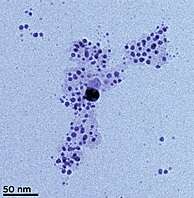
Transmission electron microscopy (TEM) image of silver nanoparticles formed from silver ions in solution with humic acid. The acid tends to coat the nano particles (visible here as a pale cloud), keeping them in a colloidal suspension instead of clumping together. (Color added for clarity.)Credit: SUNY, Buffalo
Humic acid is a complex mixture of many organic acids that are formed during the decay of dead organic matter. Although the exact composition varies from place to place and season to season, humic acid is ubiquitous in the environment. Metallic nanoparticles, MacCuspie explains, have characteristic colors that are a direct consequence of their size. Silver nanoparticles appear a yellowish brown.The team mixed silver ions with humic acid from a variety of sources at different temperatures and concentrations and found that acids from river water or sediments would form detectable silver nanoparticles at room temperature in as little as two to four days. Moreover, MacCuspie says, the humic acid appears to stabilize the nanoparticles by coating them and preventing the nanoparticles from clumping together into a larger mass of silver. We believe its actually a similar process to how nanoparticles are synthesized in the laboratory, he says, except that the lab process typically uses citric acid at elevated temperatures.
This caught us by surprise because a lot of our work is focused on how silver nanoparticles may dissolve when theyre released into the environment and release silver ions, MacCuspie says. Many biologists believe the toxicity of silver nanoparticles, the reason for their use as an antibacterial or antifungal agent, is due to their high surface area that makes them an efficient source of silver ions, he says, but this creates the idea that there may be some sort of natural cycle returning some of the ions to nanoparticles. It also helps explain the discovery, over the past few years, of silver nanoparticles in locations like old mining regions that are not likely to have been exposed to man-made nanoparticles, but would have significant concentrations of silver ions.
More information: N. Akaighe, et al. Humic acid-induced silver nanoparticle formation under environmentally relevant conditions. Environmental Science & Technology, Published online Apr. 1, 2011. doi:10.1021/es103946g
Provided by
National Institute of Standards and Technology
-
From lemons to lemonade: Reaction uses carbon dioxide to make carbon-based semiconductor,
32 comments
-
Thioridazine kills cancer stem cells in human while avoiding toxic side-effects of conventional cancer treatments,
3 comments
-
SpaceX private rocket blasts off for space station (Update),
42 comments
-
Climate scientists say they have solved riddle of rising sea,
31 comments
-
Research team claims to have found evidence Lake Cheko is impact crater for Tunguska Event,
18 comments
-
microstructure of titanium
15 hours ago
-
Steam in My Espresso Machine
20 hours ago
-
Density question
May 24, 2012
-
Mass transport originating from a point source at a solid gas interface
May 22, 2012
-
Ammonia dispersion in Air
May 22, 2012
-
Multi Choice Help
May 21, 2012
- More from Physics Forums - Materials & Chemical Engineering
More news stories
In nanorod crystal growth, nanoparticles seen as artificial atoms
In the growth of crystals, do nanoparticles act as "artificial atoms" forming molecular-type building blocks that can assemble into complex structures? This is the contention of a major but controversial theory ...
May 24, 2012 |
4.8 / 5 (6) |
0
|
First direct observation of oriented attachment in nanocrystal growth
Berkeley Lab researchers have reported the first direct observation of nanoparticles undergoing oriented attachment, the critical step in biomineralization and the growth of nanocrystals. A better understanding ...
May 24, 2012 |
4.7 / 5 (3) |
0
|
Dopant gives graphene solar cells highest efficiency yet
(Phys.org) -- By taking advantage of graphenes favorable electrical and optical properties, and then adding an organic dopant, researchers have achieved the highest power conversion efficiency yet for ...
Synthetic nano-waste does not disappear
(Phys.org) -- Tiny particles of cerium oxide do not burn or change in the heat of a waste incineration plant. They remain intact on combustion residues or in the incineration system, as a new study by Swiss ...
Nanotechnology / Bio & Medicine
May 25, 2012 |
5 / 5 (2) |
1
|
'Metamaterials,' quantum dots show promise for new technologies
(Phys.org) -- Researchers are edging toward the creation of new optical technologies using "nanostructured metamaterials" capable of ultra-efficient transmission of light, with potential applications including ...
May 24, 2012 |
5 / 5 (7) |
1
|
Browser wars flare in mobile space
The browser wars are heating up again, but this time the fight is for dominance of the mobile Internet.
Nvidia trumpets Tegra 3 phone design wins for 2012
(Phys.org) -- Nvidias competitive war paint has a name, Tegra 3. On the heels of Nvidia announcements about lowering costs of its Tegra 3 processors and Nvidia-enabled tablets running Android Ice Cream ...
Scientist: Evolution debate will soon be history
(AP) -- Richard Leakey predicts skepticism over evolution will soon be history. Not that the avowed atheist has any doubts himself.
Dell tablet leak: 10.1-inch display, two-battery choice
(Phys.org) -- Headline after headline talks about vendors tablets in the wings as likely number-one contenders for the iPad. Such claims have justifiably been taken with a grain of salt, considering ...
SpotterRF debuts Radar Backpack Kit (w/ Video)
(Phys.org) -- SpotterRF has announced a special radar backpack kit designed to enhance situational awareness for soldiers on the ground. The company says its special radar is designed for warfighters as part ...
SpaceX capsule has 'new car' smell, astronauts say (Update)
SpaceX's Dragon cargo vessel smells like a new car, said astronauts at the International Space Station after opening the hatches Saturday following the spacecraft's landmark mission to the orbiting lab.