Environmentally friendly rockets
May 27, 2011

Environmentally friendly rockets

Enlarge

(PhysOrg.com) -- Many rockets, satellites, and spacecraft are driven by hydrazine, sometimes with an oxidizing agent like nitric acid or dinitrogen tetroxide. When filling tanks with these highly toxic substances, technicians must wear full protective clothing—and a failed launch can lead to significant environmental damage. Researchers are thus looking for alternatives that are more environmentally friendly and less toxic, but just as powerful—requirements that are hard to meet in a single material.

Stefan Schneider and his co-workers at the Air Force Laboratory (Edwards Air Force Base, USA) have now introduced a new approach in the journal Angewandte Chemie: special hydrogen-rich ionic liquids that self-ignite in the presence of peroxide.

Despite the potential danger, hydrazine is used as a rocket fuel because it delivers high performance, can be stored for a relatively long time, and spontaneously ignites upon contact with an or a suitable catalyst. The oxidizing agents used as fuels are also dangerous. Dinitrogen tetroxide is less corrosive than nitric acid, but it is toxic and highly volatile. Hydrogen peroxide is a promising alternative because it is less corrosive and leads to much less toxic gas at room temperature. Its decomposition produces only water and oxygen.

As an alternative to hydrazine as a fuel component, Schneider and his co-workers propose an ionic liquid. Ionic liquids are compounds that consist of ions, namely positive and negatively charged particles, like a salt. However, they are not crystalline; they remain “molten” as a liquid at room temperature. Ionic liquids essentially do not vaporize, which prevents the formation of toxic vapors. It has previously not been possible to produce an ionic liquid that is flammable when partnered with hydrogen peroxide.

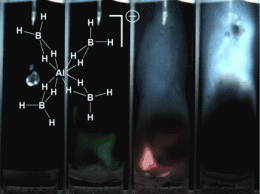
Schneider and his team have now overcome this barrier. The positively charged ion of their ionic liquid is a phosphorus atom bound to four hydrocarbon chains. At the core, however, lies the negatively charged ion made from one aluminum, four boron, and sixteen hydrogen atoms. The hydrogen-rich composition raises the power of the fuel component. “This aluminum borohydride ion can be viewed as a densified form of hydrogen stabilized by metal atoms. In fact, for a given tank size, liquids with this ion contain even more hydrogen than pure liquid hydrogen, without the difficult cooling requirements,” according to Schneider.

In order to test the ignitibility, the researchers applied drops of the novel ionic liquid onto various oxidizing agents. Upon contact with hydrogen peroxide, ignition was nearly instant; with fuming nitric acid it exploded. Says Schneider: “It is thus interesting as a potential component for greener high-performance fuels.”

More information: Stefan Schneider, Green Bipropellants: Hydrogen-Rich Ionic Liquids that Are Hypergolic with Hydrogen Peroxide, Angewandte Chemie International Edition, http://dx.doi.org/ … ie.201101752

Provided by Wiley search and more info website

Filter


Move the slider to adjust rank threshold, so that you can hide some of the comments.


Display comments: newest first

that_guy
May 27, 2011

Rank: 5 / 5 (1)
I want to know how this compares with standard rocket fuel. Is it more powerful, less powerful, or about the same?

With little or no vapor pressure, and liquid at room temperature, there's a lot of cooling equipment/insulation/venting equipment/etc that you won't need - essentially the difference between a $3000 hydrogen tank and a $100 gas tank.

The potential of this kind of rocket fuel goes far beyond environmental concerns.
Rank 5 /5 (3 votes)
Relevant PhysicsForums posts
  • What's the rule to covalent character
    created2 hours ago
  • Schwartz reagent-- NMR/MS/IR
    created20 hours ago
  • High school chemistry EEI
    createdMay 25, 2012
  • oxidation of I- by KMnO4
    createdMay 25, 2012
  • Inversion temp
    createdMay 25, 2012
  • Hybridization of SnCl3 -
    createdMay 25, 2012
  • More from Physics Forums - Chemistry

More news stories

New CO2-removing catalyst can take the heat

(Phys.org) -- The current method of removing the greenhouse gas carbon dioxide (CO2) from the flues of coal-fired power plants uses so much energy that no one bothers to use it. So says Roger Aines, principal ...

Chemistry / Materials Science

created May 24, 2012 | popularity 5 / 5 (7) | comments 7 | with audio podcast

High-speed method to aid search for solar energy storage catalysts

Eons ago, nature solved the problem of converting solar energy to fuels by inventing the process of photosynthesis.

Chemistry / Materials Science

created May 25, 2012 | popularity 5 / 5 (3) | comments 4 | with audio podcast

Researchers demonstrate possible primitive mechanism of chemical info self-replication

(Phys.org) -- When scientists think about the replication of information in chemistry, they usually have in mind something akin to what happens in living organisms when DNA gets copied: a double-stranded molecule ...

Chemistry / Materials Science

created May 25, 2012 | popularity 5 / 5 (4) | comments 2 | with audio podcast

Building a better solar panel -- one molecule at a time

(Phys.org) -- One of the fundamental building blocks in modern chemistry, an organometallic chemical compound called ferrocene, has never been structurally defined - until now.

Chemistry / Materials Science

created May 25, 2012 | popularity 5 / 5 (3) | comments 0 | with audio podcast

Discarded data may hold the key to a sharper view of molecules

(Phys.org) -- There's nothing like a new pair of eyeglasses to bring fine details into sharp relief. For scientists who study the large molecules of life from proteins to DNA, the equivalent of new lenses have come in the ...

Chemistry / Biochemistry

created May 24, 2012 | popularity 4.7 / 5 (3) | comments 0 | with audio podcast


Browser wars flare in mobile space

The browser wars are heating up again, but this time the fight is for dominance of the mobile Internet.

Nvidia trumpets Tegra 3 phone design wins for 2012

(Phys.org) -- Nvidia’s competitive war paint has a name, Tegra 3. On the heels of Nvidia announcements about lowering costs of its Tegra 3 processors and Nvidia-enabled tablets running Android Ice Cream ...

Scientist: Evolution debate will soon be history

(AP) -- Richard Leakey predicts skepticism over evolution will soon be history. Not that the avowed atheist has any doubts himself.

Dell tablet leak: 10.1-inch display, two-battery choice

(Phys.org) -- Headline after headline talks about vendors’ tablets in the wings as likely number-one contenders for the iPad. Such claims have justifiably been taken with a grain of salt, considering ...

SpotterRF debuts Radar Backpack Kit (w/ Video)

(Phys.org) -- SpotterRF has announced a special radar backpack kit designed to enhance situational awareness for soldiers on the ground. The company says its special radar is designed for warfighters as part ...

SpaceX capsule has 'new car' smell, astronauts say (Update)

SpaceX's Dragon cargo vessel smells like a new car, said astronauts at the International Space Station after opening the hatches Saturday following the spacecraft's landmark mission to the orbiting lab.