It's not easy being green: Scientists grow understanding of how photosynthesis is regulated
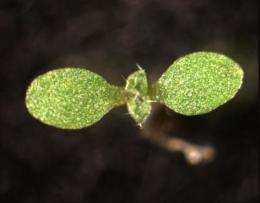
The seeds sprouting in your spring garden may still be struggling to reach the sun. If so, they are consuming a finite energy pack contained within each seed. Once those resources are depleted, the plant cell nucleus must be ready to switch on a "green" photosynthetic program. Researchers at the Salk Institute for Biological Studies recently showed a new way that those signals are relayed.
In a study published in the May 24, 2011, issue of the journal Current Biology, a team led by Joanne Chory, Ph.D., professor and director of the Plant Molecular and Cellular Biology Laboratory, and including postdoctoral fellows, Jesse Woodson, Ph.D., and Juan Perez-Ruiz, Ph.D., identify a signaling factor sent by plant chloroplasts to turn on photosynthesis-related genes. Their finding may help achieve greater crop yields and better plant health.
"When a seedling establishes a photosynthetic lifestyle, it needs to activate several thousand genes in the nucleus," says Chory, also a Howard Hughes Medical Institute investigator and holder of the Howard H. and Maryam R. Newman Chair in Plant Biology. "One of the signals to do this comes from the organelle in charge of photosynthesis, called the chloroplast. In this study we identified this signaling molecule as heme."
Although in plants and animals most genes reside in the nucleus, small DNA rings of genes are found in other cellular venues such as energy-producing mitochondria. Plant chloroplasts, whose primary function is to turn light and carbon dioxide into energy and carbohydrates required for growth, also contain genes that regulate photosynthesis-related factors encoded in the plant cell nucleus.
"The Chory lab previously identified mutations in five genes in Arabidopsis thaliana plants that were unable to synthesize molecules such as chlorophyll or respond to signals generated by intermediates of the chlorophyll biosynthetic pathway," explains Woodson, the study's first author. "Those studies suggested that when plants undergo stress, an intermediate accumulates that tells the nucleus to stop 'turning green.'"
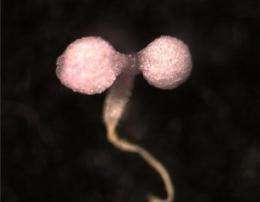
These mutants—called GUN (for genomes uncoupled) 1 to 5—lack proteins necessary to relay these signals to the nucleus. Chloroplasts in normal plants might deploy those signals when plants encounter stress, such as too much heat or too little water. Inhibitory signals could also be sent when germinating sprouts are not yet mature enough to make the leap from relying on the seed energy pack to generating their own energy using sunlight.
Suspecting that positive signals must also govern the process, the team screened Arabidopsis for factors that switched photosynthetic proteins on, rather than off. For that, they employed an experimental approach called activation tagging, in which gene-activating DNA sequences are inserted randomly into the Arabidopsis genome and plants are then subjected to a herbicide shower. The team then looked for any survivor that persisted in making photosynthetic proteins. By definition, in that mutant plant a gene required to sustain a photosynthetic growth response must have been experimentally switched on.
What they found was a gene designated gun 6, which encodes the enzyme ferrochelatase 1 (FC1), the first gun mutant indicating a positive rather than a negative signal. "Gun 6 mutants make too much FC1 protein, an enzyme required to make a signaling molecule called heme," explains Woodson. Although it is a cofactor in numerous plant and animal pathways, heme is most famous as the oxygen-carrying component of hemoglobin.
The study suggests that excess heme drives expression of photosynthesis-related genes. "If a plant makes abnormally high levels of heme, the nucleus could be unaware that the chloroplast is nonfunctional and may keep making growth-related proteins," says Woodson. "Heme is likely the signal sent from a healthy chloroplast to the nucleus saying it is time to make proteins required for photosynthesis."
The team also genetically engineered plants to make too much of an FC1 isoform, known as FC2, and found photosynthesis-related genes were not upregulated, suggesting that heme made from FC2 differs from that made by FC1, and that overall signals regulating plant growth are highly complex.
The mustard plant Arabidopsis is favored by plant biologists for the same reasons that animal biologists rely on mice and fruitflies—it's easy to grow, compact, reproduces rapidly (which for plant biologists means it makes tons of seeds—and fast), its genome is sequenced, and it can be manipulated genetically.
Plus, it is incredibly boring. "There is nothing unusual about Arabidopsis," notes Woodson. "Which is good, because anything we learn from it will be generally true for most plants."
Affirming that "every plant" quality, the team isolated the corn (Zea mays) equivalent of the FC1 gene and engineered Arabidopsis to make artificially high levels of the corn protein. Like gun 6 mutants, those plants continued to make photosynthesis-related genes when subjected to herbicide, demonstrating that FC1 likely does the same thing in a crop plant as it does in a weed. However, analysis of corn, rice or barley would be experimentally less practical, given their longer growth cycles and the space required to grow them.
"Overall, this work answers basic questions regarding how a plant grows, builds chloroplasts and harvests light energy in order to turn into a photosynthetic organism," says Chory. "Understanding how plants coordinate gene expression between the chloroplast and nucleus will ultimately increase crop yields in the field, where plants often encounter multiple stresses during the growing season."
Provided by Salk Institute


