Explained: Measuring earthquakes
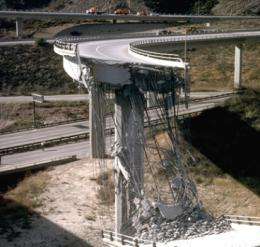
The powerful earthquake that struck Japan in March was a 9.0-magnitude event. But this was not, as some people may assume, as registered on the Richter scale, the famed measuring system dating to the 1930s. Seismologists today do not use the Richter scale as a universal tool for measuring earthquakes, because it does not accurately measure the energy emitted in jolts as big as the one that hit Japan.
Instead, scientists use the moment magnitude scale, developed in the 1970s. An earthquake produces many types of waves, which radiate from its epicenter and move with a wide variety of frequencies. Compared to the Richter scale, the moment magnitude scale can account for more types of these waves, and at more frequencies. It is thus better able to estimate the total energy of earthquakes, and can also relate these observations to the physical features of a fault.
“The moment magnitude is a measure that relates more to what is going on at the fault itself,” says Robert van der Hilst, the Cecil and Ida Green Professor of Geophysics at MIT. “It is a very good measure of the total energy that is being radiated.”
Richter logic
To be sure, the Richter scale, introduced by Charles Richter and Beno Gutenberg, employs a clear logic. Some types of seismic waves, called body waves, travel through the interior of the Earth with relatively high frequency but less force. By contrast, surface waves move across the surface of the Earth with lower frequency but more destructive force.
Richter and Gutenberg measured these waves by using seismographs, delicate instruments featuring a balance and a scroll of paper; when the Earth moves, a seismograph records the amplitude, or height, of a wave. The larger the recorded waves, the bigger the earthquake — a 7.0 earthquake is 10 times as large as a 6.0 — and the more energy it releases. “The fundamental thing is that you relate what you measure for a particular seismic arrival in the seismogram directly to the magnitude of the earthquake,” van der Hilst says.
The Richter scale has two shortcomings, however. Seismographs are set to measure seismic waves at specific frequencies — say, at a frequency of one hertz, or a period of one second, for a type of body wave called a P-wave; or 50 megahertz, a period of 20 seconds, for surface waves. But unusually massive earthquakes — those well beyond 7.0 — emit most of their energy at even lower frequencies and are more powerful than typical surface waves indicate, so the amplitudes of these waves do not represent the energy they release.
To measure all the energy produced by a colossal earthquake, seismologists sometimes have to wait days or weeks to analyze the vibrations of the entire Earth. “The Richter-scale magnitude breaks down because a single measurement of a particular seismic phase may not represent the total energy of the earthquake,” van der Hilst says. Seismologists call this problem “saturation.”
Measuring the fault’s slip
The second shortcoming of the Richter scale, van der Hilst says, is that “it doesn’t relate directly to the physical properties of the fault zone.” By contrast, the moment magnitude scale, developed by seismologists Thomas Hanks and Hiroo Kanamori, can be related to the distance a fault has slipped, the size of the area in which that slip has occurred, and the strength of the physical material, such as rock, in which the movement has occurred.
Using seismic data for an earthquake from a variety of sensors, researchers can infer what they call a “moment tensor,” a three-dimensional plot of both a fault’s orientation and the direction in which it slipped, as well as the distance the fault slipped. This is then used to calculate the total energy released by the earthquake, which the moment magnitude scale’s numbers represent. The moment magnitude scale is calibrated so that it roughly matches the Richter scale’s numbers up to 7.0 or so. But unlike the Richter scale, the moment magnitude scale does not suffer from the saturation problem, and can account for the energy released by unexpectedly large earthquakes.
These unexpectedly large earthquakes — like Japan’s — often involve faults that scientists did not previously know about. By linking measurements of earthquake size to the dynamics of fault movements, the moment magnitude scale helps seismologists better understand where and why really large earthquakes happen. “We are learning that the geometry of many of these faults is very complicated,” van der Hilst says, adding: “That changes our understanding of what a maximum earthquake could be in a certain area.” Which, for millions of people, could be very valuable knowledge.
This story is republished courtesy of MIT News (web.mit.edu/newsoffice/), a popular site that covers news about MIT research, innovation and teaching.
Provided by Massachusetts Institute of Technology


