Development of DNA trap paves way for personalized medicine
May 23, 2011

Particle trap paves way for personalized medicine

Enlarge

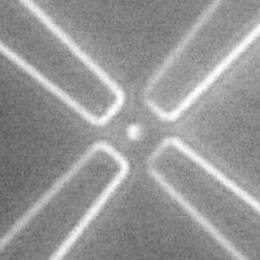
Scientists were able to trap a single particle between four microelectrodes, paving the way for a faster and cheaper way to sequence DNA. Credit: Weihua Guan and Mark Reed/Yale University

Sequencing DNA base pairs – the individual molecules that make up DNA – is key for medical researchers working toward personalized medicine. Being able to isolate, study and sequence these DNA molecules would allow scientists to tailor diagnostic testing, therapies and treatments based on each patient's individual genetic makeup.

But being able to isolate individual molecules like DNA base pairs, which are just two nanometers across – or about 1/50,000th the diameter of a human hair – is incredibly expensive and difficult to control. In addition, devising a way to trap DNA molecules in their natural aqueous environment further complicates things. Scientists have spent the past decade struggling to isolate and trap individual DNA molecules in an aqueous solution by trying to thread it through a tiny hole the size of DNA, called a "nanopore," which is exceedingly difficult to make and control.

Now a team led by Yale University researchers has proven that isolating individual charged particles, like DNA molecules, is indeed possible using a method called "Paul trapping," which uses oscillating electric fields to confine the particles to a space only nanometers in size. (The technique is named for Wolfgang Paul, who won the Nobel Prize for the discovery.) Until now, scientists have only been able to use Paul traps for particles in a vacuum, but the Yale team was able to confine a charged test particle – in this case, a polystyrene bead – to an accuracy of just 10 nanometers in aqueous solutions between quadruple microelectrodes that supplied the electric field.

This video is not supported by your browser at this time.

Weihua Guan and Mark Reed confine a single polystyrene bead to an accuracy of just 10 nanometers, or about 1/10,000th the width of a human hair. Credit: Weihua Guan and Mark Reed/Yale University

Their device can be contained on a single chip and is simple and inexpensive to manufacture. "The idea would be that doctors could take a tiny drop of blood from patients and be able to run diagnostic tests on it right there in their office, instead of sending it away to a lab where testing can take days and is expensive," said Weihua Guan, a Yale engineering graduate student who led the project.

In addition to diagnostics, this "lab-on-a-chip" would have a wide range of applications, Guan said, such as being able to analyze how individual cells respond to different stimulation. While there are several other techniques for cell-manipulation available now, such as optical tweezers, the Yale team's approach actually works better as the size of the targets gets smaller, contrary to other approaches.

The team, whose findings appear in the May 23 Early Edition of the , used charged polystyrene beads rather than actual DNA molecules, along with a two-dimensional trap to prove that the technique worked. Next, they will work toward creating a 3-D trap using DNA molecules, which, at two nanometers, are even smaller than the test beads. They hope to have a working, 3-D trap using molecules in the next year or two. The project is funded by a National Institutes of Health program that aims to sequence a patient's entire for less than $1,000.

"This is the future of personalized medicine," Guan said.

More information: PNAS, DOI: 10.1073/pnas.1100977108

Provided by Yale University search and more info website

3.6 /5 (8 votes)  

Filter


Move the slider to adjust rank threshold, so that you can hide some of the comments.


Display comments: newest first

pauljpease
May 23, 2011

Rank: 5 / 5 (1)
Sounds like an Anti-Brownian ELectrophoretic (ABEL) trap. See

http://www.stanfo...PIE3.pdf
Smellyhat
May 23, 2011

Rank: not rated yet
10 nm polystyrene beads in 2 dimensions is not equal to 2 nm DNA molecule in 3 dimensions. Not that the work isn't promising, but the title and suggestion of the article - "development of DNA trap" - is demonstrably *false* when one examines the actual findings and future plans. They have *not* developed a DNA trap. They are hopeful that they *may* develop a DNA trap.

BTW, it would be nice if this comment form interpreted UTF-8 correctly.
Rank 3.6 /5 (8 votes)
Relevant PhysicsForums posts

More news stories

In nanorod crystal growth, nanoparticles seen as artificial atoms

In the growth of crystals, do nanoparticles act as "artificial atoms" forming molecular-type building blocks that can assemble into complex structures? This is the contention of a major but controversial theory ...

Nanotechnology / Nanophysics

created May 24, 2012 | popularity 4.8 / 5 (6) | comments 0 | with audio podcast

First direct observation of oriented attachment in nanocrystal growth

Berkeley Lab researchers have reported the first direct observation of nanoparticles undergoing oriented attachment, the critical step in biomineralization and the growth of nanocrystals. A better understanding ...

Nanotechnology / Nanophysics

created May 24, 2012 | popularity 4.7 / 5 (3) | comments 0 | with audio podcast

Dopant gives graphene solar cells highest efficiency yet

(Phys.org) -- By taking advantage of graphene’s favorable electrical and optical properties, and then adding an organic dopant, researchers have achieved the highest power conversion efficiency yet for ...

Nanotechnology / Nanophysics

created May 21, 2012 | popularity 5 / 5 (10) | comments 14 | with audio podcast feature

Synthetic nano-waste does not disappear

(Phys.org) -- Tiny particles of cerium oxide do not burn or change in the heat of a waste incineration plant. They remain intact on combustion residues or in the incineration system, as a new study by Swiss ...

Nanotechnology / Bio & Medicine

created May 25, 2012 | popularity 5 / 5 (2) | comments 1 | with audio podcast

'Metamaterials,' quantum dots show promise for new technologies

(Phys.org) -- Researchers are edging toward the creation of new optical technologies using "nanostructured metamaterials" capable of ultra-efficient transmission of light, with potential applications including ...

Nanotechnology / Nanophysics

created May 24, 2012 | popularity 5 / 5 (7) | comments 1 | with audio podcast


Browser wars flare in mobile space

The browser wars are heating up again, but this time the fight is for dominance of the mobile Internet.

Nvidia trumpets Tegra 3 phone design wins for 2012

(Phys.org) -- Nvidia’s competitive war paint has a name, Tegra 3. On the heels of Nvidia announcements about lowering costs of its Tegra 3 processors and Nvidia-enabled tablets running Android Ice Cream ...

Scientist: Evolution debate will soon be history

(AP) -- Richard Leakey predicts skepticism over evolution will soon be history. Not that the avowed atheist has any doubts himself.

Dell tablet leak: 10.1-inch display, two-battery choice

(Phys.org) -- Headline after headline talks about vendors’ tablets in the wings as likely number-one contenders for the iPad. Such claims have justifiably been taken with a grain of salt, considering ...

SpotterRF debuts Radar Backpack Kit (w/ Video)

(Phys.org) -- SpotterRF has announced a special radar backpack kit designed to enhance situational awareness for soldiers on the ground. The company says its special radar is designed for warfighters as part ...

SpaceX capsule has 'new car' smell, astronauts say (Update)

SpaceX's Dragon cargo vessel smells like a new car, said astronauts at the International Space Station after opening the hatches Saturday following the spacecraft's landmark mission to the orbiting lab.