DNA falls apart when you pull it
May 20, 2011
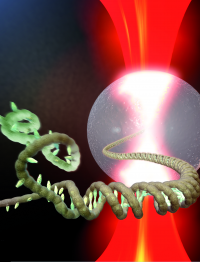
Artist's impression of optical tweezers used to pull DNA. On both ends of the DNA, beads are glued that are held by a laser beam. With the laser beam, the DNA can be pulled, by which, as can be seen on the left, it falls apart.

DNA falls apart when you pull it with a tiny force: the two strands that constitute a DNA molecule disconnect. Peter Gross of VU University Amsterdam has shown this in his PhD research project. With this research, researchers can now have a better understanding of how DNA in cells is locally opened so genes can be turned ‘on’ or ‘off’.

DNA is one of the most important molecules in cells because it contains the . A consists of two strands that are wound around each other and connected together like a spiral staircase: the double helix. Whether the genetic code in a piece of DNA is actually used, partially depends on the ease with which the two DNA strands separate from each other – like a zipper. Because that is required in order to read the genetic code. When you heat DNA in a test tube to about 80 degrees Celsius, the two strands fall apart, they ‘melt’. use a different way to melt DNA: proteins pull the DNA strands apart.

To investigate this process of pulling DNA, Peter Gross used so-called optical tweezers to pull the DNA with tiny forces. Simultaneously, he used fluorescence microscopy to see closely what happens to the DNA. What he saw can be described as a game of tug of war with a frayed rope: when you pull harder, the rope frays further and further apart. When Peter Gross increased the force on the DNA, he saw that the DNA strands fall apart with tiny shocks. He could accurately analyze these shocks and saw that the pattern of shocks is determined by the genetic code of the DNA: the pattern is like a fingerprint of the DNA. He also observed that the two DNA strands spontaneously join together and form a double helix again when he reduced the force on the DNA. This research has led to a better understanding of the complex properties of , in particular the stability of the .

Explore further: Study finds chemical behind cancer resistance in naked mole rats

Provided by University of Amsterdam

5 /5 (2 votes)
add to favorites email to friend print save as pdf

Related Stories

Stretching DNA to the Limit: DNA damage in a new light

Apr 20, 2007

It has long been known that UV light can damage DNA, reducing its ability to replicate and interact with proteins, and often resulting in the development of skin cancers. However, not much is known about how the elasticity ...

Unraveling the physics of DNA's double helix

Jul 12, 2007

Researchers at Duke University's Pratt School of Engineering have uncovered a missing link in scientists' understanding of the physical forces that give DNA its famous double helix shape.

DNA constraints control structure of attached macromolecules

Jun 28, 2005

A new method for manipulating macromolecules has been developed by researchers at the University of Illinois at Urbana-Champaign. The technique uses double-stranded DNA to direct the behavior of other molecules. In previous ...

Recommended for you

Long distance calls by sugar molecules

Jun 18, 2013

All our cells wear a coat of sugar molecules, so-called glycans. ETH Zurich and Empa researchers have now discovered that glycans rearrange water molecules over long distances. This may have an effect on ...

Researchers discover a way to detect new viruses

Jun 17, 2013

(Phys.org) —In research published in Biochemical and Biophysical Research Communications, Saint Louis University researchers describe a technology that can detect new, previously unknown viruses. The te ...

User comments : 0

More news stories

DNA constructs antenna for solar energy

Researchers at Chalmers University of Technology have found an effective solution for collecting sunlight for artificial photosynthesis. By combining self-assembling DNA molecules with simple dye molecules, ...

Unexpected behavior of well-known catalysts

Industrial palladium-copper catalysts change their structures before they get to work, already during the activation process. As a result, the reaction is catalysed by a catalyst that is different from the ...

Danish chemists in molecular chip breakthrough

Electronic components built from single molecules using chemical synthesis could pave the way for smaller, faster and more green and sustainable electronic devices. Now for the first time, a transistor made ...

Sony chief says time needed to study proposal

Sony Corp. needs more time to study a key proposal from a U.S. hedge fund to spin off a part of its entertainment unit as a way to propel its fledgling revival, the chief executive told shareholders Thursday.

China astronauts float water blob in kids' lecture

Astronauts struck floating martial arts poses, twirled gyroscopes and manipulated wobbling globes of water during a lecture Thursday from China's orbiting space station that's part of efforts to popularize ...