Discovery of cis-4-Hydroxy-L-proline, a material of pharmaceutical, cosmetic products
May 18, 2011
Discovery of cis-4-Hydroxy-L-proline, a material of pharmaceutical, cosmetic products

Discovery of the new enzyme, available for manufacturing of cis-4-Hydroxy-L-proline, a material of pharmaceutical and cosmetic products.

Prof. Kuniki Kino (Department of Applied Chemistry, Faculty of Science and Engineering) and Dr. Ryotaro Hara (Research Institute for Science and Engineering) have discovered New Enzyme, which contributes establish an innovative new industrial manufacturing method for cis-4-hydroxy-L-proline, an amino acid derivative.

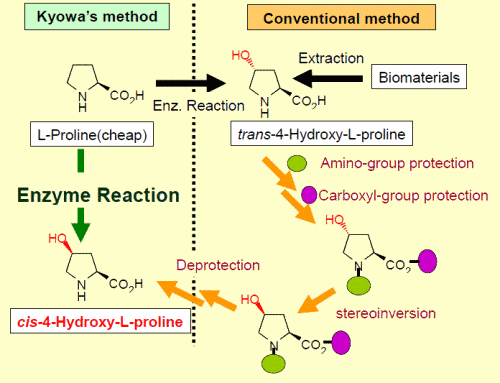
cis-4-Hydroxy-L-proline is a kind of amino acid which is hydroxylated in the 4-position of L-proline and it is believed to have potential as a raw material for pharmaceutical and . trans-4-Hydroxy-L-proline , a cis-4-hydroxy-L-proline stereoisomer , has been used for a broad range of applications since an efficient fermentation production method was established by KYOWA HAKKO BIO CO., LTD. in 1997. cis-4-Hydroxy-L-proline, however, could only be manufactured through a complex chemical synthetic procedure, and due to the high costs involved, usage has been limited.

Using a new that positionally and stereoscopically hydroxylates L-proline discovered by Prof. Kino and Dr. Hara, KYOWA HAKKO BIO has established an efficient industrial production method for cis-4-hydroxy-L-proline. As a result, they are now able to steadily supply highly pure cis-4-hydroxy-L-proline at a low cost. Further, they now have the technology to cheaply produce a variety of highly pure proline .

Waseda University, as a “Research University”, keeps contributing to the development of industry through promoting Research collaborations.

Explore further: Protein study suggests drug side effects are inevitable

add to favorites email to friend print save as pdf

Related Stories

Stretchy spider silks can be springs or rubber

May 31, 2008

It’s stronger than steel and nylon, and more extensible than Kevlar. So what is this super-tough material? Spider silk; and learning how to spin it is one of the materials industries’ Holy Grails. John Gosline has been ...

Researchers unveil a new class of fatty acids

Apr 28, 2008

CSIRO researchers have discovered a new class of fatty acids – alpha-hydroxy polyacetylenic fatty acids – that could be used as sensors for detecting changes in temperature and mechanical stress loads.

Recommended for you

Protein study suggests drug side effects are inevitable

18 hours ago

A new study of both computer-created and natural proteins suggests that the number of unique pockets – sites where small molecule pharmaceutical compounds can bind to proteins – is surprisingly small, meaning drug side ...

Attacking MRSA with metals from antibacterial clays

May 17, 2013

In the race to protect society from infectious microbes, the bugs are outrunning us. The need for new therapeutic agents is acute, given the emergence of novel pathogens as well as old foes bearing heightened antibiotic resistance.

Keeping fruit, vegetables and cut flowers fresh longer

May 15, 2013

New technology offers the promise of reducing billions of dollars of losses that occur each year from the silent, invisible killer of fruits, vegetables and cut flowers—a gas whose effects are familiar to everyone who has ...

Why don't beetles freeze in the winter?

May 14, 2013

For 37 years, Queen's University Biochemistry professor Peter Davies has been unraveling the mystery of why some organisms including insects and fish don't freeze in the winter. His research into insect antifreeze protein ...

User comments : 0

More news stories

Protein study suggests drug side effects are inevitable

A new study of both computer-created and natural proteins suggests that the number of unique pockets – sites where small molecule pharmaceutical compounds can bind to proteins – is surprisingly small, meaning drug side ...

Non-wetting fabric drains sweat

(Phys.org) —Waterproof fabrics that whisk away sweat could be the latest application of microfluidic technology developed by bioengineers at the University of California, Davis.

Beautiful 'flowers' self-assemble in a beaker

By simply manipulating chemical gradients in a beaker of fluid, materials scientists at Harvard have found that they can control the growth behavior of crystals to create precisely tailored structures—such ...

Attacking MRSA with metals from antibacterial clays

In the race to protect society from infectious microbes, the bugs are outrunning us. The need for new therapeutic agents is acute, given the emergence of novel pathogens as well as old foes bearing heightened antibiotic resistance.

Study shows where scene context happens in our brain

In a remote fishing community in Venezuela, a lone fisherman sits on a cliff overlooking the southern Caribbean Sea. This man –– the lookout –– is responsible for directing his comrades on the water, ...

Green conversion of heat to electricity

Soon, it will be possible to produce electricity from heat over 30 degrees emitted from a waste incinerator, refinery, or data processor. The start-up Osmoblue has just confirmed the feasibility of this new ...

New rice contamination reported in China

Authorities are investigating rice mills in southern China following tests that found almost half of the staple grain in one of the country's largest cities was contaminated with a toxic metal.