Mapping deformation in buried semiconductor structures using the hard X-Ray nanoprobe
May 13, 2011

Mapping deformation in buried semiconductor structures using the hard X-Ray nanoprobe

Enlarge

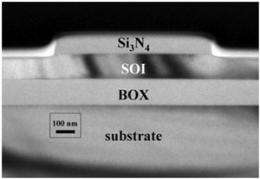
Cross-sectional TEM image of the edge of the SOI/Si3N4 stressor structure. The Si3N4 liner transfers stress into the SOI material. Strain is an important method for optimizing CMOS performance. Nano-XRD allows for the first time in situ nanoscale mapping of lattice strain and tilt within a buried semiconductor layer at high spatial resolution without sectioning the object.

(PhysOrg.com) -- Scientists from IBM's T. J. Watson Research Center and Columbia University, working with the X-Ray Microscopy Group, have mapped rotation and strain fields across a silicon-on-insulator (SOI) structure that included a liner of stressed Si3N4 using X-ray nanodiffraction (nano-XRD) at the CNM/APS Hard X-Ray Nanoprobe beamline.

Inducing strain in semiconductors is an important method to improve performance of (CMOS) devices. One strategy for inducing strain includes the deposition of liner materials that possess residual stress, ultimately producing strain within the CMOS device. However, this strain is heterogeneous at the nanoscale, leading to a wide distribution of environments along current-carrying paths of the structure. Improved understanding of the distribution of strain in CMOS devices is critical for continued improvement of their efficiency. Although a number of techniques have been applied to characterize strain at the nanoscale, none enable the mapping of subsurface regions or buried layers with the high spatial resolution offered by nano-XRD.
Mapping deformation in buried semiconductor structures using the hard X-Ray nanoprobe
Enlarge

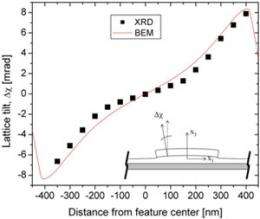
Comparison of the measured SOI lattice tilt (squares) to the boundary element (BEM) calculated, depth-averaged rotation distribution (line) of the SOI layer under the Si3N4 stressor. The inset shows the cross-sectional geometry showing the direction of rotation. Deviations from the model indicate nanoscale regions that are not well predicted by elastic, continuum mechanics – potentially offering unique opportunities for strain engineering at the nanoscale.

The new in situ studies reveal the distribution of lattice tilt as a function of position within the structure and also the maximum magnitude of the lattice tilt. The work is significant because it is one of the first nondestructive studies of subsurface strain with spatial resolution better than 100 nm done without sectioning or otherwise modifying the sample.

Modeling is also performed via a boundary element approach. The modeling and experimental results show that strain transfer into the underlying SOI from the liner primarily induces elastic deformation with secondary nanoscale regions exhibiting a unique noncontinuum, nonelastic response that is the subject of further study.

The Hard X-Ray Nanoprobe beamline is jointly managed by the CNM and the X-Ray Science Division of the at Argonne National Laboratory.

More information: C. E. Murray et al., “Nanoscale silicon-on-insulator deformation induced by stressed liner structures,” J. Appl. Phys. 109, 083543 (2011). DOI:10.1063/1.3579421

Provided by Argonne National Laboratory search and more info website


Rank not rated yet
Relevant PhysicsForums posts
  • distribution of molecules throughout the atmosphere
    created1 hour ago
  • The Global Positioning System !
    created2 hours ago
  • A Question relating Power
    created3 hours ago
  • Writing a book so im learning about things, i have some general questions please read
    created5 hours ago
  • Question about induced E field.
    created6 hours ago
  • Charging a capacitor in a tesla coil
    created6 hours ago
  • More from Physics Forums - General Physics

More news stories

Is a classical electrodynamics law incompatible with special relativity?

(Phys.org) -- The laws of classical electromagnetism that were developed in the 19th century are the same laws that scientists use today. They include Maxwell’s four equations along with the Lorentz la ...

Physics / General Physics

created May 24, 2012 | popularity 4.7 / 5 (15) | comments 42 | with audio podcast feature

Landmark calculation clears the way to answering how matter is formed

(Phys.org) -- An international collaboration of scientists, including Thomas Blum, associate professor of physics, is reporting in landmark detail the decay process of a subatomic particle called a kaon – ...

Physics / General Physics

created May 25, 2012 | popularity 4.2 / 5 (21) | comments 47 | with audio podcast

Lying in wait for WIMPs: Researchers seek to dramatically increase sensitivity of Large Underground Xenon detector

Although it's invisible, dark matter accounts for at least 80 percent of the matter in the universe. No one knows what it is, but most scientists would bet on weakly interacting massive particles, or WIMPs.

Physics / General Physics

created May 23, 2012 | popularity 4 / 5 (7) | comments 15 | with audio podcast

Hawaii lab turns laser-powered bubbles into microrobots

(Phys.org) -- A team of scientists from the University of Hawaii are working on microrobots created from bubbles of air in a saline solution. The bubbles take on their title of “robots” as a laser ...

Physics / General Physics

created May 23, 2012 | popularity 5 / 5 (4) | comments 2 | with audio podcast weblog

Sound increases the efficiency of boiling

Scientists at the Georgia Institute of Technology achieved a 17-percent increase in boiling efficiency by using an acoustic field to enhance heat transfer. The acoustic field does this by efficiently removing vapor bubbles ...

Physics / Soft Matter

created May 24, 2012 | popularity 5 / 5 (2) | comments 2


Browser wars flare in mobile space

The browser wars are heating up again, but this time the fight is for dominance of the mobile Internet.

Nvidia trumpets Tegra 3 phone design wins for 2012

(Phys.org) -- Nvidia’s competitive war paint has a name, Tegra 3. On the heels of Nvidia announcements about lowering costs of its Tegra 3 processors and Nvidia-enabled tablets running Android Ice Cream ...

Scientist: Evolution debate will soon be history

(AP) -- Richard Leakey predicts skepticism over evolution will soon be history. Not that the avowed atheist has any doubts himself.

Dell tablet leak: 10.1-inch display, two-battery choice

(Phys.org) -- Headline after headline talks about vendors’ tablets in the wings as likely number-one contenders for the iPad. Such claims have justifiably been taken with a grain of salt, considering ...

SpotterRF debuts Radar Backpack Kit (w/ Video)

(Phys.org) -- SpotterRF has announced a special radar backpack kit designed to enhance situational awareness for soldiers on the ground. The company says its special radar is designed for warfighters as part ...

SpaceX capsule has 'new car' smell, astronauts say (Update)

SpaceX's Dragon cargo vessel smells like a new car, said astronauts at the International Space Station after opening the hatches Saturday following the spacecraft's landmark mission to the orbiting lab.