Looking deep into a violent storm on Saturn
May 19, 2011

Looking deep into a huge storm on Saturn

Enlarge

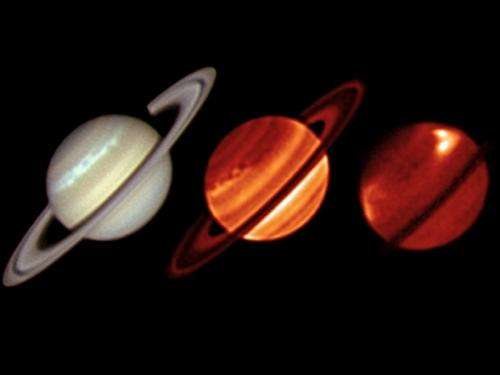
Thermal infrared images of Saturn from the Very Large Telescope Imager and Spectrometer for the mid-Infrared (VISIR) instrument on the European Southern Observatory's Very Large Telescope, on Cerro Paranal, Chile, appear at center and on the right. An amateur visible-light image from Trevor Barry, of Broken Hill, Australia, appears on the left. The images were obtained on Jan. 19, 2011, during the mature phase of the northern storm. The second image is taken at a wavelength that reveals the structures in Saturn's lower atmosphere, showing the churning storm clouds and the central cooler vortex. The third image is sensitive to much higher altitudes in Saturn's normally peaceful stratosphere, where we see the unexpected beacons of infrared emission flanking the central cool region over the storm. Credit: ESO/Univ. of Oxford/T. Barry

(PhysOrg.com) -- ESO’s Very Large Telescope (VLT) has teamed up with NASA’s Cassini spacecraft to study a rare storm in the atmosphere of the planet Saturn in more detail than has ever been possible before. The new study by an international team will appear this week in the journal Science.

The atmosphere of the planet Saturn normally appears placid and calm. But about once per Saturn year (about thirty Earth years), as spring comes to the northern hemisphere of the giant planet, something stirs deep below the clouds that leads to a dramatic planet-wide disturbance.

The latest such storm was first detected by the radio and science instrument on NASA's , in orbit around the planet, and also tracked by in December 2010. It has now been studied in detail using the VISIR on ESO's Very Large (VLT) in conjunction with observations from the CIRS instrument on Cassini.

This is only the sixth of these huge storms to be spotted since 1876. It is the first ever to be studied in the thermal infrared — to see the variations of temperature within a Saturnian storm — and the first ever to be observed by an orbiting spacecraft.
Looking deep into a huge storm on Saturn
Enlarge

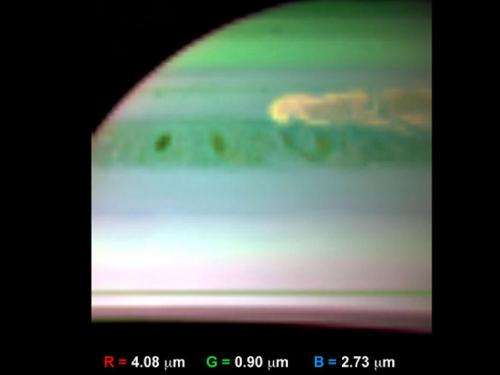
This false-color infrared image, obtained by NASA's Cassini spacecraft, shows clouds of large ammonia ice particles dredged up by a powerful storm in Saturn's northern hemisphere. Credit: NASA/JPL/Univ. of Arizona

"This disturbance in the northern hemisphere of has created a gigantic, violent and complex eruption of bright cloud material, which has spread to encircle the entire planet," explains Leigh Fletcher (University of Oxford, UK), lead author of the new study. "Having both the VLT and Cassini investigating this storm at the same time gives us a great chance to put the Cassini observations into context. Previous studies of these storms have only been able to use reflected sunlight, but now, by observing thermal infrared light for the first time, we can reveal hidden regions of the atmosphere and measure the really substantial changes in temperatures and winds associated with this event."

The storm may have originated deep down in the water clouds where a phenomenon similar to a thunderstorm drove the creation of a giant convective plume: just as hot air rises in a heated room, this mass of gas headed upwards and punched through Saturn's usually serene upper atmosphere. These huge disturbances interact with the circulating winds moving east and west and cause dramatic temperature changes high up in the atmosphere.

"Our new observations show that the storm had a major effect on the atmosphere, transporting energy and material over great distances, modifying the atmospheric winds — creating meandering jet streams and forming giant vortices -- and disrupting Saturn's slow seasonal evolution," adds Glenn Orton (Jet Propulsion Laboratory, Pasadena, USA), another member of the team.

Some of the unexpected features seen in the new imaging from VISIR have been named stratospheric beacons. These are very strong temperature changes high in the Saturnian stratosphere, 250-300 km above the cloud tops of the lower atmosphere, that show how far up into the the effects of the storm extend. The temperature in Saturn's stratosphere is normally around -130 degrees Celsius at this season but the beacons are measured to be 15-20 degrees Celsius warmer.

The beacons are completely invisible in reflected sunlight but can outshine the emission from the rest of the planet in the thermal infrared light detected by VISIR. They had never been detected before, so astronomers are not sure if they are common features in such storms.

"We were lucky to have an observing run scheduled for early in 2011, which ESO allowed us to bring forward so that we could observe the storm as soon as possible. It was another stroke of luck that Cassini's CIRS instrument could also observe the at the same time, so we had imaging from VLT and spectroscopy of Cassini to compare," concludes Leigh Fletcher. "We are continuing to observe this once-in-a-generation event."

Provided by ESO search and more info website

Filter


Move the slider to adjust rank threshold, so that you can hide some of the comments.


Display comments: newest first

yyz
May 20, 2011

Rank: not rated yet
"It was another stroke of luck that Cassini's CIRS instrument could also observe the storm at the same time, so we had imaging from VLT and spectroscopy of Cassini to compare," concludes Leigh Fletcher. "We are continuing to observe this once-in-a-generation event."

For comparison with the Earth-based imagery, here's a visible light view of this rare storm by Cassini taken back in February: http://www.flickr...4425093/
Rank 5 /5 (8 votes)
Relevant PhysicsForums posts
  • revamping general concept and cosmological principle
    createdMay 25, 2012
  • Transiting Exoplanet Light Curve
    createdMay 25, 2012
  • Math behind Theoretical Physics
    createdMay 24, 2012
  • Do we know whats at the center of galaxies yet?
    createdMay 23, 2012
  • Structure of the Milky Way?
    createdMay 20, 2012
  • What would it take to terraform Pluto and Charon?
    createdMay 19, 2012
  • More from Physics Forums - General Astronomy

More news stories

SpaceX capsule has 'new car' smell, astronauts say (Update)

SpaceX's Dragon cargo vessel smells like a new car, said astronauts at the International Space Station after opening the hatches Saturday following the spacecraft's landmark mission to the orbiting lab.

Space & Earth / Space Exploration

created 22 hours ago | popularity 4.5 / 5 (20) | comments 2

Australia hails surprise super-telescope decision

Australia has hailed a surprise decision giving it a role in a radio telescope project aimed at revolutionising astronomy, vowing to draw on its decades of experience in space science.

Space & Earth / Astronomy

created 22 hours ago | popularity 5 / 5 (4) | comments 2

Astronomers seize last chance in lifetime for Venus Transit

Astronomers are gearing for one the rarest events in the Solar System: an alignment of Earth, Venus and the Sun that will not be seen for another 105 years.

Space & Earth / Astronomy

created 22 hours ago | popularity 5 / 5 (3) | comments 2

Astronauts enter world's 1st private supply ship

(AP) -- Space station astronauts floated into the Dragon on Saturday, a day after its heralded arrival as the world's first commercial supply ship.

Space & Earth / Space Exploration

created 22 hours ago | popularity 5 / 5 (6) | comments 0

Sophisticated simulations predict future warming

The chances of our planet being hit by a global warming of 3 degrees Celsius by 2050 is as likely as it being hit by an increase of 1.4 degrees, new research shows. Presented in the journal Nature Geoscience, the British study ...

Space & Earth / Earth Sciences

created May 22, 2012 | popularity 4.4 / 5 (9) | comments 51


Browser wars flare in mobile space

The browser wars are heating up again, but this time the fight is for dominance of the mobile Internet.

Nvidia trumpets Tegra 3 phone design wins for 2012

(Phys.org) -- Nvidia’s competitive war paint has a name, Tegra 3. On the heels of Nvidia announcements about lowering costs of its Tegra 3 processors and Nvidia-enabled tablets running Android Ice Cream ...

Scientist: Evolution debate will soon be history

(AP) -- Richard Leakey predicts skepticism over evolution will soon be history. Not that the avowed atheist has any doubts himself.

Dell tablet leak: 10.1-inch display, two-battery choice

(Phys.org) -- Headline after headline talks about vendors’ tablets in the wings as likely number-one contenders for the iPad. Such claims have justifiably been taken with a grain of salt, considering ...

SpotterRF debuts Radar Backpack Kit (w/ Video)

(Phys.org) -- SpotterRF has announced a special radar backpack kit designed to enhance situational awareness for soldiers on the ground. The company says its special radar is designed for warfighters as part ...

Thousands of shellfish found dead in Peru

Thousands of crustaceans were found dead off the coast of Lima following the mystery mass death of dolphins and pelicans, the Peruvian Navy said Friday.