Crickets that live fast die young
May 26, 2011 by Sara Coelho, PlanetEarth Online

Crickets that live fast die young

Male crickets advertise their attractiveness with a loud and clear call to females. Calling effort has been linked to more mating success, but what are the hidden costs of showing off?

David Hosken, an based at the University of Exeter, and his team looked at crickets to understand how and are related to metabolic rate.

'Metabolism can be thought of as the burning of fuel that keeps us alive.' explains Hosken. 'Metabolic rate is the speed at which we burn the fuel. If we burn it faster we die younger.'

Translating the analogy to , the team reasoned that the resting metabolic rate – 'the body's idling speed' – may influence the amount of energy which is left to be used in other tasks.

Resting metabolic rate varies from individual to individual, even within the same species, and some crickets will have a smaller energy budget than others. This means the energy available for expensive advertising of sexual maturity will vary and some crickets will have less energy at the end of the day. 'This in turn could have an impact on lifespan,' says Hosken.

To test this prediction, the team followed the life of about 70 lab-raised crickets. They started by measuring the calling effort of the ten-day old males with a microphone fitted in a custom-build chamber. The device was on for about 15 hours and recorded how much time each cricket spent calling out for mates.

The next day, the crickets were weighed and moved to a different chamber, to assess their resting metabolic rate. This was done by measuring the amount of carbon dioxide produced by each individual. Crickets with a higher metabolic rate produced more carbon dioxide. Following these tests, the male crickets were housed in their own container and provided with food and water until the end of their natural lives.

The results, published in Behavioral Ecology and Sociobiology, show that with a higher resting metabolic rate have lower life expectancy: 'males that live fast die young,' says Hosken.

Surprisingly, the effort invested in sexual signals – the amount of time spent calling – was not part of the equation: 'In our study we found no evidence that calling effort influenced longevity,' he adds. This might be because 'our calling measure was not good enough or because good quality individuals can call more and have relatively low metabolic rate, just as some individuals can buy an expensive house and an expensive car' suggests Hosken.

The lack of a clear relationship between calling effort and longevity shows that the mechanisms behind the balance might be more complex than previously thought. Hosken points out that the links between physiological performance measures (such as ) and behaviour traits (sexual signals) are 'largely under-explored even though they are likely to be very important.'

More information: K Okada, WR Pitchers, MD Sharma, J Hunt and DJ Hosken. Longevity, calling effort, and metabolic rate in two populations of cricket. Behav. Ecol. Sociobiol., doi:10.1007/s00265-011-1185-3

Provided by PlanetEarth Online search and more info website

Filter


Move the slider to adjust rank threshold, so that you can hide some of the comments.


Display comments: newest first

Doug_Huffman
May 26, 2011

Rank: not rated yet
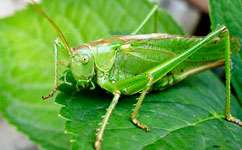
Sorry Physorg, that's Tettigoniidae illustrated, while Gryllidae is commonly known as 'cricket'.
Rank not rated yet
Relevant PhysicsForums posts

More news stories

Scientist: Evolution debate will soon be history

(AP) -- Richard Leakey predicts skepticism over evolution will soon be history. Not that the avowed atheist has any doubts himself.

Biology / Evolution

created 12 hours ago | popularity 3.5 / 5 (11) | comments 30

Thousands of shellfish found dead in Peru

Thousands of crustaceans were found dead off the coast of Lima following the mystery mass death of dolphins and pelicans, the Peruvian Navy said Friday.

Biology / Ecology

created 22 hours ago | popularity 4.8 / 5 (4) | comments 7

More plant species responding to global warming than previously thought

(Phys.org) -- Far more wild plant species may be responding to global warming than previous large-scale estimates have suggested.

Biology / Ecology

created May 22, 2012 | popularity 4.6 / 5 (14) | comments 18 | with audio podcast

For monogamous sparrows, it doesn't pay to stray (but they do it anyway)

It's quite common for a female song sparrow to stray from her breeding partner and mate with the male next door, but a new study shows that sleeping around can be costly.

Biology / Plants & Animals

created May 22, 2012 | popularity 5 / 5 (1) | comments 7 | with audio podcast

Study uncovers secret to speedy burrowing by razor clams

(Phys.org) -- If you look at a razor burrowing clam sitting in a bucket, you’d never guess that it could burrow itself down into the soil, much less do it with any speed. Razor clams look like fat straws, ...

Biology / Plants & Animals

created May 25, 2012 | popularity 1 / 5 (1) | comments 3 | with audio podcast report


Browser wars flare in mobile space

The browser wars are heating up again, but this time the fight is for dominance of the mobile Internet.

Nvidia trumpets Tegra 3 phone design wins for 2012

(Phys.org) -- Nvidia’s competitive war paint has a name, Tegra 3. On the heels of Nvidia announcements about lowering costs of its Tegra 3 processors and Nvidia-enabled tablets running Android Ice Cream ...

Dell tablet leak: 10.1-inch display, two-battery choice

(Phys.org) -- Headline after headline talks about vendors’ tablets in the wings as likely number-one contenders for the iPad. Such claims have justifiably been taken with a grain of salt, considering ...

SpotterRF debuts Radar Backpack Kit (w/ Video)

(Phys.org) -- SpotterRF has announced a special radar backpack kit designed to enhance situational awareness for soldiers on the ground. The company says its special radar is designed for warfighters as part ...

SpaceX capsule has 'new car' smell, astronauts say (Update)

SpaceX's Dragon cargo vessel smells like a new car, said astronauts at the International Space Station after opening the hatches Saturday following the spacecraft's landmark mission to the orbiting lab.

Australia hails surprise super-telescope decision

Australia has hailed a surprise decision giving it a role in a radio telescope project aimed at revolutionising astronomy, vowing to draw on its decades of experience in space science.