Striking the right balance: Researchers counteract biofuel toxicity in microbes
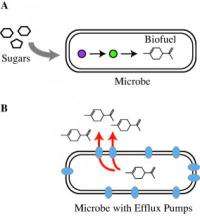
Advanced biofuels – liquid transportation fuels derived from the cellulosic biomass of perennial grasses and other non-food plants, as well as from agricultural waste – are highly touted as potential replacements for gasoline, diesel and jet fuels. Equally touted is the synthesis of these fuels through the use of microbes. However, many of the best candidate compounds for advanced biofuels are toxic to microbes, which presents a "production versus survival" conundrum. Researchers at the U.S. Department of Energy (DOE)'s Joint BioEnergy Institute (JBEI) have provided a solution to this problem by developing a library of microbial efflux pumps that were shown to significantly reduce the toxicity of seven representative biofuels in engineered strains of Escherichia coli.
"Working with all available microbial genome sequence data, we generated a library of largely uncharacterized genes and were able to devise a simple but highly effective strategy to identify efflux pumps that could alleviate biofuel toxicity in E. coli and, as a consequence, help improve biofuel production," says Aindrila Mukhopadhyay, a chemist with JBEI's Fuels Synthesis Division, who led this research.
Mukhopadhyay, who also holds an appointment with the Lawrence Berkeley National Laboratory (Berkeley Lab)'s Physical Biosciences Division, is the corresponding author on a paper published in the journal Molecular Systems Biology, titled "Engineering Microbial Biofuel Tolerance and Export Using Efflux Pumps." Co-authoring the paper with Mukhopadhyay were Mary Dunlop, Zain Dossani, Heather Szmidt, Hou-Cheng Chu, Taek Soon Lee, Jay Keasling and Masood Hadi.
Research efforts are underway at JBEI and elsewhere to engineer microorganisms, such as E. coli, to produce advanced biofuels in a cost effective manner. These fuels, which encompass short-to-medium carbon-chain alcohols, such as butanol, isopentanol and geraniol, can replace gasoline on a gallon-for-gallon basis and be used in today's infrastructures and engines, unlike ethanol. Biofuels made from branched carbon-chain compounds, such as geranyl acetate and farnesyl hexanoate, would also be superior to today's biodiesel, which is made from esters of linear fatty acids. Cyclic alkenes, such as limonene and pinene, could serve as precursors to jet fuel. Although biosynthetic pathways to the production of these carbon compounds in microbes have been identified, product toxicity to microbes is a common problem in strain engineering for biofuels and other biotechnology applications.
"In order for microbial biofuel production to be cost effective, yields must exceed native microbial tolerance levels, necessitating the development of stress-tolerant microbe strains," Mukhopadhyay says. "It is crucial that we improve tolerance in parallel with the development of metabolic pathways for the production of next-generation biofuels."
Microbes employ various strategies for addressing cell toxicity but perhaps the most effective are efflux pumps, proteins in the cytoplasmic membrane of cells whose function is to transport toxic substances out of the cell. This is done actively, using proton motive force. However, to date very few of these have been characterized for efficacy against biofuel like compounds.
"Sequenced bacterial genomes include many efflux pumps but remain a largely unexplored resource for use in engineering fuel tolerance," Mukhopadhyay says. "We took a systematic approach to screen a library of primarily uncharacterized heterologous pumps for engineering biofuel tolerant host strains. We were then able to demonstrate that expression of a heterologous pump can increase the yield of a biofuel in the production strain."
Since all known solvent-resistant efflux pumps in Gram-negative bacteria fall into the hydrophobe/amphiphile efflux (HAE1) family, Mukhopadhyay and her colleagues constructed a database of all HAE1 pumps from sequenced bacterial genomes. They then performed a bioinformatics screen to compare regions predicted to be responsible for substrate specificity to those of TtgB, a well-characterized solvent-resistant efflux pump.
"This metric allowed us to rank the complete set of pumps and select a subset that represented a uniform distribution of candidate genes," says Mukhopadhyay. "To construct the library, we amplified efflux pump operons from the genomic DNA of the selected bacteria, cloned them into a vector, and transformed the vector into an E. coli host strain."
In a series of survival competitions, the two microbial efflux pumps that performed best were the native E. coli pump AcrAB and a previously uncharacterized pump from a marine microbe Alcanivorax borkumensis.
"We focused on the A. borkumensis pump and tested it in a strain of host microbe engineered to produce the limonene jet fuel precursor," Mukhopadhyay says. "Microbes expressing the pump produced significantly more limonene than those with no pump, providing an important proof of principle demonstration that efflux pumps that increase tolerance to exogenous biofuel can also improve the yield of a production host."
Mukhopadhyay and her JBEI colleagues have begun evaluating microbial efflux pumps for other important compounds as well as inhibitors present in the carbon source from lignocellulose. They are also looking to improve the A. borkumensis pump and other high performers in their current library, and to optimize the systems by which pump genes are expressed in engineered biofuel-producing microbial strains.
"We believe our bioprospecting strategy for biofuel tolerance mechanisms is going to be a valuable and widely applicable tool in the biotechnology field for engineering new microbial production strains," Mukhopadhyay says.
Provided by Lawrence Berkeley National Laboratory


