How can a colorblind animal change its colors to blend into the background?
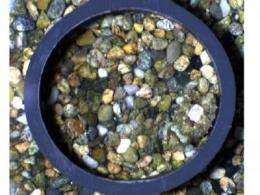
This image shows a calibrated well-camouflaged cuttlefish. Credit: Photo by JK Wickiser, West Point.
How could a colorblind animal know how to change its skin color to blend into its surroundings? And what will the animal's predator "see," looking at its prey before and after it hides?
These provocative questions are addressed in article published today by a collaborative team from the Marine Biological Laboratory (MBL) in Woods Hole, Mass., and the U.S. Military Academy in West Point, N.Y. The article, "Hyperspectral imaging of cuttlefish camouflage indicates good color match in the eyes of fish predators," appears in Proceedings of the National Academy of Sciences (PNAS).
"What makes camouflage effective? The answer is that it's an opinion, and that opinion completely depends on who is being asked. Our work presented in this paper takes the field a step closer to quantifying camouflage effectiveness," says J. Kenneth Wickiser, Asst. Prof. in the Department of Chemistry and Life Science at the U.S. Military Academy in West Point.
Understanding the principles of camouflage is not only important in biology, but also provides insights into architecture, advertisement, and defense applications.
For this study, the team studied camouflage in the marine animals known as coleoid cephalopods (octopus, squid, and cuttlefish). Camouflage is the primary defense in these animals and their rapidly adaptable body patterning system is among the most sophisticated in the animal kingdom. The expression of camouflage body patterns in cuttlefish is a visually driven behavior. Previous studies have shown that certain background variablessuch as brightness, contrast, edge and size of objects, etc.are essential for eliciting camouflaged body patterns. However, cephalopod eyes lack color perception, thus the vexing question of how they achieve effective camouflage while being colorblind still remains.
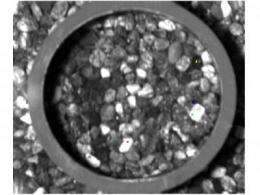
Camouflaged cuttlefish. ROI greyscale 2 white 2 black. Credit: J.K. Wickiser, West Point
Moreover, camouflage studies suffer from the inability to assess the effectiveness of camouflage in the visual space of predators; in short, it is difficult to determine whether a predator actually visually picks out the prey from the background environment. Knowledge of the visual capabilities of many predators is surprisingly lacking. Thus, the team asked, how does a colorblind animal change its color to blend into its surroundings, how do predators actually "see" their prey?
"To tackle this incredibly difficult problem, we put together a team with Chuan-Chin Chiao as a vision expert, Roger Hanlon and his scientists at the MBL as world leaders in cuttlefish and camouflage biology, and combined it with our expertise in hyperspectral imagery analysis at West Point," says Wickiser.
The team exploited a new imaging technology (HyperSpectral Imaging, HSI) to more accurately measure color match between animal and background, and to enable them to model camouflage in the eyes of predators. HSI employs a camera that captures not just 3 narrow windows (Red, Green, Blue RGB) like human eyes or typical digital cameras do rather it captures the entire spectrum using 540 windows. In essence, HSI offers the opportunity to "see" things that humans, and many predators, cannot because of the limitations on our eyes. Because of the wealth of information HSI images provide, the scientists could extract a small amount of that data and compile an image from the perspective of a predator.
Importantly, modeling color vision of potential di- and tri-chromatic (RG or RGB capable) fish predators of cuttlefish corroborated the spectral match analysis and revealed that much of the contrast information (which allows a predator to "pick out" a cuttlefish from the background environment) resides in the brightness (luminance) rather than in the color (chromatic) aspect of the reflected light. What this means is that cuttlefish camouflage strategies take away a tool from predators in their ability to pick out their prey from the background and instead leave them with only brightness as a method for prey identification.
These findings (i) indicate the strong potential of HSI technology to evaluate camouflage body patterns simultaneously in the spatial and spectral domains, (ii) provide supporting evidence that cuttlefish can produce color-coordinated camouflage on natural substrates despite lacking color vision, and that (iii) the color aspect of cuttlefish camouflage is highly effective against fish predators. This is the first time that color matching in camouflaged animals has been visualized more realistically through the eyes of their potential predators.
"So much is unknown about how predators actually see their prey. Using hyperspectral imagery tools is a huge advance in getting us the information we need to model predator vision," says Wickiser. "We hope our work takes us one step closer to understanding how a colorblind animal adopts near-perfect camouflage in a variety of backgrounds."
The color-changing abilities of cephalopods have been appreciated since Aristotle's time. Although this topic has received much attention in the past, no quantitative assessment has been made to examine the color match between animal and background. Applying hyperspectral imaging system and modeling the predator's visual system adds a new dimension to quantifying animal camouflage in the eyes of the beholders. The team's findings provide strong support that cuttlefish are capable of hiding in plain sight of their visual predators. Furthermore, this approach may prove to be tranformational in the way that color is quantified in sensory studies of camouflage and signaling in the natural world.
More information: Chiao, C-C, Wickiser, J.K., Allen, J.J., Genter, B., and Hanlon, R.T. Hyperspectral imaging of cuttlefish camouflage indicates good color match in the eyes of fish predators. PNAS Early Edition, week of May 16, 2011.
Provided by Marine Biological Laboratory
-
From lemons to lemonade: Reaction uses carbon dioxide to make carbon-based semiconductor,
32 comments
-
Thioridazine kills cancer stem cells in human while avoiding toxic side-effects of conventional cancer treatments,
3 comments
-
SpaceX private rocket blasts off for space station (Update),
42 comments
-
Climate scientists say they have solved riddle of rising sea,
31 comments
-
SpaceX capsule has 'new car' smell, astronauts say (Update),
2 comments
-
What would stain as translucent on light-coloured fabric?
14 hours ago
-
How do I identify different bacteria on culture plates?
May 26, 2012
-
Why Do Dogs do Strange things...
May 25, 2012
-
What does exophillic and endophillic mean in terms of mosquito and their control?
May 24, 2012
-
Semen stains glows under black lights (uv light)?
May 23, 2012
-
Question on Human Chromosome 2
May 23, 2012
- More from Physics Forums - Biology
More news stories
Scientist: Evolution debate will soon be history
(AP) -- Richard Leakey predicts skepticism over evolution will soon be history. Not that the avowed atheist has any doubts himself.
13 hours ago |
3.5 / 5 (11) |
30
Thousands of shellfish found dead in Peru
Thousands of crustaceans were found dead off the coast of Lima following the mystery mass death of dolphins and pelicans, the Peruvian Navy said Friday.
23 hours ago |
4.8 / 5 (4) |
7
More plant species responding to global warming than previously thought
(Phys.org) -- Far more wild plant species may be responding to global warming than previous large-scale estimates have suggested.
May 22, 2012 |
4.6 / 5 (14) |
18
|
For monogamous sparrows, it doesn't pay to stray (but they do it anyway)
It's quite common for a female song sparrow to stray from her breeding partner and mate with the male next door, but a new study shows that sleeping around can be costly.
May 22, 2012 |
5 / 5 (1) |
7
|
Study uncovers secret to speedy burrowing by razor clams
(Phys.org) -- If you look at a razor burrowing clam sitting in a bucket, youd never guess that it could burrow itself down into the soil, much less do it with any speed. Razor clams look like fat straws, ...
Nvidia trumpets Tegra 3 phone design wins for 2012
(Phys.org) -- Nvidias competitive war paint has a name, Tegra 3. On the heels of Nvidia announcements about lowering costs of its Tegra 3 processors and Nvidia-enabled tablets running Android Ice Cream ...
Browser wars flare in mobile space
The browser wars are heating up again, but this time the fight is for dominance of the mobile Internet.
Dell tablet leak: 10.1-inch display, two-battery choice
(Phys.org) -- Headline after headline talks about vendors tablets in the wings as likely number-one contenders for the iPad. Such claims have justifiably been taken with a grain of salt, considering ...
SpotterRF debuts Radar Backpack Kit (w/ Video)
(Phys.org) -- SpotterRF has announced a special radar backpack kit designed to enhance situational awareness for soldiers on the ground. The company says its special radar is designed for warfighters as part ...
SpaceX capsule has 'new car' smell, astronauts say (Update)
SpaceX's Dragon cargo vessel smells like a new car, said astronauts at the International Space Station after opening the hatches Saturday following the spacecraft's landmark mission to the orbiting lab.
Australia hails surprise super-telescope decision
Australia has hailed a surprise decision giving it a role in a radio telescope project aimed at revolutionising astronomy, vowing to draw on its decades of experience in space science.

May 16, 2011
Rank: 4 / 5 (3)
May 16, 2011
Rank: 5 / 5 (3)
May 16, 2011
Rank: 5 / 5 (2)
May 16, 2011
Rank: 4.3 / 5 (4)
Life quickly weeds out those who guess wrong.
May 16, 2011
Rank: 1 / 5 (1)
Close enough. Have fun rediscovering centuries-ago-answered questions. Just don't get caught rehashing the past as something new. You might lose cover.
May 17, 2011
Rank: not rated yet
PS, I thought it was in the bottom left, not the right. Could be wrong though. :)
May 17, 2011
Rank: not rated yet
May 17, 2011
Rank: not rated yet
May 17, 2011
Rank: not rated yet
It seems to me that this would force a convergent evolution of the eyes of predator and prey (at least of the color spectrum they are sensitive to). Any maladatptaion would lead to a wrong choice of camouflage and therefore to sudden death.
May 17, 2011
Rank: not rated yet
____
On the question of control of chromatophores, there are at least three modes that cuttlefish have: camourflage, courtship and other signalling. I suspect that this means that the only conscious control the animal has over the chromatophores is which mode to be in.
PS. I've just seen it in the picture! Right across the bottom.
May 17, 2011
Rank: not rated yet
May 17, 2011
Rank: not rated yet
http://rsbl.royal...223.full
"Evidence for distributed light sensing in the skin of cuttlefish, Sepia officinalis"
So, conundrum solved (albeit only last year)!
May 17, 2011
Rank: not rated yet
I have century-old references to signal representation in a colorless world. Do those signal representations (energy distributions) have a biological/chemical expression in cuttlefish? Assigning 'purpose' to expression can be done at anytime during research.
People born blind and color blind have representations in their mind of what color is. A different representation from ours. What is 'camouflage' to them?
May 18, 2011
Rank: not rated yet
I doubt that this had been fully understood a century ago.
May 18, 2011
Rank: not rated yet
May 18, 2011
Rank: not rated yet
May 18, 2011
Rank: not rated yet
I agree. I share your doubt.
Obviously, the signals have a "representation" and form that differs from the point of origin where the signal originates.
(Maybe the 'depot' for this signal/information is the brain).
Whatever that brain "representation" is, the "spectral" discrimination is not "spectral" for the cuttle fish.
To end speculation, simple put cuttle fish in an artificial "black and white" environment and watch what happens.
The smallest and cheapest test to big research.
May 19, 2011
Rank: not rated yet
May 19, 2011
Rank: not rated yet
(!) <--(eyebrows raise, eyes widen, jaw drops in dismay)
May 20, 2011
Rank: not rated yet
May 20, 2011
Rank: not rated yet
May 20, 2011
Rank: not rated yet
And this fast, cheap, simple, experiment can be just another feather in the cap/hat of additional data fortifying the researchers conclusions. 100% confidence researchers welcome anything strengthening an original hypothesis/theory - the more additional data confirms, the more merrier the researchers. Nothing can "threaten" a confidence level of 100 percent. So why even the need for additional experimentation to support a successful existing theory?
That was stated already. Nothing is absolute. There are as many rationalizations for not questioning the "end of all speculation" as there are the number of questions, questioning the exist of God.
When I last checked, that was a lot questioning.
And we all know God needs no data or support.
May 23, 2011
Rank: not rated yet
Basically, it's absurd to portray a scientific conclusion as being religion-based, as you are doing, on the basis of a phrase I used.
May 23, 2011
Rank: not rated yet
May 23, 2011
Rank: not rated yet
May 23, 2011
Rank: not rated yet
Here's one more:
"There is NO WAY ... in their skin."
You missed the point referencing God completely. The emphasis is on the RATIONALIZATIONS anyone uses to defend conclusions.
Whether those conclusions are reached through scientific method or religion is completely irrelevant to the point at hand - namely, your rationalizations.
"...NO WAY..." is a rationalization. A completely unscientific, unfounded, illogical expression to avoid scientific inquiry and legitimate question or doubt.
Alright. I'll state this differently:
Nothing is absolute. There are as many rationalizations for a scientist's 'fact' as there are falsehoods. Every one of those rationalizations make "sense" for a scientist as long as those rationalization support the scientist's fact and not the falsehood.
May 23, 2011
Rank: not rated yet
You, presumably, think that the late Paul the octopus actually had a supernatural ability to predict the result of football matches!
May 23, 2011
Rank: not rated yet
May 23, 2011
Rank: not rated yet
"There is, indeed, no way that any organism can respond reliably to its environment without information about that environment."
We, humans, respond reliably to death. There is no information we know of, about that state of the environment.
May 24, 2011
Rank: not rated yet
By "truth", I mean an observable fact.
May 24, 2011
Rank: not rated yet
May 24, 2011
Rank: not rated yet
Enlighten us with your death-defying semantics of what death is.
You have wasted everyone's time.
Anyone can see this "fact".
It is "observable" right here.
I see no point to further engage in your nonsense.
Feel free to "woo" others with your "logic". (Wave your wand)
Let us know if your work even does ever turn towards science.
May 25, 2011
Rank: not rated yet
Perhaps physorg staff should indicate a final score, by actually rating the posts?