Does the central Andean backarc have the potential for a great earthquake?
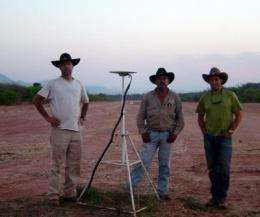
The region east of the central Andes Mountains has the potential for larger scale earthquakes than previously expected, according to a new study posted online in the May 8th edition of Nature Geoscience. Previous research had set the maximum expected earthquake size to be magnitude 7.5, based on the relatively quiet history of seismicity in that area. This new study by researchers from the University of Hawaii at Manoa (UHM) and colleagues contradicts that limit and instead suggests that the region could see quakes with magnitudes 8.7 to 8.9.
Benjamin Brooks, Associate Researcher in the Hawaii Institute of Geophysics and Planetology in the School of Ocean and Earth Science and Technology at UHM and colleagues used GPS data to map movement of the Earth's surface in the Subandean margin, along the eastern flank of the Andes Mountains. They report a sharp decrease in surface velocity from west to east. "We relate GPS surface movements to the subsurface via deformation models", says Brooks. "In this case, we use a simple elastic model of slip on a buried dislocation (fault) and do millions of Monte Carlo simulations to determine probability distributions for the model parameters (like slip, width, depth, dip, etc.)." From these data, the researchers conclude that the shallow section in the east of the region is currently locked in place over a length of about 100 km, allowing stress to build up as the tectonic plates in the region slowly move against each other. Rupture of the entire locked section by one earthquake could result in shaking of magnitudes up to 8.9, they estimate.
This project is a long-term collaborative effort between UHM, Ohio State University, Arizona State University, the Bolivian Instituto Geografico Militar (IGM), the Bolivian Seismological Observatory (Observatorio San Calixto), the Universidad Nacional de Cuyo (Argentina), and University of Memphis. The project's general name is the Central and Southern Andes Project (CAP).
These findings came as a surprise to Brooks. "No one suspected the previous estimates were too low, it was a discovery that came out of my broader interest which is studying the way in which mountains (in this case the Andes) actively grow and deform."
Major Arturo Echalar of the Bolivian IGM says "The findings here are critical in helping us to continue to provide the most up-to-date and accurate information regarding geological hazards in Bolivia."
The researchers are quick to report that the findings only demonstrate the potential for an earthquake of such a size. "It is not yet known if one of that size has ever happened in the Bolivian Subandes," adds Brooks. "Nonetheless we hope that this information will be widely disseminated and considered in Bolivia by the people ( including the general population, engineers, planners, emergency mitigators, policy makers, etc.) who may be most affected by a potential event here."
There are two important steps that the researchers are now undertaking simultaneously to confirm these findings. They are performing paleoseismolgic research to determine dates and sizes of past earthquakes, and they will continue to monitor the earthquake zone to see if some of the accumulated strain can be released aseismically, potentially slowing down the time until the next big event. "As we state in the paper, we believe that the Mandeyapecua thrust fault at the mountain front exhibits evidence for past earthquake ruptures", says Brooks. "So by applying techniques like digging trenches and identifying and dating offset layers we'll be able to quantify the seismic past of the region."
More information: Nature Geoscience, Orogenic-wedge deformation and potential for great earthquakes in the central Andean backarc, DOI: 10.1038/ngeo1143
Provided by University of Hawaii at Manoa


