Cambodian scientist discovers new species of blind and legless lizard
May 12, 2011 by Ally Catterick

Cambodian scientist discovers new species of blind and legless lizard

Enlarge

First on record in Cambodia and the first reptile to be both discovered and formally described in a scientific journal by a Cambodian national.

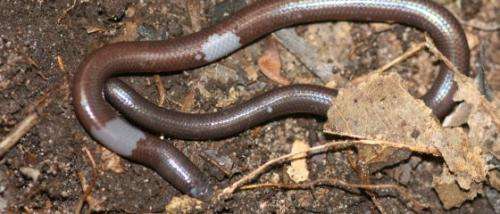
Cambodian national Neang Thy thought he had found a common flowerpot when he turned over a log in the Cardamom Mountains and noticed a small worm-like creature trying to flee from the sudden light. On closer inspection the diminutive reptile was revealed to be a peculiar type of lizard that is both blind and legless.

“At first I thought it was a common ”, said Thy, who works as a herpetologist with the Ministry of Environment and Fauna & Flora International (FFI), “but looking closer I realised it was something I didn’t recognise.”

These cryptic species of reptile are easily overlooked and previous to this discovery there are no records for blind occurring in . The species was finally named the Dalai Mountain blind lizard Dibamus dalaiensis, after the mountain on which it was found.

Recent biological surveys in Cambodia have resulted in a wealth of unusual new species, ranging from carnivorous plants to a green-bloodied frog. “This latest find is particularly remarkable,” said Dr Jenny Daltry, Senior Conservation Biologist with FFI, “because it is not only a new species, but also the first reptile to be both discovered and formally described in a scientific journal by a Cambodian national”.

The process of describing and naming a new species is a complex one, and Thy learned this discipline during a study period in La Sierra University in the United States.

“For one of our national colleagues to discover this unusual species and make the description is particularly satisfying,” said Berry Mulligan, FFI’s Cambodia operations manager. “It shows that the capacity of Cambodian scientists is now reaching an international standard.”

The species: Dibamus dalaiensis. The genus Dibamus composes 21 species found throughout Southeast Asia. Known from Thailand and Vietnam, the genus had not been seen in Cambodia before this discovery, but was expected to occur. These small lizards are blind and without limbs (small, flap-like hind limbs occur in the males) and spend most of their lives underground.

Provided by Fauna & Flora International

2.3 /5 (3 votes)  

Filter


Move the slider to adjust rank threshold, so that you can hide some of the comments.


Display comments: newest first

88HUX88
May 12, 2011

Rank: not rated yet
did it get spattered? or is it just green-blooded?
Bob_B
May 12, 2011

Rank: 5 / 5 (1)

a small worm-like creature trying to flee from the sudden light. On closer inspection the diminutive reptile was revealed to be a peculiar type of lizard that is both blind and legless.

A blind animal responding to light?
that_guy
May 12, 2011

Rank: not rated yet
So it's kind of a combination of a worm and a snake. Can we name this new animal a snork?
Rank 2.3 /5 (3 votes)
Relevant PhysicsForums posts

More news stories

Scientist: Evolution debate will soon be history

(AP) -- Richard Leakey predicts skepticism over evolution will soon be history. Not that the avowed atheist has any doubts himself.

Biology / Evolution

created 13 hours ago | popularity 3.5 / 5 (11) | comments 30

Thousands of shellfish found dead in Peru

Thousands of crustaceans were found dead off the coast of Lima following the mystery mass death of dolphins and pelicans, the Peruvian Navy said Friday.

Biology / Ecology

created 23 hours ago | popularity 4.8 / 5 (4) | comments 7

More plant species responding to global warming than previously thought

(Phys.org) -- Far more wild plant species may be responding to global warming than previous large-scale estimates have suggested.

Biology / Ecology

created May 22, 2012 | popularity 4.6 / 5 (14) | comments 18 | with audio podcast

For monogamous sparrows, it doesn't pay to stray (but they do it anyway)

It's quite common for a female song sparrow to stray from her breeding partner and mate with the male next door, but a new study shows that sleeping around can be costly.

Biology / Plants & Animals

created May 22, 2012 | popularity 5 / 5 (1) | comments 7 | with audio podcast

Study uncovers secret to speedy burrowing by razor clams

(Phys.org) -- If you look at a razor burrowing clam sitting in a bucket, you’d never guess that it could burrow itself down into the soil, much less do it with any speed. Razor clams look like fat straws, ...

Biology / Plants & Animals

created May 25, 2012 | popularity 1 / 5 (1) | comments 3 | with audio podcast report


Nvidia trumpets Tegra 3 phone design wins for 2012

(Phys.org) -- Nvidia’s competitive war paint has a name, Tegra 3. On the heels of Nvidia announcements about lowering costs of its Tegra 3 processors and Nvidia-enabled tablets running Android Ice Cream ...

Browser wars flare in mobile space

The browser wars are heating up again, but this time the fight is for dominance of the mobile Internet.

Dell tablet leak: 10.1-inch display, two-battery choice

(Phys.org) -- Headline after headline talks about vendors’ tablets in the wings as likely number-one contenders for the iPad. Such claims have justifiably been taken with a grain of salt, considering ...

SpotterRF debuts Radar Backpack Kit (w/ Video)

(Phys.org) -- SpotterRF has announced a special radar backpack kit designed to enhance situational awareness for soldiers on the ground. The company says its special radar is designed for warfighters as part ...

SpaceX capsule has 'new car' smell, astronauts say (Update)

SpaceX's Dragon cargo vessel smells like a new car, said astronauts at the International Space Station after opening the hatches Saturday following the spacecraft's landmark mission to the orbiting lab.

Australia hails surprise super-telescope decision

Australia has hailed a surprise decision giving it a role in a radio telescope project aimed at revolutionising astronomy, vowing to draw on its decades of experience in space science.