Engineers look to the birds for the future of UAVs (w/ video)
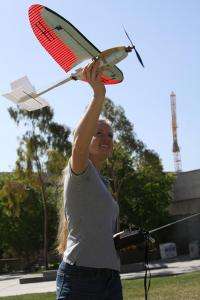
(PhysOrg.com) -- Engineers at UC San Diego are mimicking the movement of bird wings to help improve the maneuverability of unmanned aerial vehicles (UAVs).
UAVs are often used for surveillance of a fixed target in military and civilian applications. In order to observe a stationary target, a fixed wing UAV must remain airborne over the object, thus expending energy for propulsion and reducing operational time. In addition, the aircraft may need to loiter at significant altitudes to avoid detection, and thus require complex sensors to observe the target far below. Rotary wing aircraft may be able to land on a perch for surveillance, but are generally less efficient for cruising flight than a fixed wing solution. A fixed wing aircraft capable of spot landing on a perch (top of a pole, building, fence, etc.) would be an ideal solution capable of efficient cruising and versatile landing for longer surveillance missions. Because the target is nearby, simple sensors could be used onboard the perched aircraft.
The problem of perching has already been solved by nature. Birds routinely land on small surfaces, using wing morphing and flapping techniques. The UC San Diego engineers, led by mechanical and aerospace engineering professor Tom Bewley and graduate student Kim Wright, analyzed in slow motion several videos of birds landing to generate a working hypotheses for how wing morphing and flapping can be used for spot landing.
“One of the key behaviors observed in the birds was their use of wing sweep for pitch control in both forward flight and stalled landing approaches,” she said. “Birds can move their wings in a myriad of ways, providing a level of aerodynamic control that is unmatched by UAVs,” Wright said.
To verify their hypotheses, Wright and her team built a small remote controlled UAV with variable wing sweep and tested it using computer modeling, and an onboard microcontroller as a flight data recorder. Their initial testing validated the concept of using wing sweep for pitch control of the aircraft.
The biologically-inspired aircraft design is similar in scale to the birds the engineers observed (barn owl, hawks, large parrots, crows) and has similar wing loading and airfoil characteristics. The fuselage and tail surfaces of the prototype UAV were primarily constructed from balsa wood and foam using standard hobby aircraft construction techniques. The wings were formed using composite construction utilizing carbon fiber, fiberglass, high density foam, and rip stop nylon. Carbon fiber tubing was used for the shoulder joint structure, and fiberglass reinforcement was used in heavily stressed areas on the fuselage.
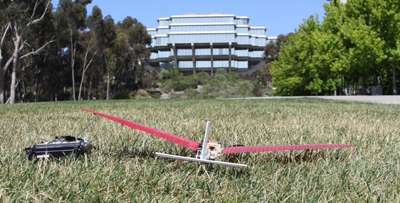
Future research could address combining wing twist, flapping, or other wing morphing aspects of the perching problem that UAVs currently have. Being able to perch UAVs autonomously on features in the environment (tree tops, buildings, telephone poles, etc...), and then to take off again as required, is an immensely valuable and significantly increases mission duration.
“Combining these aspects into a fully actuated, intelligent UAV would be the ultimate goal,’ said Wright, who nabbed first place for this research under a poster titled “Investigating the use of wing sweep for pitch control of a small unmanned air vehicle,” during the Jacobs School’s Research Expo 2011. “A small UAV that could maneuver and land like a bird would be a valuable tool for surveillance and search and rescue. This project has brought the aerospace community a small step closer to that goal.”
Wright said the future of UAVs is diverse. UAVs are quickly becoming popular tools for the armed forces, but there are also a myriad of civilian applications, which are rapidly developing, such as wildfire monitoring, search and rescue, and traffic observation.
“The technology is out there, and once federal aviation regulations are able to safely accommodate UAVs, I believe we will start seeing a lot more of them,” she said.
Bewley added that sensor-equipped UAVs play an important emerging role for the tracking and accurate forecasting of the movement of large environmental plumes, such as the ash plume from the volcano in iceland and the radioactive plume from the nuclear accident in Japan.
“There are several important scientific problems that need to be worked on to advance our capability to respond to such events,” Bewley said. “Two of the key underlying computational algorithms, state estimation (that is, synchronizing a large computer simulation of the environmental plume with the measurements taken in the recent past) and adaptive observation (that is, optimizing the trajectories of the sensor-equipped UAVs in the near future in order to minimize forecast uncertainty) are under intense scrutiny by our lab. Initial experimental testing of these algorithms were performed by our lab in a parking lot at UC San Diego last summer, initially using small surface vehicles probing a heavy plume that hugged the ground. Doing analogous tests in airborne plumes that do not hug the ground requires UAVs that can loiter for long periods of time.”
Provided by UC Davis


