Big leap in understanding frog threat
May 25, 2011

Big leap in understanding frog threat

Enlarge

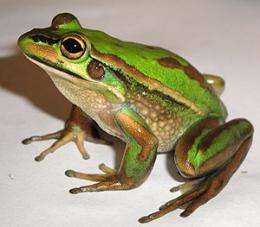
A Green and Golden Bell Frog, one of the species affected by this parasite.

(PhysOrg.com) -- University of Sydney researchers have identified two new parasite species causing disease among endangered Australian frogs. They say they are most likely native, overturning a commonly held view they were introduced with cane toads in 1935.

The parasites have so far been found in 10 , including the iconic Green and Golden Bell Frog, the Southern Bell Frog and even the Yellow Spotted Bell Frog - a species presumed extinct for 30 years until recently.

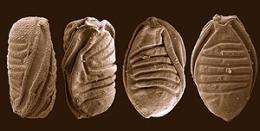
These singled-celled myxosporean parasites have been identified in bell since 1997, says Ashlie Hartigan, a PhD student leading the research with Dr. Jan Šlapeta from the Faculty of Veterinary Science, David Phalen, Director of the University of Sydney's Wildlife Health and Conservation Center, and Karrie Rose from the Australian Registry of Wildlife Health.

"Infected lose weight, are lethargic, and some can't move their back legs, making them more vulnerable to predators," Hartigan says. "Infection could also be reducing the number of tadpoles that become adults, with affected tadpoles more likely to delay metamorphosis and die from liver disease."
Big leap in understanding frog threat
Enlarge

The singled-celled myxosporean parasites under an electron microscope.

When Hartigan and colleagues genotyped parasites from frogs and collected in New South Wales and Queensland and compared them to myxosporea from South American cane toads, they found that the Australian parasites were distinct from the South American species. This debunks the theory the parasites came to Australia with cane .

"We are 99 percent sure the cane toad did not bring it in," says Hartigan, whose research was recently published in a leading science journal PLoS ONE.

But the cane toad is not completely off the hook. "Our data suggests these parasites recently spread across eastern Australia from their original source," Hartigan said. "While the spread may have occurred by a number of means, it is possible that by infecting the invasive Cane Toad the parasite has spread faster and further as a result."

Hartigan says frogs are under increasing threat of disease, and global losses can be attributed to different pathogens. Frogs are bio-indicator species, she says: "The presence of frogs in a habitat indicates good environmental health."

"If we can learn more about the life cycle of these , how they are spread, and identify other potential hosts, we will be able to screen frogs for infection and control the spread to captive breeding populations and threatened populations in the wild."

More information: http://www.plosone … pone.0018871

Provided by University of Sydney


Rank not rated yet
Relevant PhysicsForums posts

More news stories

Scientist: Evolution debate will soon be history

(AP) -- Richard Leakey predicts skepticism over evolution will soon be history. Not that the avowed atheist has any doubts himself.

Biology / Evolution

created 13 hours ago | popularity 3.5 / 5 (11) | comments 30

Thousands of shellfish found dead in Peru

Thousands of crustaceans were found dead off the coast of Lima following the mystery mass death of dolphins and pelicans, the Peruvian Navy said Friday.

Biology / Ecology

created 23 hours ago | popularity 4.8 / 5 (4) | comments 7

More plant species responding to global warming than previously thought

(Phys.org) -- Far more wild plant species may be responding to global warming than previous large-scale estimates have suggested.

Biology / Ecology

created May 22, 2012 | popularity 4.6 / 5 (14) | comments 18 | with audio podcast

For monogamous sparrows, it doesn't pay to stray (but they do it anyway)

It's quite common for a female song sparrow to stray from her breeding partner and mate with the male next door, but a new study shows that sleeping around can be costly.

Biology / Plants & Animals

created May 22, 2012 | popularity 5 / 5 (1) | comments 7 | with audio podcast

Study uncovers secret to speedy burrowing by razor clams

(Phys.org) -- If you look at a razor burrowing clam sitting in a bucket, you’d never guess that it could burrow itself down into the soil, much less do it with any speed. Razor clams look like fat straws, ...

Biology / Plants & Animals

created May 25, 2012 | popularity 1 / 5 (1) | comments 3 | with audio podcast report


Nvidia trumpets Tegra 3 phone design wins for 2012

(Phys.org) -- Nvidia’s competitive war paint has a name, Tegra 3. On the heels of Nvidia announcements about lowering costs of its Tegra 3 processors and Nvidia-enabled tablets running Android Ice Cream ...

Browser wars flare in mobile space

The browser wars are heating up again, but this time the fight is for dominance of the mobile Internet.

Dell tablet leak: 10.1-inch display, two-battery choice

(Phys.org) -- Headline after headline talks about vendors’ tablets in the wings as likely number-one contenders for the iPad. Such claims have justifiably been taken with a grain of salt, considering ...

SpotterRF debuts Radar Backpack Kit (w/ Video)

(Phys.org) -- SpotterRF has announced a special radar backpack kit designed to enhance situational awareness for soldiers on the ground. The company says its special radar is designed for warfighters as part ...

SpaceX capsule has 'new car' smell, astronauts say (Update)

SpaceX's Dragon cargo vessel smells like a new car, said astronauts at the International Space Station after opening the hatches Saturday following the spacecraft's landmark mission to the orbiting lab.

Australia hails surprise super-telescope decision

Australia has hailed a surprise decision giving it a role in a radio telescope project aimed at revolutionising astronomy, vowing to draw on its decades of experience in space science.