'Barcoding blitz' on Australian moths and butterflies
May 05, 2011
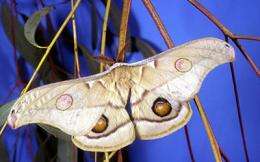
An Emperor Gum Moth, Opodiphthera eucalypti, well camouflaged amongst Eucalyptus foliage on which they feed Image: CSIRO

In just 10 weeks a team of Canadian researchers has succeeded in 'barcoding' 28,000 moth and butterfly specimens – or about 65 per cent of Australia’s 10,000 known species – held at CSIRO's Australian National Insect Collection (ANIC) in Canberra.

Conducted in collaboration with the Atlas of Living Australia (ALA) as part of the International Barcode of Life (IBoL), the project involved extracting DNA from each specimen to record its unique genetic code and entering the results, together with an image and other details, to the ALA and ANIC databases.

ANIC is the first national collection to integrate the new barcoding approach for a major group of insects.

The Collection's Director, Dr John La Salle, said DNA barcoding is a kind of ‘genetic fingerprinting’ which has proven useful in identifying different forms of life.

"Barcoding will be critically important to our goal of being able to rapidly identify most organisms on the planet within the next decade or so," Dr La Salle said.

"This will produce strong benefits for entomology, life sciences and biosecurity."

He said barcoding has already achieved some interesting successes in, for example, Europe and the US where it is being used to investigate food fraud, such as selling one type of fish as another type of fish.

According to Atlas of Living Australia Director, Donald Hobern, many moths and are of economic and/or environmental importance to Australia.

"Using barcoding for rapid identification will transform how we handle monitoring of biodiversity across Australia and how we respond to potential pest arrivals at Australian borders," Mr Hobern said.

"Barcoding for rapid species identification is a powerful new tool which will also assist taxonomists in recognising and describing new species."

Explore further: The pirate ant: A new species from the Philippines with a bizarre pigmentation pattern

add to favorites email to friend print save as pdf

Related Stories

Building a digital library for life on Earth

Sep 24, 2010

The largest biodiversity genomics initiative ever undertaken - an international effort to build a digital identification system for all life on Earth - will be officially activated this week.

Global barcode project to scan plants in the wild

Dec 16, 2009

(PhysOrg.com) -- A cheap and fast method of identifying the world's most important plants in the wild could soon be possible, thanks to a global project involving the University of Adelaide.

Barcoding endangered sea turtles

Sep 14, 2009

Conservation geneticists who study sea turtles have a new tool to help track this highly migratory and endangered group of marine animals: DNA barcodes. DNA barcodes are short genetic sequences that efficiently ...

DNA 'barcode' for tropical trees

Nov 04, 2009

In foods, soil samples or customs checks, plant fragments sometimes need to be quickly identified. The use of DNA “barcodes” to itemize plant biodiversity was proposed during the 1992 Rio de Janeiro Summit. ...

Recommended for you

User comments : 0

More news stories

Encouraging signs for bee biodiversity

Declines in the biodiversity of pollinating insects and wild plants have slowed in recent years, according to a new study. Researchers led by the University of Leeds and the Naturalis Biodiversity Centre in the Netherlands ...

If you can remember it, you can remember it wrong

(Medical Xpress)—Native peoples in regions where cameras are uncommon sometimes react with caution when their picture is taken. The fear that something must have been stolen from them to create the photo ...

B vitamins could delay dementia

(Medical Xpress)—Despite spending billions of dollars on research and development, drug companies have been unable to come up with effective treatments for dementia and Alzheimer's Disease (AD). Now, A. ...

New method for producing clean hydrogen

Duke University engineers have developed a novel method for producing clean hydrogen, which could prove essential to weaning society off of fossil fuels and their environmental implications.